
LED illuminated mirrors – how to choose a bathroom mirror with lighting
An LED illuminated mirror may light the face evenly, provide a soft night light or merely draw a decorative halo on the wall. These effects are not interchangeable. Diode position, colour rendering, brightness, moisture protection and the power connection all matter. This guide explains how to choose a bathroom mirror with lights, when a demister is useful and which features genuinely help with shaving and make-up.

Contents
- Front-lit or backlit?
- Choosing the mirror size
- Brightness and facial uniformity
- Colour temperature and CRI
- What does a demister do?
- IP rating and bathroom installation
- Touch control, dimming and memory
- Power supply, cable and service
- Shape and style
- Installation checklist
- Common mistakes
- Summary
Front-lit or backlit?
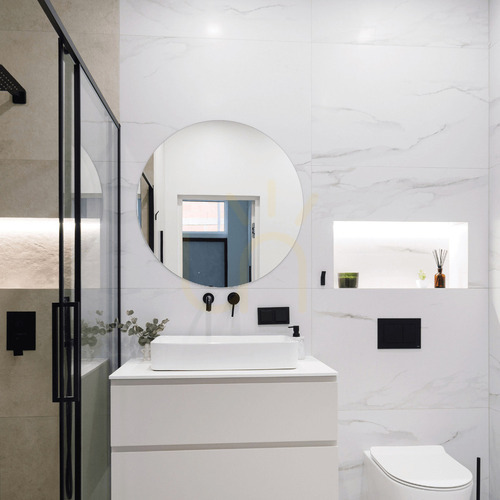
In a front-lit mirror, light emerges through frosted strips or a frame facing the user. If the strips run down both sides of the face, they help reduce shadows under the eyes and chin. This is the best starting point for make-up, shaving and skincare. A single strip above the mirror can light the basin well, but it casts stronger shadows on the face.
A backlit mirror shines backwards, creating a halo on the wall. The effect visually separates the glass from the background and provides atmospheric light, but the glow alone is usually not enough for precise tasks. A model combining front and rear light gives both effects. If you choose halo only, plan additional Bathroom lighting at the sides or above the glass.
Browse Illuminated Mirrors and other Mirrors.




Choosing the mirror size
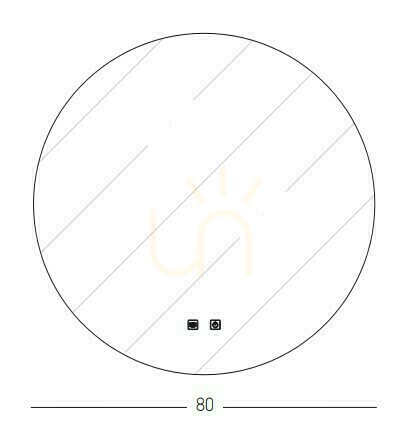
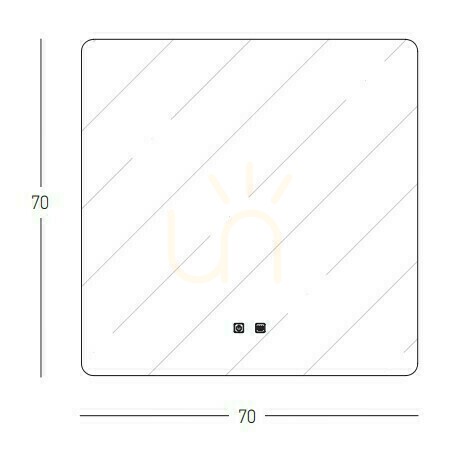
The mirror should relate to the width of the basin and vanity unit, not only to the free wall. In a single zone, glass slightly narrower than the furniture looks good; a wide double basin needs a mirror spanning both positions or two separate models. Leave room for opening cabinets, the tap, sockets and wall lights.
Set the centre of the glass near the eye level of the main users. The top edge must account for the tallest person, and the bottom should not clash with a tall tap. On a round model, the quoted diameter includes the frame and the luminous band, so the real reflective area may be smaller.
Brightness and facial uniformity
Do not judge a mirror by wattage alone. Look for information on lumens, the way light is emitted and whether it can be dimmed. Light should reach the face from the front and both sides, without visible LED points, harsh reflections in the eyes or dark patches at the edge of the glass.
In a bright bathroom, the level you need depends on the ceiling light, wall colour and the distance of the face from the mirror. An overly strong strip on a small surface can dazzle, so dimming is more practical than buying the maximum output. Also check that the electronics do not cause visible flicker at lower brightness.
Colour temperature and CRI
Neutral 4000 K gives a clear image and is universal for shaving and daily care. Warm 2700–3000 K encourages relaxation but can warm the skin tone. Cooler light emphasises detail but need not show colours faithfully. A model with adjustable colour lets you compare the effect in warm light and daylight.
For make-up choose CRI of at least 90. The index alone does not describe everything, but it is a better reference than colour temperature. The most even lighting comes from vertical strips at the sides or a full frame at face height. It is worth checking the final result of cosmetics in daylight too.
What does a demister do?
An LED mirror with a demister has a heating pad on the back that raises the temperature of part of the glass above the dew point. It does not dry the whole bathroom and usually does not cover the entire mirror surface. Check the dimensions of the heated zone, the wattage and whether a separate button switches the function on. The time to a clear zone depends on the pad power, room temperature and mirror size.
A demister is convenient after a shower, but it does not replace ventilation. Long heating uses energy, so a timer or automatic switch-off is beneficial. Do not cover the rear contrary to the instructions, and keep the required clearance from the wall.
IP rating and bathroom installation
IP describes the enclosure’s protection against solid objects and water. IP44 means protection against splashes under test conditions, but it does not grant the right to install the mirror anywhere above a bath or shower. A bathroom is divided into zones 0, 1 and 2 with different requirements. The correct rating and whether installation is permitted depend on the exact position, voltage, supply method, protection class, the product instructions and local regulations.
Before buying, agree the exact position of the mirror’s edge and the power point with an electrician. The manufacturer should explicitly approve the model for a bathroom and indicate the mounting position. An ordinary decorative LED mirror does not become a bathroom one just because the strip is low-voltage.
Touch control, dimming and memory
A touch button on the glass is convenient, but fingerprints remain after every use. A contactless sensor is more hygienic, provided it does not react accidentally while you clean the basin. A classic wall switch is sometimes the simplest to use day to day.
Check whether the mirror remembers brightness and colour after the power is cut. Without memory it may return to full output or a different temperature. Separate control of the light and the demister pad limits unnecessary heating. Choose Bluetooth, a clock or a speaker only if they will genuinely be used.
Power supply, cable and service
Some mirrors are wired permanently to a cable brought out of the wall, others have a plug. Check where the cable exits, the depth of the housing and whether the driver can be hidden. If the installation point falls outside the space behind the glass, the cable may remain visible. A plug does not remove the requirements for socket location and circuit protection in a bathroom.
Ask whether the driver, LED module, heating pad and controller can be replaced. An integrated construction looks clean, but the failure of a non-replaceable part may mean replacing the whole mirror. Warranty, parts availability and the ability to remove the glass without damaging the tiles all matter. Repairs to 230 V parts should be left to a specialist, and the glass and touch panel cleaned with a lightly damp cloth as instructed, without flooding the edges.
Shape and style
A rectangular mirror uses the width above the vanity and lights two people well. A round one softens the straight lines of the furniture but leaves less glass in the corners. An oval visually raises the wall, and an irregular shape becomes a decoration, although it is harder to match symmetrical light to it.
A thin black frame brings order to a modern bathroom, gold and brass link the mirror to the tap fittings, and a frameless model looks light. Finishes need not be identical, but they should have a similar tone and degree of sheen.
Installation checklist
- Measure the vanity, tap, distance to the ceiling and the wet zones.
- Mark the centre of the glass and the actual fixing points from the manufacturer’s template.
- Check the routing of cables and pipes before drilling.
- Match the fixings to the wall type and the mirror’s weight; plasterboard alone may need reinforcement.
- Leave a fixed 230 V connection to an electrician, who will check the circuit protection and carry out measurements.
- Hang the mirror with a second person, keeping the ventilation gaps from the instructions.
- Test the light, dimming, memory and demister before sealing the surround.
Common mistakes
- treating the rear halo as make-up lighting;
- choosing by wattage or an interior photo alone;
- no information on CRI and flicker;
- glass too small over a wide basin;
- collision with the tap, cabinet or wall light;
- assuming IP44 suits every zone;
- switching the light and demister together without need;
- no setting memory;
- a non-replaceable driver with no service access;
- drilling without checking cables and pipes.
Summary
A good LED illuminated mirror lights the face evenly, has CRI 90+ and a brightness you can match to the time of day. Front strips serve grooming, the rear halo builds atmosphere, and the demister pad heats only a defined zone and does not replace ventilation. Before buying, check the size, the IP rating for the specific location, the power point, the setting memory and serviceability. Leave the installation of a fixed circuit in a bathroom to an electrician.
Compare Illuminated Mirrors, classic Mirrors and complementary Bathroom lighting.
Maciej Hudaszek


Maybe you will be interested in products from these categories?
Illuminated Mirrors, Mirrors, Bathroom Lamps
Tags & Blog Categories