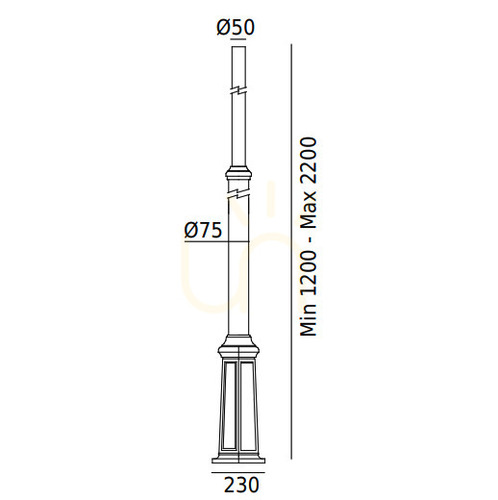
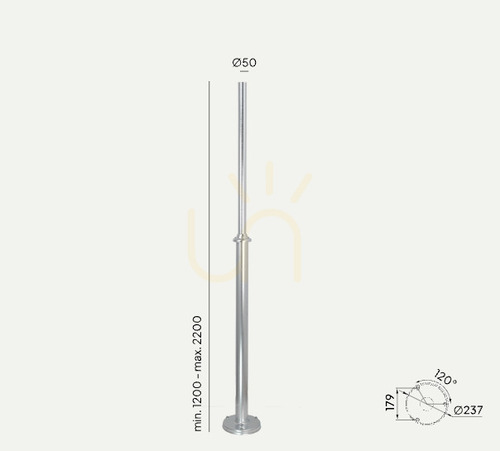
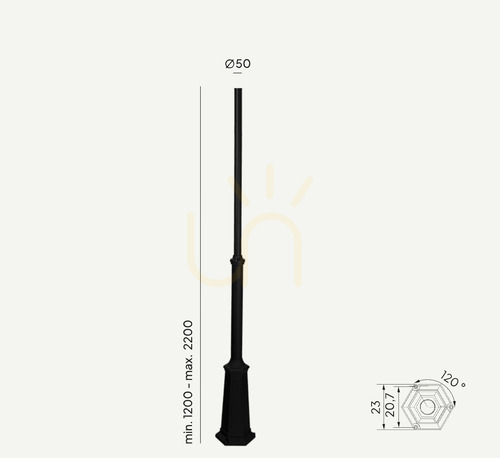
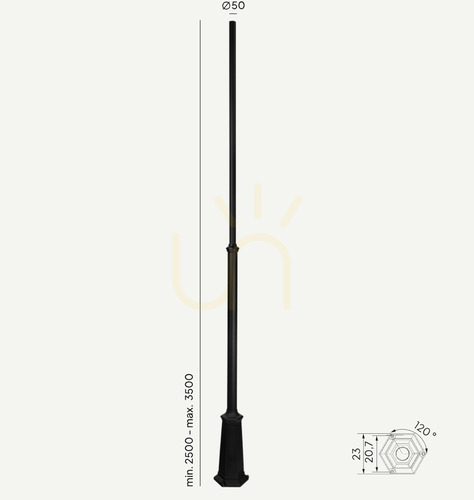
Lighting masts are tall, fixed structures that light large, open areas from a single point — where a row of shorter poles would be awkward and costly. One mast carrying several floodlights on its head replaces a dozen luminaires and covers a square, car park, sports pitch or industrial yard with even light. This category holds permanent lighting masts — steel and aluminium, ready for LED floodlights.
One important note up front, because it's often confused: these are fixed masts on a foundation, not the portable light towers with a generator or battery that you tow to a site. Those are a different product with a different use.
Lighting mast vs lighting pole — what's the difference?
The line is blurry, but in practice it comes down to scale:
- A pole (column) usually carries one luminaire at 3–8 m and lights a road, path or car park along a line.
- A mast is taller, carries several floodlights on a shared head (crown) and lights a wide area all around — as a point, not a line.
Need to light a footway or street? Head to the lighting poles category. Got a large square or pitch to cover? Stay here.
Types of lighting mast
-
Fixed tubular and conical masts — welded from steel plate, multi-sided or round; the classic for squares and car parks.
-
Masts with a fixed head — floodlights mounted rigidly at the top; a simple, economical build.
-
Masts with a lowering head — the crown slides down a guide so the floodlights can be serviced from the ground, no cherry picker; ideal for tall masts and hard-to-reach sites.
-
Aluminium masts — lighter and corrosion-resistant, for smaller, prestige installations.
Common forms are multi-sided masts (12- and 16-sided) with a tapered section — the taller the mast, the more aerodynamics and wind-load calculation matter.
Which mast height should you choose?
Height follows the size of the area and the required lighting level. Rule of thumb: a single high point lights an area of roughly its own radius, and several floodlights spread the light evenly.
| Height |
Typical use |
| 6–8 m |
Smaller squares, site car parks, club sports pitches |
| 8–12 m |
Large car parks, manoeuvring yards, sports and leisure areas |
| 12 m and up |
Road junctions, ports, large industrial and logistics sites |
The taller the mast, the fewer structures the same area needs — meaning fewer foundations, less cabling and fewer poles to steer a mower or sweeper around.
Head, crown and floodlights
The heart of the mast is the head (crown) — the fitting that carries the LED floodlights. Their number (from a few to more than a dozen) and aiming angle set the light distribution. Look at:
-
Floodlight output and optics — wide throw over a square, tighter over a pitch.
-
Light colour — 4000 K (neutral white) for good contrast across large areas.
-
Maximum weight and wind area of the luminaires — these drive the mast selection.
Mounting, foundation and wind load
Fixed masts sit on a pre-cast foundation with an anchor cage, sized to height and ground conditions. Key here are calculations to EN 40 and the wind-load class — the taller the mast and the larger the floodlights' wind area, the more substantial the foundation and shaft. Steel masts are hot-dip galvanised, often with an added powder coat.
Where lighting masts work best
-
Squares and car parks — even, low-shadow light across a large area from a few points.
-
Sports grounds — pitches, courts, running tracks and training areas.
-
Industrial and logistics sites — manoeuvring, storage and loading yards.
-
Traffic nodes — large junctions, roundabouts, car parks at public facilities.
Fixed or portable mast?
-
Fixed mast (this category) — on a foundation, mains-powered, for permanent lighting of a site.
-
Portable / mobile mast — on a trailer, with a generator or battery, for temporary lighting of a works, event or operation.
If you want lighting "for good", the fixed mast is the right choice — lower running costs and no fuel to top up.
Durability and maintenance
A well-protected steel mast lasts for decades. The biggest operational help is the lowering head — replacing or cleaning the floodlights is done from the ground, with no cherry-picker hire. With a fixed head, plan for access from above.
Frequently asked questions
How does a lighting mast differ from a pole?
A mast is taller and carries several floodlights on one head to light a large area as a point. A pole usually carries one luminaire and lights a road or path along a line.
Is this a portable mast with a generator?
No. This category covers fixed masts on a foundation, mains-powered. Portable masts with a generator or battery are a separate product.
How many floodlights does a mast hold?
Depending on the head — from a few to more than a dozen. Number and optics are matched to the area and the required lighting level.
How are the floodlights on a tall mast serviced?
Most conveniently via a lowering head that comes down to ground level. With a fixed head you need a cherry picker.
What foundation is needed?
A pre-cast foundation with an anchor cage, sized to the mast height, the floodlights' wind area and the ground conditions, to EN 40.
Not what you're after? For roads, paths, car parks and gardens, lighting poles — lower structures for single luminaires — suit better.