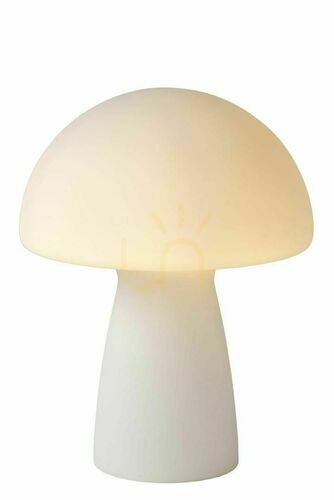
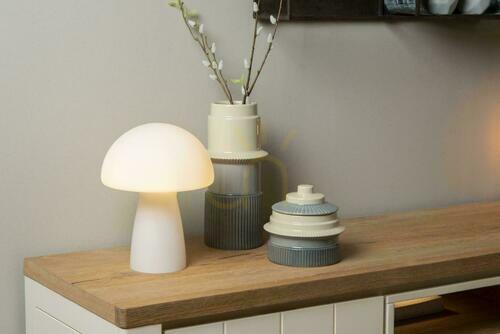
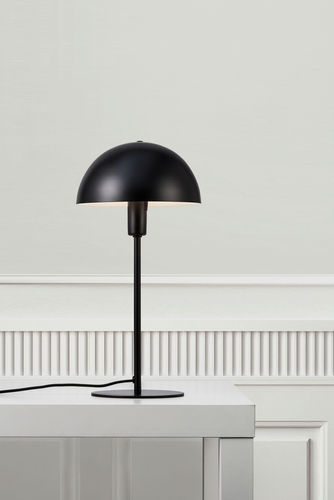
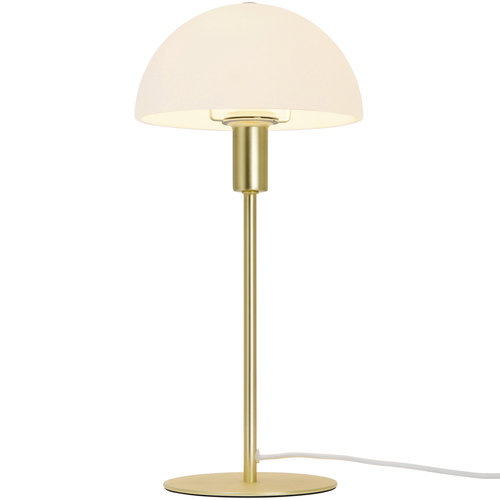
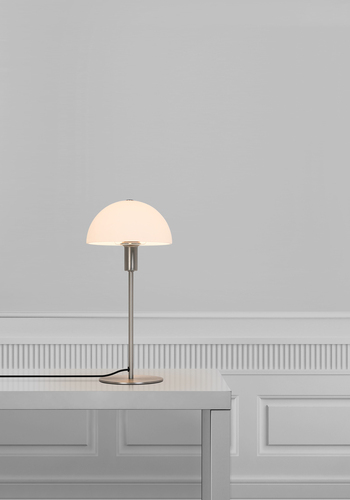
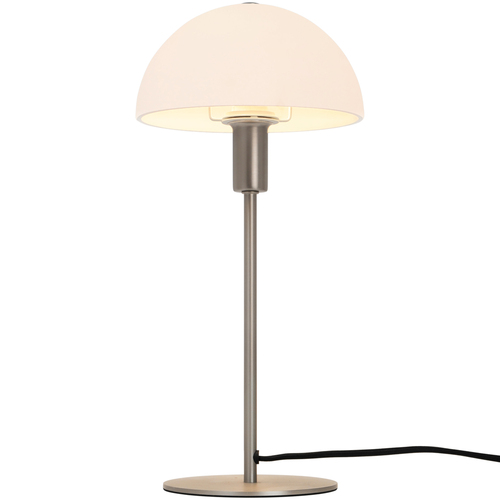
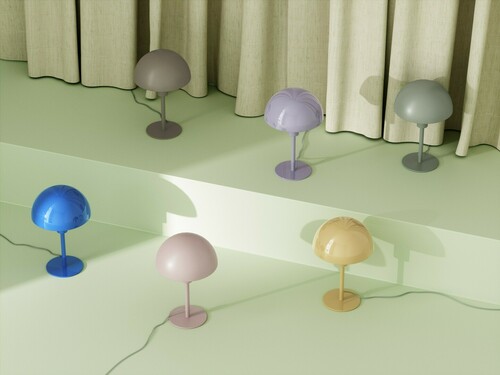
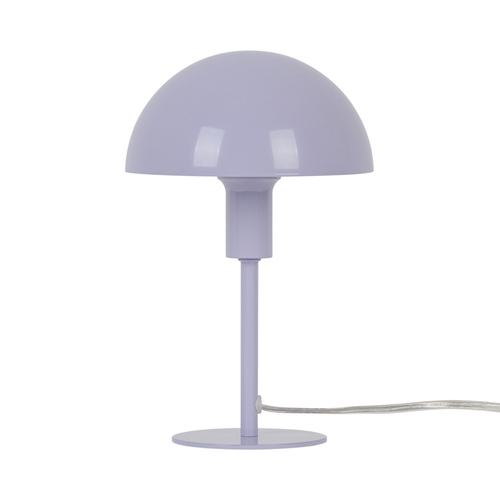
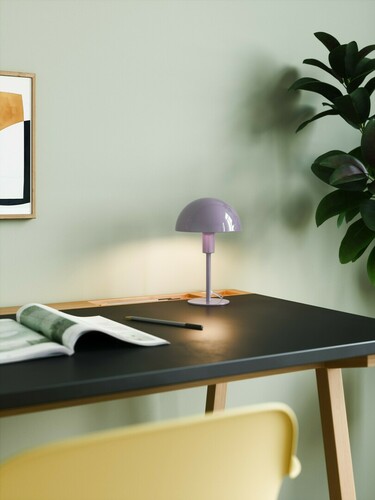
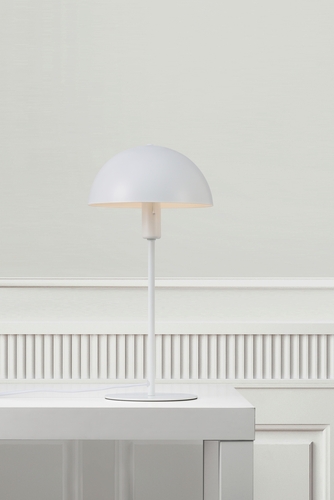
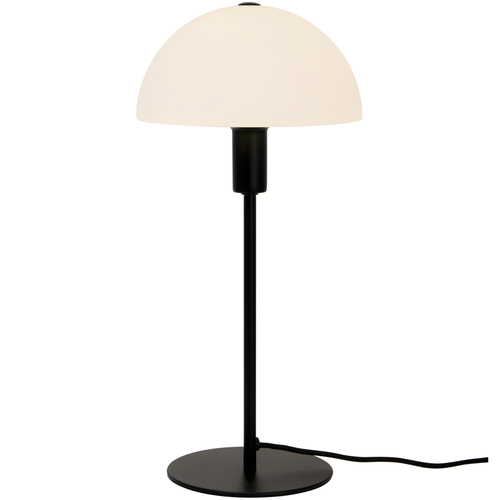
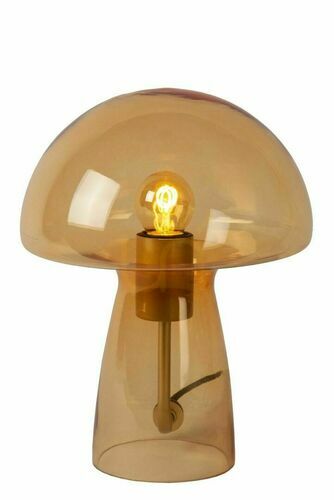
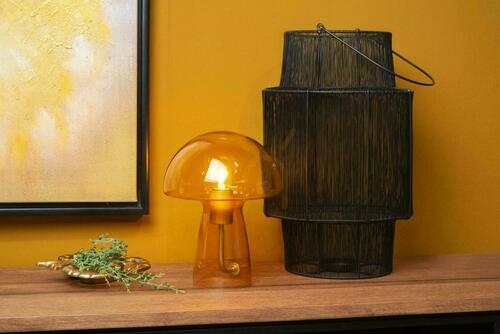
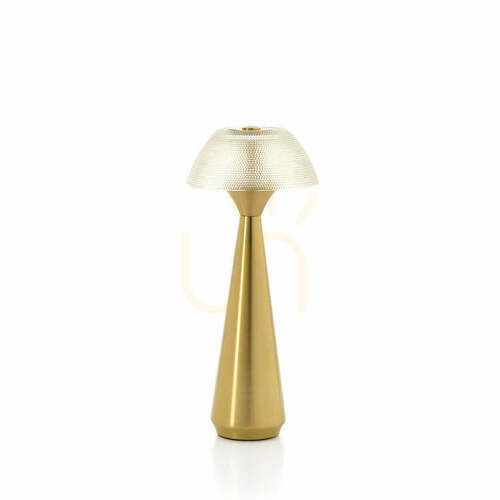
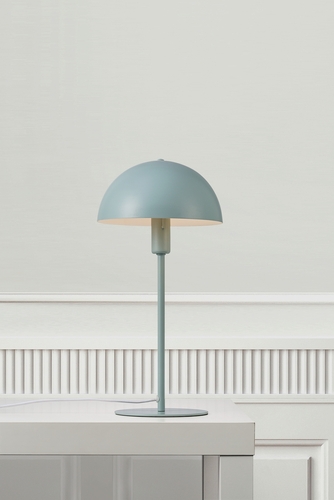
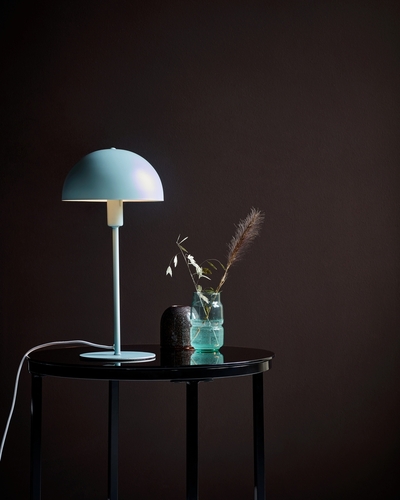
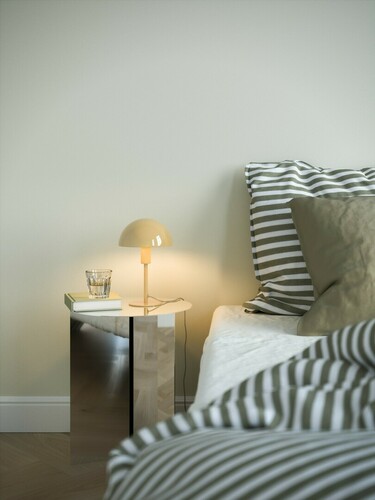
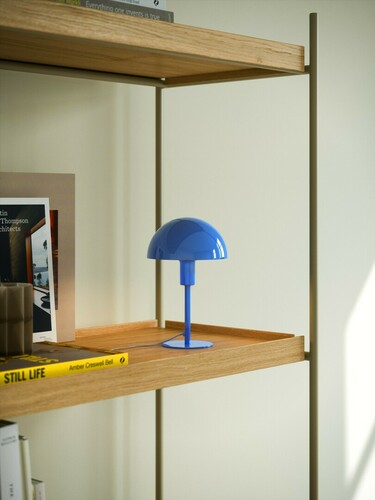
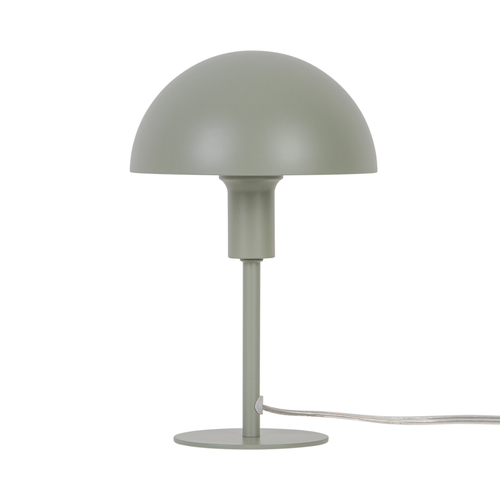
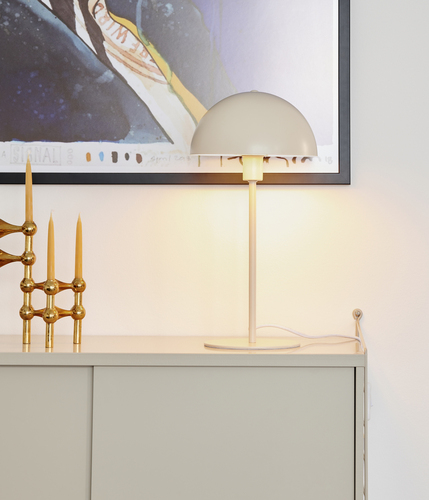
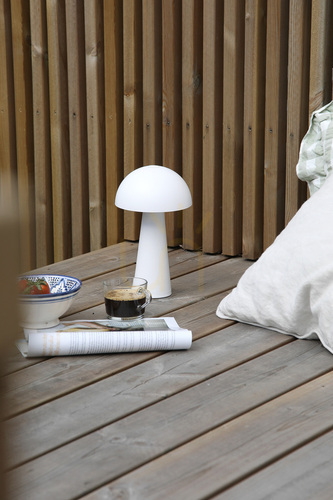
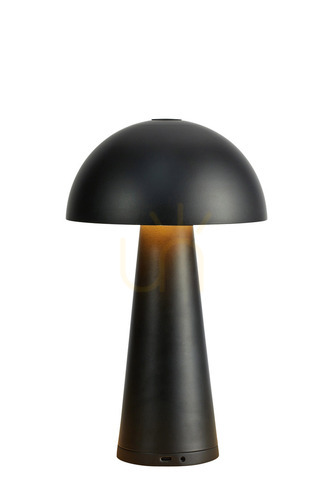
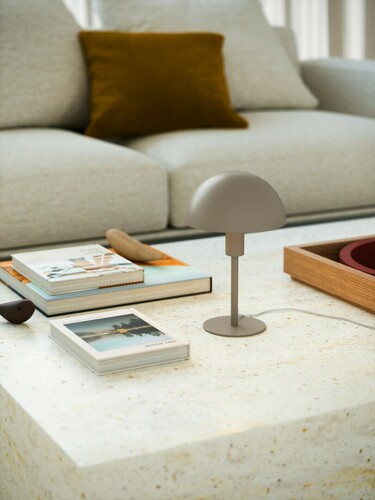
Mushroom table lamps pair a broad, cap-like shade with a slimmer stem or base, and that soft outline looks at home on a bedside table, a sideboard or a side table by the sofa. What you get from the light depends mostly on the cap: an opaque metal dome sends a pool of light downwards, opal glass glows all over, and clear glass turns the bulb itself into part of the look.
So start with two questions. Where will the lamp stand, and what should it do there? A gentle glow for winding down, a decorative accent on a shelf and a light good enough to read by are three different jobs. Pick the size and the shade for the job, and the mushroom shape takes care of the charm.
A cap, a stem and room around them
The signature of a mushroom lamp is a shade that reaches out wider than the stem below it. The cap can be a neat hemisphere, a flattened dome or a softly rounded glass form. Some lamps join a metal cap to a separate base; others are one flowing glass piece from top to bottom. Most stand roughly 25–60 cm tall, with caps from about 20 cm on compact models to 40 cm or more on statement pieces.
Because the cap overhangs, measure its full diameter, not just the foot. On a bedside table, a good rule of thumb is a cap no wider than about two-thirds of the tabletop, which leaves room for a book, glasses and a glass of water. Keep the cap at least 5–10 cm from the wall so it doesn't scrape the paint and the light can spread.
Height changes what you see under the shade. A dome that hides the bulb when you stand next to it can show it when you're lying in bed. Sit or lie where you'll actually use the lamp and look at it from there. Many mushroom lamps have a small diffuser under the cap to soften that view; the product photos usually show it.
| Feature |
Light it gives |
Best for |
| Opaque metal cap |
Focused pool of light below the shade |
Reading, bedside tables, desks |
| Opal glass |
Soft, even glow from the whole lamp |
Background light, sideboards, living rooms |
| Clear or tinted glass |
Sparkle, with the bulb on show |
Decorative accents with a low-output bulb |
| Compact base |
Same light, smaller footprint |
Narrow bedside tables and shelves |
| Rechargeable model |
Cordless light you can move around |
Dining tables, balconies, flexible use |
What the shade does to the light
An opaque metal cap blocks light through its walls and sends it out through the opening below. That gives a defined circle of light on the table, ideal for reading or for a calm, low-lying glow. A white or brushed inner surface reflects more light than a dark one, and a bulb set slightly higher inside the dome spreads the circle wider.
Opal glass lets light pass through the whole shade, so the lamp itself becomes a soft, glowing object. That's lovely as background light in a living room or as a night-time accent on a sideboard. Pair it with a bulb of modest output, and the glass stays pleasantly even without bright spots.
Clear or tinted glass puts the bulb on display and adds reflections around it. Choose a decorative bulb with a nice shape and low output, around 150–300 lm, so it sparkles rather than glares. Ribbed, mottled and textured glass add their own pattern both when lit and when switched off, which makes them a strong pick for a lamp that's on show all day.
Choosing a bedside mushroom lamp
At the bedside, the switch matters more than almost any design detail. Make sure you can reach it from bed without sitting up: a touch point on the base or the cap, an inline switch on the flex or a push button near the foot all work, as long as it's on your side. Many touch lamps step through two or three brightness levels; the product description tells you whether yours dims or simply turns on and off.
For reading, place the lamp so the bottom edge of the cap is roughly at chin height when you sit up in bed. Aim for about 400–500 lm on the page; an opaque dome gets there with less glare than open glass. For winding down afterwards, 150–250 lm of warm light is plenty, which is why a dimmable lamp is such a good bedside companion.
A matching pair gives a bedroom a calm, balanced look. Check both sides separately, since the socket, the table height and the reading position often differ. Route the flex behind the bedside table so the bed frame doesn't trap it and nobody trips over it on the way to the door.
On a sideboard, shelf or occasional table
On a sideboard, a mushroom lamp works as an evening light and as a sculpture during the day. A pair at either end frames the furniture nicely, and one lamp beside a mirror doubles the glow. Move it a little off the mirror's centre line so you don't see the bulb reflected from the sofa.
On a side table, a lamp 30–45 cm tall keeps the cap above a cup or a book and the light below eye level when you sit. On a shelf, leave clear air above the cap for heat and for your hand to reach the switch, and keep the lamp near the front so it's easy to dust.
The rounded outline softens straight-edged cabinets and boxy sofas. Pick up a colour or a metal already in the room, or let a coloured glass lamp be the one bold accent. A neutral metal dome in black, white or brass blends in almost anywhere.
Replaceable bulbs and integrated LED
For lamps with a bulb holder, check three things: the cap type (E14 and E27 are the most common), the maximum wattage and the bulb size that fits under the shade. Compact caps often need a small golf-ball or mini-globe bulb rather than a standard A60 shape. The maximum wattage is an upper limit for heat; a 4–6 W LED bulb usually gives all the light a mushroom lamp needs.
Lamps with integrated LED come with the light source built in. Compare their lumens, colour temperature and controls just as you would a bulb. Integrated LEDs are typically rated for 15,000–30,000 hours or more, so most last for many years of evening use. If you'd like to replace the module one day, look for a note on spare parts in the documentation.
Warm white around 2700 K is the classic choice for bedrooms and living rooms; 2200–2500 K feels even cosier late in the evening. Neutral white around 4000 K suits a desk or a craft corner better. If you want textiles, artwork or knitting colours to look true, choose CRI 90 or higher; that's listed separately from the colour temperature.
How to judge dimming and controls
There are three common ways to dim a mushroom lamp:
-
Touch dimming built into the lamp, usually in two to four steps.
-
Inline dimmer on the flex, often a rotary wheel or slider for stepless control.
-
Smart bulb in a standard E14 or E27 holder, controlled from an app or voice assistant.
With a built-in dimmer, use the bulb type the manufacturer recommends, typically a dimmable LED. With a smart bulb, keep the lamp's own switch on and do the dimming in the app. Some rechargeable lamps also let you change the colour of the light, from warm to neutral white.
Think about daily use. A switch on the flex needs a spot where furniture won't press it. A touch base needs a clear approach for your hand. Try the gesture in your head: reaching out from bed in the dark, or tapping the lamp as you pass the sideboard.
Rechargeable mushroom lamps and outdoor use
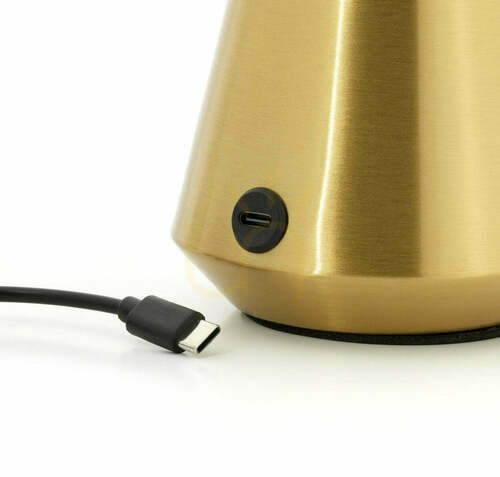
Cordless mushroom lamps are a joy on a dining table, where no cable crosses the tablecloth, and you can carry them to the balcony or the garden table for the evening. Most charge via USB-C and run for roughly 5–20 hours, depending on the brightness setting. Low brightness gives the longest run time.
For outdoor use, check the IP rating: IP44 handles splashes on a covered terrace, while IP65 suits a lamp that stays out on an open garden table, where a heavy shower can catch it. Bring indoor-only models back inside after use, and charge every cordless lamp indoors in a dry place.
For mains-powered lamps, check the plug type and the flex length for your socket position. Plan the cable route before you arrange the rest of the table, so the lamp stands securely and the lead stays out of the way.
Stability and looking after the finish
Place the lamp on a level surface, a few centimetres in from the edge. Lift it by the base or stem rather than by the cap. Glass lamps and trailing leads are best kept out of reach of small children and lively pets, since a pulled cable can bring the lamp down.
Before cleaning, unplug the lamp and let it cool. Dust metal caps with a soft, dry cloth; wipe glass with a slightly damp microfibre cloth and dry it straight away to avoid streaks. Brass-look and coloured finishes are often lacquered or painted, so skip abrasive cleaners and keep moisture away from the switch, the holder and the charging port.
Questions about mushroom table lamps
Do mushroom lamps only shine downwards?
Lamps with an opaque metal cap do: they make a pool of light on the table. Opal and frosted glass caps glow all over and light the room around them as well. Pick metal for reading and glass for ambient light.
Are they suitable for reading in bed?
Yes, especially models with an opaque cap and around 400–500 lm. Place the bottom of the cap at roughly chin height when you sit up, and choose a lamp with a switch or dimmer you can reach from the pillow.
What size works on a small bedside table?
Keep the cap to about two-thirds of the table width, often 20–30 cm on a compact table, and leave 5–10 cm to the wall. Cut a paper circle at that size and lay it on the table to check the fit.
Which bulb should I use in a glass mushroom lamp?
Match the holder (often E14 or E27), stay within the maximum wattage and choose a bulb that fits under the cap. In clear glass, a decorative LED bulb of 150–300 lm looks best; in opal glass, a frosted 400–500 lm bulb gives an even glow.
Can I dim a mushroom lamp with touch control?
Many touch lamps dim in two to four steps; the product description lists it as touch dimming. Lamps with a simple on/off touch can be dimmed with a smart bulb instead.
Can a rechargeable model be used outside?
Yes, when it has an IP rating for outdoor use: IP44 for a covered terrace, IP65 for a lamp that stays out on an open garden table. Charge it indoors and bring it in for the winter.
Can I put a mushroom lamp in a child's room?
Yes, a sturdy model with a metal or plastic cap on a stable base works well as a soft night light. Place it out of reach, keep the flex behind furniture and choose warm light around 2200–2700 K for bedtime.
What should I compare first?
Start with the surface and the job: atmosphere, decoration or reading. Then compare cap size, shade material, light source, controls and care. If another shape suits your space better, browse our wider range of table lamps and compare them the same way.