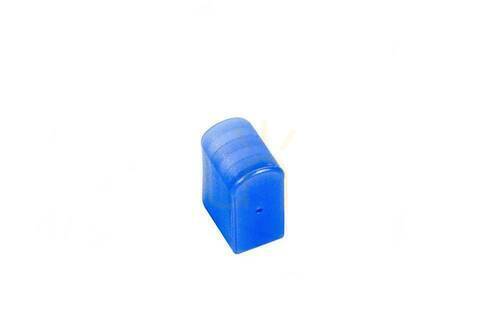
Neon flex end caps close the cut ends of an LED neon run, keep moisture and dust away from the exposed contacts and give the installation a finished, factory look. A standard run takes two of them: a solid cap at the free end and a cap with a cable outlet at the end where the power comes in.
Blind caps and feed caps
The difference is the hole.
-
Blind end caps have no opening. They seal the far end of the neon, where nothing is connected.
-
Feed end caps (also sold as power-connection caps or plugs) let the supply lead out of the neon. They come with the cable leaving in one of three directions.
| Cable outlet |
Where the lead goes |
Typical use |
| Straight |
in line with the neon |
the run ends at a wall or ceiling edge and the lead carries on behind it |
| Side |
out at 90° to the strip |
the lead runs along the mounting surface to a driver nearby |
| Bottom |
out of the back, into the surface |
the lead disappears straight into a drilled hole or a profile, so no cable shows |
Pick the outlet before you cut the neon, because it decides where the cable has to be routed and whether you need to drill.
Getting the right size and colour
End caps are moulded to the exact cross-section of one neon series, so a cap for 8 × 8 mm neon will not seal a 10 × 10 mm or a flat 10 × 18 mm profile, even if the numbers look close. Check the series name and the cross-section of your strip and order caps for that exact model. Neon that lights all round, at 360°, has caps of its own too.
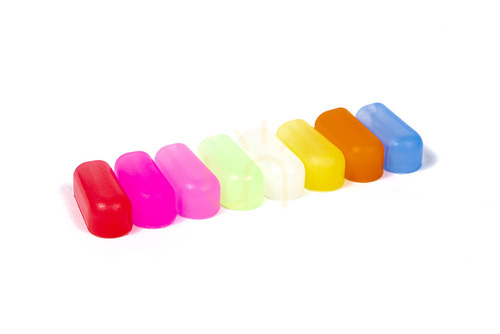
Coloured neon usually has caps in matching colours, from white to red, yellow, orange, green, blue, violet or pink. A matching cap blends into the line of light, which matters on signs, lettering and short decorative runs where the ends are in plain view.
Fitting a neon flex end cap
- Disconnect the power supply and cut the neon only at the marked cutting points.
- On the feed end, connect the lead first, then thread the cap over the cable.
- Apply a neutral-cure (acid-free) silicone to the cut end and inside the cap. Acetic silicone can corrode the contacts.
- Push the cap on firmly, wipe off the excess and seal the cable exit. A short piece of heat-shrink tubing over the lead helps.
- Leave the joint still until the silicone has cured, often around 24 hours, before mounting or switching on outdoors.
The cap and silicone together give the neon its rated protection, often IP65 or IP67. An open or badly sealed end lets in water, and the strip fails from that end first. Neon flex of this kind usually runs at 24 V; any connection to 230 V, including the driver, is a job for a qualified electrician.
FAQ
Do I need an end cap with or without a hole?
Both, for a standard run: a cap with an outlet where the power enters and a blind cap at the other end.
What silicone should I use with neon flex end caps?
A neutral-cure, acid-free silicone, ideally clear or matched to the neon. Avoid acetic sealants that smell of vinegar.
Can I reuse a cap after cutting the neon shorter?
Rarely. Once glued, a cap tears or keeps old silicone inside, and a clean seal is hard to get. Buy a spare or two when you plan to cut.
Will an end cap from another series fit my neon?
Only if the cross-section and shape are identical. Caps are made per series, so check the model before ordering.
Caps go hand in hand with the rest of the system: see the neon flex strips themselves and the neon flex mounting accessories.