LED neon flex looks best when it runs in a perfectly straight line or an even curve, and that is the job of a profile. A neon flex profile is an aluminium channel that is screwed or glued to the wall, ceiling or a sign board, after which the neon is pressed into it. The profile keeps the tube aligned, stops it sagging between fixing points and gives a neat, finished edge where clips alone would leave the line wavy.
Straight and flexible profiles
-
Straight profiles. Rigid channels, usually supplied in lengths of about 1 m or 2 m, for runs along a shelf, a stair, a ceiling edge or a reception desk.
-
Bendable profiles. Thinner or slotted aluminium that can be shaped by hand into gentle curves, arches and waves, and then fixed in place.
-
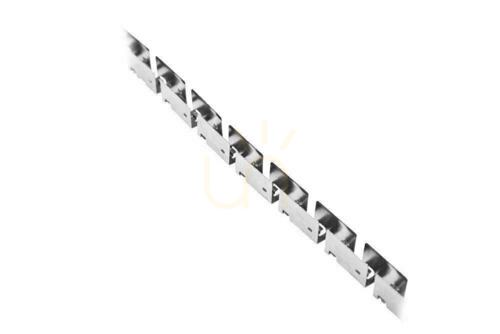
Segmented flexible profiles on a roll. A chain of short segments joined into one long band, supplied on a roll, which follows tight curves for lettering, logos and outlines.
Profiles are usually anodised aluminium, often in silver. Anodising protects the surface and gives an even finish that suits both modern interiors and shopfronts.
How to choose the right profile
The profile must match the neon, not just its width. Each neon flex family has its own cross-section and bending direction, so check that the product page names the same family as the neon you are using.
| What you are building |
Profile type |
What to check |
| Long straight line |
Straight, 1–2 m lengths |
Joints between lengths and screw spacing |
| Soft curve or arch |
Bendable |
Minimum bend radius of the neon |
| Lettering, logo, outline |
Segmented, on a roll |
Bending direction: side bend or top bend |
| Shallow recess or tight space |
Low-profile straight channel |
Check the overall width including the base |
Installation
Mark the line first with a pencil or a laser level. The surface should be clean, dry and free of dust. Fix the profile with screws suited to the base, or with mounting adhesive on smooth surfaces, and only then press or slide the neon in until it sits evenly along the whole length. Bend flexible profiles gradually by hand; forcing a tight radius can kink the aluminium and spoil the line. Leave room at the ends for the end cap and the power connector, and plan where the cable will go before fixing the first length. Whatever voltage the neon itself runs on, connecting its power supply to 230 V is a job for a qualified electrician.
Frequently asked questions
Do I need a profile for neon flex, or are clips enough?
Clips hold the neon at points, which is fine for short or hidden runs. A profile supports it along its whole length, so long visible lines and signs stay straight.
Can I cut a neon flex profile?
Straight aluminium profiles can be cut with a fine-toothed saw; deburr the edge before fitting the neon. For segmented profiles, follow the maker's instructions on where they can be shortened.
Will any profile fit any neon?
No. The cross-section and bending direction differ between neon families, so the profile must be made for the one you use.
See also neon flex and neon flex mounting accessories.