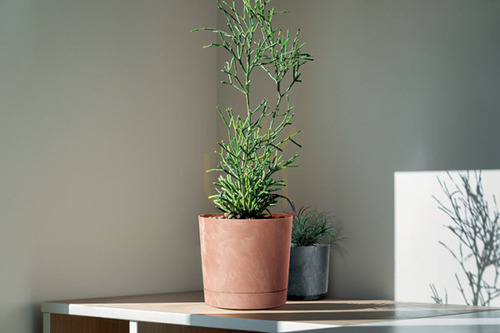
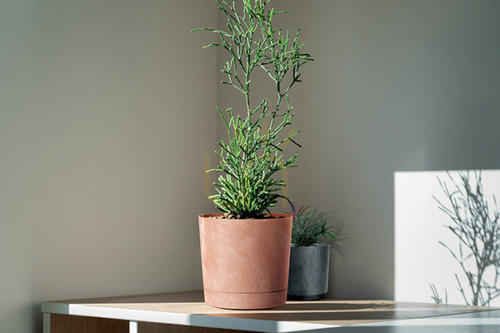
Small flower pots are the ones you move around most: herbs on a kitchen windowsill, a succulent on a desk, a row of geraniums along a balcony rail or a young plant on its way to a bigger container. The small plant pots here are made of lightweight plastic that is frost-resistant and UV-resistant, so the same pot can stand indoors in winter and outdoors in summer without cracking or fading quickly.
Shapes and finishes
Plastic lets one pot imitate many materials. You will meet smooth round cylinders, square pots with straight sides, ribbed bowls that taper towards the base, and finishes that look like concrete or stone. Some pots stand on legs with a wood texture, which lifts the base off a floor or a table and leaves an air gap underneath. Colours run from white and anthracite to pine green, warm marsala and concrete grey, so a set of pots can match the window frames, the balcony railing or the rest of the room.
How to choose the right size
Pot size is usually given as the diameter at the rim, the height and the capacity in litres. When repotting, go up one step at a time: a pot only slightly wider than the root ball keeps the compost from staying wet for too long.
| Use |
Typical capacity |
Typical rim diameter |
| Cuttings, cacti, small succulents |
0.5–2 L |
9–14 cm |
| Herbs, African violets, desk plants |
2–4 L |
14–19 cm |
| Balcony flowers, small houseplants |
4–8 L |
19–24 cm |
| Plants outgrowing a 19–24 cm nursery pot |
8–15 L |
24–30 cm |
Measure the place first. A pot that tapers takes up the space of its rim, not its base, which matters on a narrow windowsill or shelf.
Plastic, terracotta or ceramic?
Plastic is light, so a full pot is easy to lift onto a shelf or carry in for the winter. It also holds moisture longer than unglazed terracotta, which dries out quickly through its porous walls. That makes plastic a good match for thirsty herbs and balcony flowers, and a forgiving choice if you sometimes forget to water. Terracotta and ceramic are heavier and more stable for tall plants, but unglazed clay can crack in frost unless it is rated frost-proof.
Drainage, placement and care
Roots need air as much as water, so excess water must be able to leave the pot. Use pots with drainage holes or a drainage insert, add a layer of grit or expanded clay if there is no insert, and empty the saucer half an hour after watering. Indoors, a decorative pot without holes can serve as an outer pot (cachepot), with the plant left in its plastic nursery pot inside. Small pots dry out faster than large ones, especially on a sunny balcony, so check the compost with a finger every day or two in summer. Rinse pots with warm water and a little washing-up liquid before replanting, to avoid carrying pests or disease to the next plant.
Frequently asked questions
What plants grow well in small pots?
Herbs such as basil, thyme and chives, succulents and cacti, African violets, small ferns, and balcony flowers such as pelargoniums or petunias all do well in pots of 2–8 L.
Can plastic pots stay outside in winter?
Pots described as frost-resistant can, but the plant inside may still need protection, because compost in a small pot freezes through quickly. Move tender plants indoors or group pots against a wall.
Do small plant pots need drainage holes?
Yes, for anything planted directly in them. Without drainage, water collects at the bottom and the roots start to rot.
Are plastic pots good for indoor plants?
Yes. They are light, keep moisture well and are easy to clean. Stand them on a saucer to protect furniture and floors.
For bigger plants, see medium flower pots, and for catching water, flowerpot saucers.