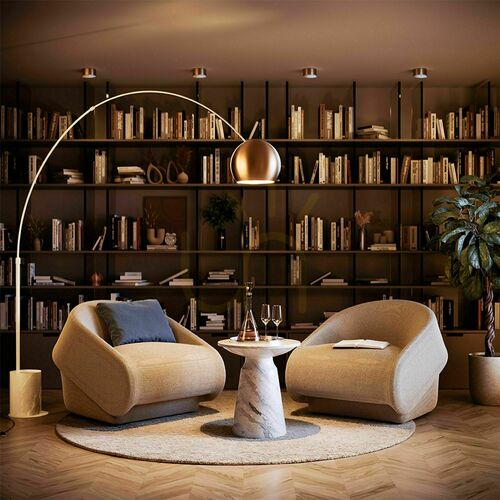
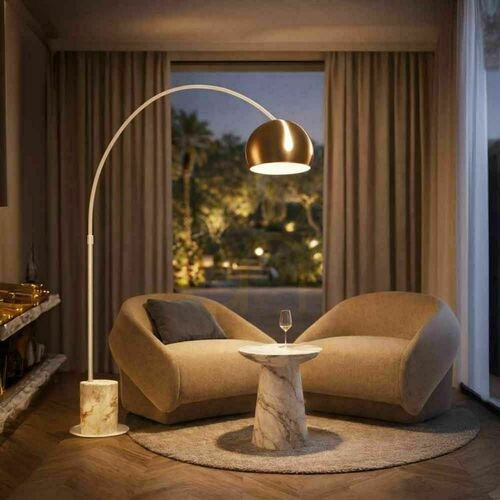
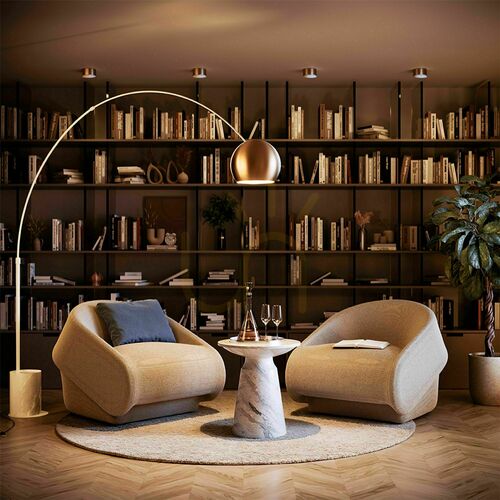
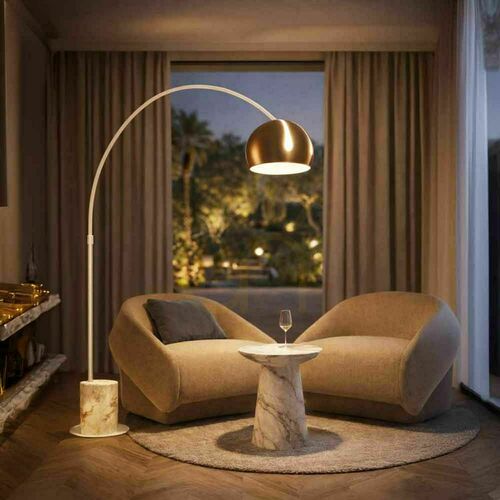
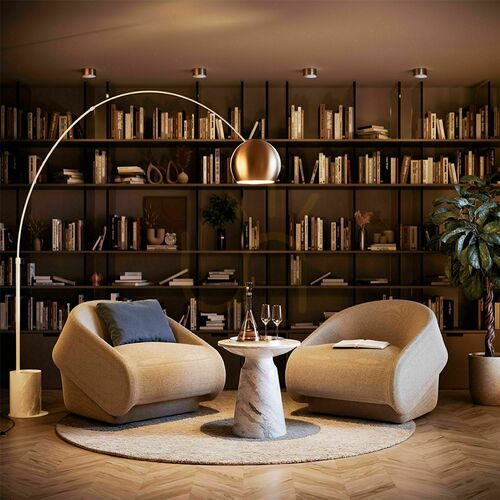
Arc floor lamps put light over a chair, sofa or coffee table while keeping the base to one side. A curved arm carries the shade away from its support, creating an overhead light without a ceiling fixing. For a reading corner or an open-plan sitting room, that reach is often more useful than height alone.
Start with the room rather than the photograph. Decide where the light should fall, where a base can stand and how the cable will reach a socket. Then compare the lamp’s dimensions, shade and controls. A beautiful arch still needs to work around everyday movements: getting out of a chair, opening a cupboard and walking through the room.
Plan the position before choosing an arc lamp
There are two positions to establish: the footprint on the floor and the light above the furniture. An arc floor lamp connects them. The base might sit beside a sofa while the shade reaches towards its centre, or stand behind an armchair with the light coming over a shoulder. Check both positions together; a useful shade location is no help if the base blocks the route to a door.
A paper outline or a few strips of removable tape can help you visualise the footprint. Include the upright, which may prevent a base from sliding very far beneath furniture. Next, hold a light object roughly where the shade would be. This simple room check reveals whether the lamp will obscure a view, compete with a pendant or sit directly in front of a television.
Measure the route to the power point as well. A cable running neatly along a wall takes a different distance from a straight line across the floor. The plug type, supply requirements and any power supply supplied with the lamp need to suit the place where it will be used. Confirm those details on the individual product rather than assuming every plug-in lamp has the same connection.
Height and reach measure different things
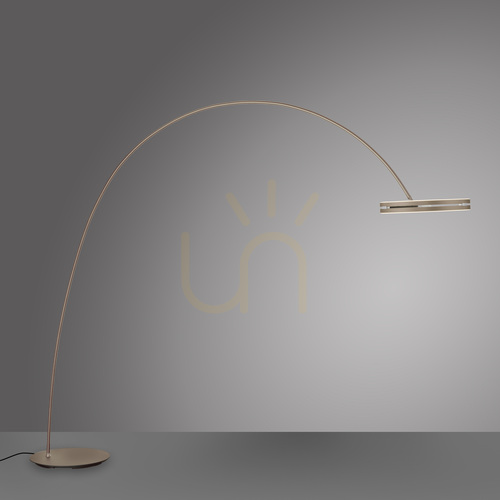
Overall height tells you the highest point of the lamp. Reach describes its horizontal extension, although drawings may measure from different starting points. Overall width can include the base and the shade; it is not automatically the distance between the centre of the base and the centre of the light. Look at the dimension drawing before making a final comparison.
| Dimension or detail |
What it helps you decide |
Room check |
| Overall height |
Whether the arch fits below a ceiling, shelf or sloping roof |
Allow for the highest part of the curve, not only the shade |
| Horizontal reach |
Whether the light can reach the seat or table from the base position |
Measure the required horizontal offset on the floor plan |
| Base diameter or width |
How much usable floor space the lamp occupies |
Check walkways, cupboard doors and sofa-bed movement |
| Base thickness |
Whether the base can sit beneath a raised piece of furniture |
Compare with the actual clearance and the position of the upright |
| Shade size and opening |
How much of the view it occupies and how well it screens the bulb |
Check from a seated position and from the entrance to the room |
| Cable and switch position |
Whether the lamp can be powered and operated conveniently |
Follow the intended cable route and test access beside the furniture |
For example, if the light needs to sit 90 cm away from the planned base position, a tall lamp with a short curved neck may not do the job. Height cannot make up for missing reach. Equally, a long arch is not automatically too large for a compact room: what matters is whether its actual footprint and overhead path fit the space.
Reading light, soft background light or a feature over a table?
For reading, place the light so that it reaches the page without exposing a bright bulb directly to your eyes. A shade that looks deep from above may look quite open from an armchair. Consider your seated eye level, the direction of the opening and the way you normally hold a book. The ideal position can differ for two chairs of different heights.
For background lighting, the shade’s material and light distribution become particularly important. A translucent fabric shade can provide a softer glow around the seating area, while an opaque dome directs more of its light through the opening. A dimming control can make a lamp more flexible, provided that the light source and control are compatible.
An arc lamp can also bring light over a coffee table where a ceiling pendant would be awkward to install. Check that the shade stays clear of people standing up and reaching across the table. This is local lighting: it can define the seating area without replacing the light needed elsewhere in the room.
Fixed arches and adjustable designs
A fixed arch has a defined shape and light position. Its proportions need to suit the furniture from the outset. Adjustable designs may change the lamp’s height, extend part of the arm, swivel a shade or rotate at a joint. These are separate movements. A tilting shade does not necessarily mean the arm can be shortened or the whole lamp can turn.
Look for the exact adjustment range and any restrictions in the instructions. Imagine the lamp at the setting you intend to use, including the position of the cable and the weight of the shade. Leave room around moving sections rather than allowing them to brush curtains or rest against a shelf.
Multi-arm floor lamps can spread several shades over a seating arrangement. Before choosing one, find out whether the arms move independently and whether the lights switch together. Several light sources connected to one switch do not automatically offer separate lighting zones. Choose the control arrangement that matches how you will actually use the room.
How the shade changes the light
The curve gives an arc floor lamp its outline, but the shade has a strong influence on comfort. Its opening, depth, lining and material all affect what you see when the lamp is on. Compare the light distribution as carefully as the external finish, especially when the shade will hang close to a favourite seat.
| Shade or light form |
Useful characteristics |
Points to check |
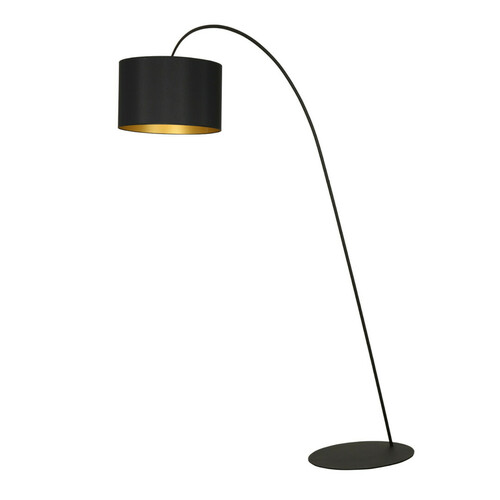
| Fabric shade |
Can soften light around the lamp as well as through the opening |
Fabric density, lining and visibility of the bulb from below |
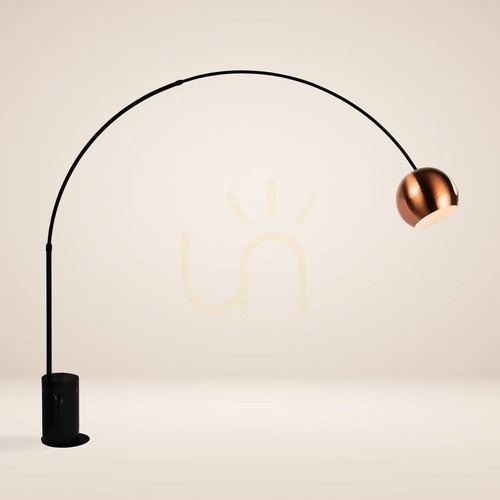
| Metal dome |
Can direct light towards a book, table or chosen part of the room |
Depth, internal finish and whether the shade can be angled |
| Opal glass |
Diffuses the light across the shade’s surface |
Brightness in your direct line of sight and cleaning access |
| Clear or tinted glass |
Makes the light source part of the visible design |
Bulb appearance and glare when viewed from the chair |
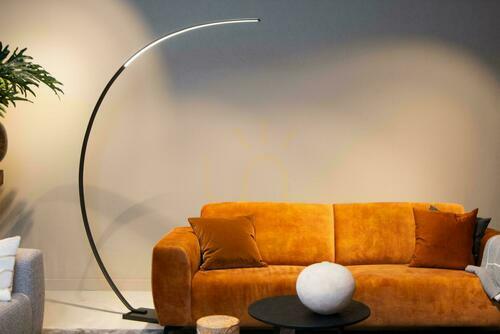
| Slim LED profile |
Places light along a defined section of the structure |
Direction of light, diffuser and information about servicing the module |
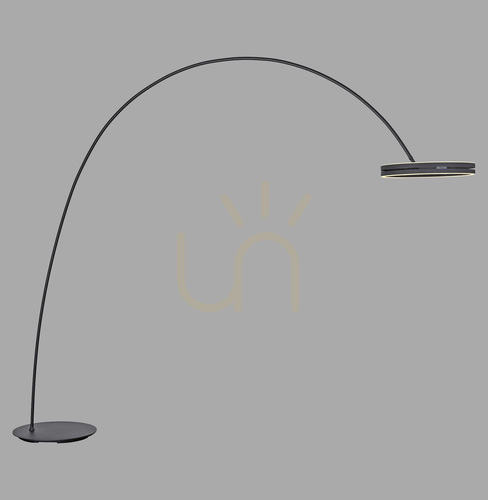
A black outer shade can have a light-coloured interior, and a brass-coloured frame can carry a cool-white light source. Finish and light colour are independent choices. If you are trying to create a relaxed evening setting, check the actual colour temperature rather than judging the effect from the metalwork.
Replaceable bulbs and integrated LED arc floor lamps
A lamp with a replaceable bulb gives you a choice of light sources within the fitting’s stated limits. Match the cap, maximum permitted power and physical dimensions. E27 and E14 are screw-cap formats, not brightness ratings. A bulb with the correct cap can still be too large for the shade or protrude far enough to become uncomfortable to look at.
Integrated LEDs allow different shapes, including slender illuminated arcs. With this construction, assess the stated light output, colour temperature, dimming method and service information before choosing. LED does not itself mean dimmable, colour-changing or replaceable by the user. Those features need to be confirmed separately.
Use lumens to compare light output and watts to compare power consumption. Neither figure alone predicts how bright the page of a book will look. The distance, shade, direction of light and room surfaces matter too. A well-positioned, screened source can be more comfortable than a more powerful exposed bulb.
Choose the light colour for the way you use the room
Warm white, such as 2700 K or 3000 K, is a useful starting point for an evening sitting area. A neutral white such as 4000 K gives a different impression and should be considered alongside the other lighting in the room. Kelvin describes the shade of white, not how much light the lamp produces.
If you read illustrated books, compare fabrics or display artwork nearby, colour rendering is worth considering. Check the stated CRI as well as colour temperature. You can then choose the balance between an evening glow, comfortable reading and the appearance of objects under the light, instead of asking one figure to describe all three.
For a lamp that serves several purposes, dimming can be useful. A dimmable bulb needs a compatible control, while an integrated LED fitting needs the control method specified for that fitting. Do not assume an existing foot switch can dim a bulb simply because it switches the lamp on and off.
A stable base and a clear walkway
An extended arm places weight away from the centre of its base. The base, joints and overall geometry work together to support that load. Stone and metal can provide weight, but the material alone does not establish stability. Follow the assembly instructions and stay within the stated adjustment limits.
Set the base on a suitable, level surface. A thick rug, a raised seam or an edge underneath part of the base can change its support. Keep the cable out of busy walkways and check that the shade does not project into the path of someone standing up. An arch that clears the furniture can still sit where a person’s head will move.
If the lamp stands beside a reclining chair, opening cabinet or sofa bed, test the furniture’s full movement. A position that works with everything closed may not work in use. Leave the lamp enough independent space rather than relying on a nearby piece of furniture to keep it upright.
Make the proportions work with the furniture
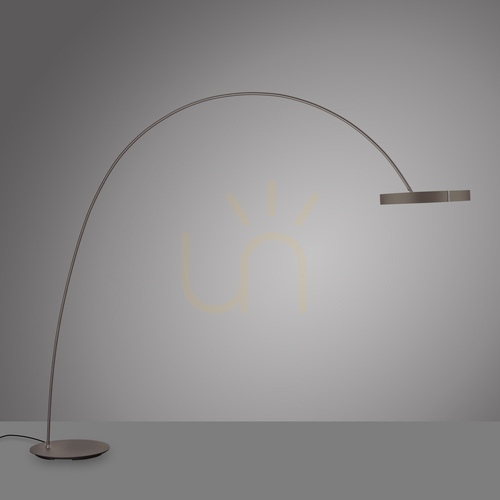
A broad shade can balance a substantial sofa, while a slim profile leaves more of the room visible. Black metal creates a clear outline against a pale wall; a lighter finish may blend more quietly into the same background. Brushed, polished and matt surfaces also respond differently to daylight, so compare the finish as well as the colour name.
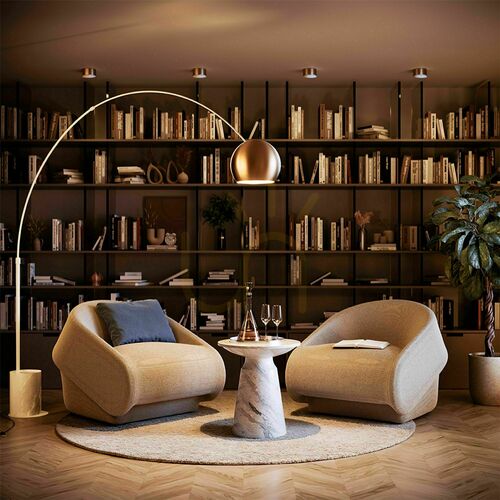
In an open-plan room, the sweep of an arch can help define the sitting area. Consider its relationship with the dining pendant, shelving and the view through the room. Two large shades at a similar height may compete visually even if both fit physically. A smaller arch or a more open shade may make the arrangement feel easier.
The same practical approach works beside a window. Leave room for curtains to move, for the window handle to turn and for the area to be cleaned. A lamp that fits the room’s daily routines will be easier to live with than one positioned only for its appearance.
Cleaning and moving a curved floor lamp
Use the care instructions for the actual finish. Natural stone, lacquered metal, glass and fabric can require different treatment, and a cleaner suitable for one surface may mark another. Disconnect the lamp before cleaning and allow the light source to cool. Keep moisture away from electrical parts.
Move the lamp using the support points described in its instructions. Lifting a heavy assembly by its shade or the end of its arm places stress on joints that were not designed as handles. After moving it, check the base, fixings and cable before returning it to use.
Questions about arc floor lamps
Can an arc floor lamp work in a small living room?
Yes, if its footprint and reach fit around the furniture. Mark the base position first and check the overhead path of the arm. A compact arch can work well beside a chair; a larger design needs more clearance even when its base fits neatly into a corner.
Where should the shade sit for reading?
Position it so that light reaches the page without exposing the bright source directly to your eyes. Check the result from your normal seated position. Shade depth, direction and brightness matter as much as the height of the lamp.
Will the base slide under my sofa?
Compare the base thickness with the clearance below the sofa, then check where the upright begins. The upright may stop the base from moving further in. Use the actual drawing rather than assuming a flat-looking base will fit.
Are all arched floor lamps adjustable?
No. Some have a fixed curve; others adjust at one or more points. Check height, reach, shade movement and dimming separately. A product described as adjustable may offer only one of those functions.
Does an LED arc lamp always have a dimmer?
No. LED identifies the light source technology. Dimming depends on the fitting, driver and control arrangement. For replaceable bulbs, confirm compatibility with any dimmer already built into the lamp.
Can an arc lamp replace a pendant over a coffee table?
It can light the same area without a ceiling fixing if it has enough reach. It also needs floor space, a cable route and suitable clearance around the shade. Compare those practical requirements with the lighting effect you want.
Is a stone base automatically more stable?
Stability depends on the whole design, including weight, dimensions and the arm’s mounting. A material name is not a stability guarantee. Use the lamp on a suitable surface and assemble it exactly as instructed.
What should I compare first?
Compare the base position, horizontal reach and shade location before choosing the finish. Once those work, check the light source and controls. If another shape would suit the room better, explore the wider choice of floor lamps using the same room measurements.