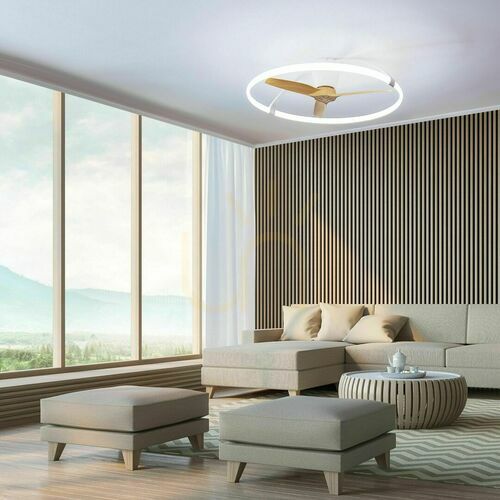
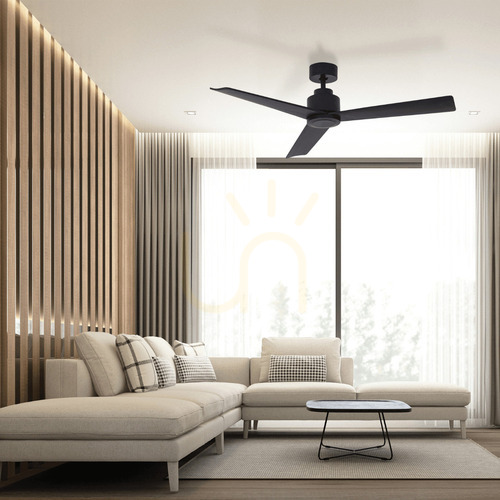
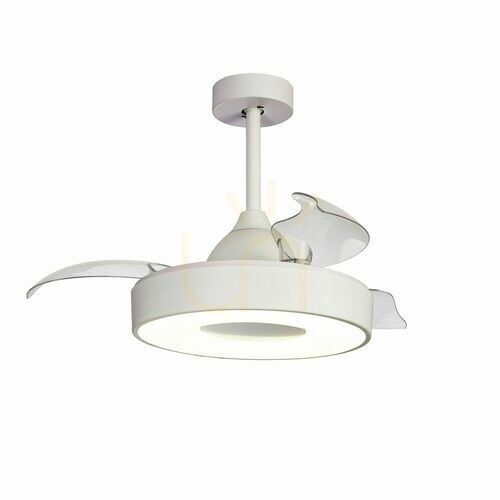
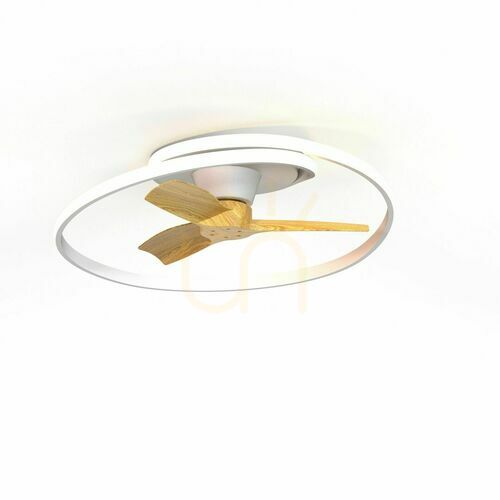
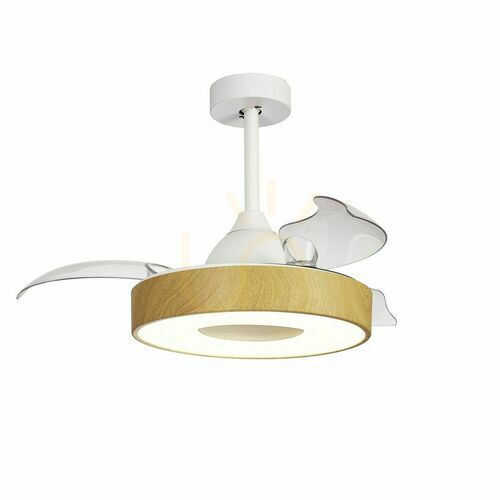
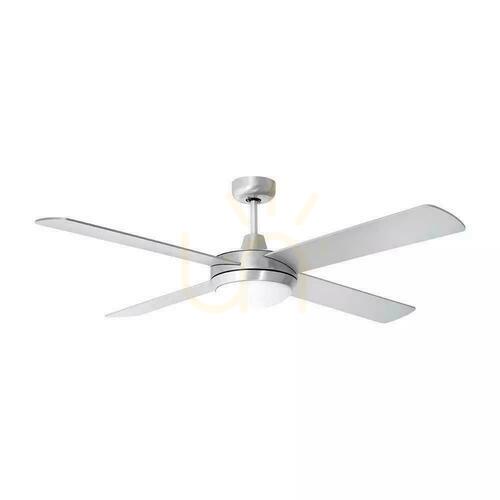
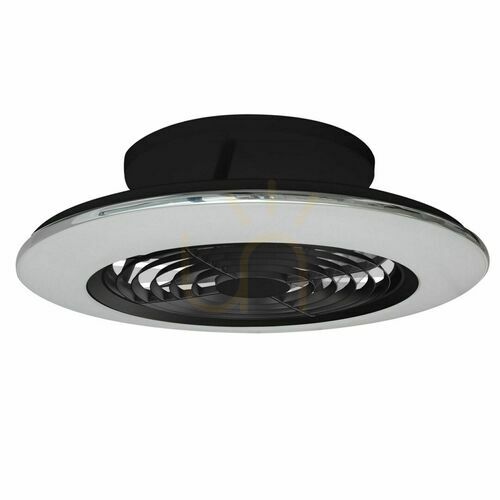
A ceiling fan with light does two jobs from a single ceiling rose: it lights the room like an ordinary ceiling fitting and moves the air at the same time. Instead of a pendant and a separate fan competing for the same spot, one fitting hangs from one fixing and answers to one remote. In summer the moving air lowers the temperature you actually feel; in winter the reverse setting pulls the warm layer back down from the ceiling. That second job is why a well-chosen fan light earns its place all year, rather than for the fortnight in July when everyone remembers they own one.
What a ceiling fan light is made of
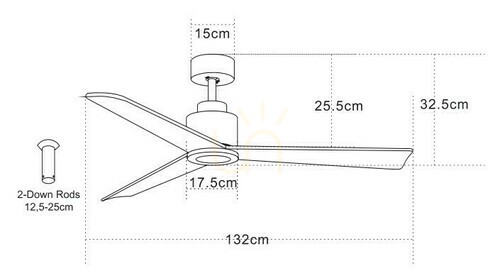
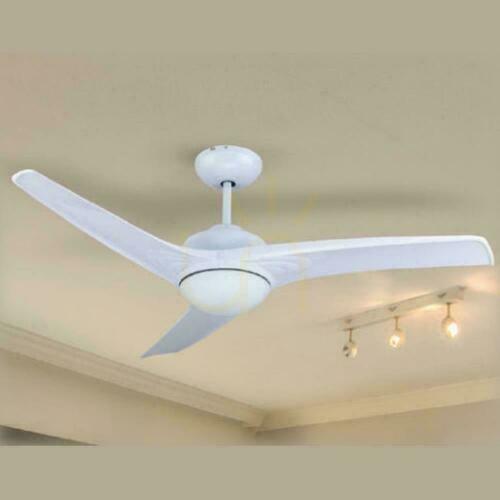
The anatomy has barely changed in decades. At the top sits the canopy, covering the fixing and the wiring. Below it the motor housing, with the blades bolted to it — usually three or five, though two-, seven- and nine-blade models exist. Inside or beneath the housing sits the LED module behind a diffuser of acrylic, etched opal glass or frosted polycarbonate.
One expectation worth setting straight: a ceiling fan does not cool the air. It moves it. The airflow speeds up evaporation from your skin, and that drops the perceived temperature by roughly 3–4 °C. You feel it while you are in the draught and not otherwise, so running one in an empty room achieves nothing. The energy story, though, is not close: the motor draws 15–58 W depending on type, and far less than that on the lowest speed.
Fan or air conditioning?
If a top-floor flat faces south and the living room still reads 30 °C at eight in the evening, air movement alone will not fix it. In a bedroom, home office, kitchen or child's room the maths is different: the goal there is comfort, not knocking eight degrees off the thermometer. And comfort arrives without an outdoor unit, a core drill through the wall, a freeholder's consent or an annual service. Nothing dries the air out, and no compressor hums in the background. Plenty of homes run both: the air conditioning cools, the ceiling fan spreads that cool air around, and the unit can then sit a degree or two higher and use less electricity.
Types of ceiling fan with light
-
Flush mount (hugger, low profile) — the body sits tight to the ceiling, with an overall drop from 16 to 20 cm. The answer for standard 2.4 m ceilings and for stretch ceilings.
-
Standard mount with a downrod — rods of 102, 114, 152, 203 or 305 mm set the blades away from the ceiling. Essential in tall rooms and on any sloped ceiling, so the fan hangs true.
-
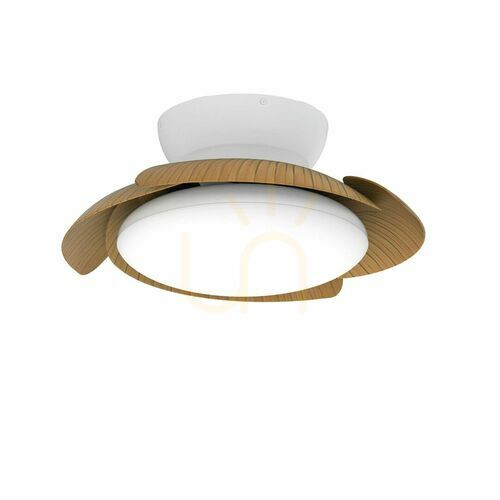
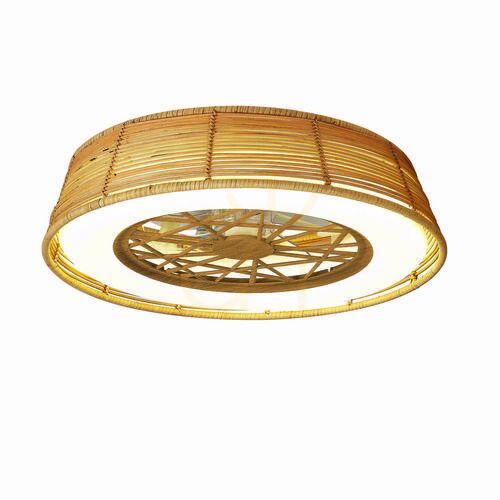
Retractable blade — switched off it reads as a plain ceiling light of 43–52 cm; switched on the blades extend to 90–106 cm. Useful where you would rather not look at a fan for nine months of the year.
-
Chandelier style — a substantial shade, crystal or several light points, with the mechanism folded into the decoration.
-
Wood and rattan blades — polycarbonate in a wood finish or genuine rattan weave, for boho, japandi and Mediterranean rooms.
-
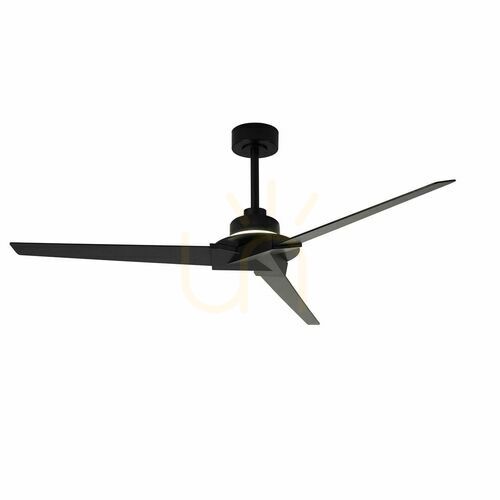
DC designer models — slim housing, three reversible blades, app control. The quietest and most frugal fittings on the market.
Blade span and room size
Of everything on a ceiling fan with light, this is the number not to guess at. Too small a span in a big living room means a fitting that spins hard and achieves little; too large a span in a small bedroom gives you a draught instead of a breeze. The spans that keep appearing across the category are 38, 66, 75, 105, 122, 132, 142 and 152 cm, with retractable models quoting ranges such as 45–91 cm or 51.5–106 cm.
Blade span by room area
Room areaBlade spanTypical room
up to 10 m²up to 34" (86 cm)box room, cloakroom, small bedroom
10–20 m²42"–52" (107–132 cm)main bedroom, dining room, home office
20–30 m²52"–56" (132–142 cm)open-plan kitchen-diner, large living room
30–50 m²56"–72" (142–183 cm)barn conversion, large open-plan space
over 50 m²72" (183 cm) or two fittingshall, restaurant, commercial space
The table assumes a roughly square room. Long, narrow rooms are better treated as two squares with a fitting in each — a 10 × 4 m space wants two 107 cm fittings rather than one enormous one in the middle. Keep at least 60–70 cm between the blade tips and the nearest wall, wardrobe or sloping eave.
Ceiling height and downrod length
The safety line is 2.1 m (7 ft) from floor to blades, and the comfortable band is 2.4–2.7 m — high enough that nobody ducks, low enough that the airflow reaches people rather than dispersing. Above the blades you want 25–30 cm of clearance to the ceiling, otherwise the fan cannot draw air in and simply makes noise.
Mounting by ceiling height
Ceiling heightMountingDownrod
under 2.4 mflush mount / huggernone
2.4–2.7 mstandard mount102–114 mm
2.7–3.0 mstandard mount152 mm
3.0–3.7 mdrop mount203–305 mm
sloped ceilingangled mount with sloped-ceiling adaptorrequired; check the model's maximum pitch
Models rated for stretch ceilings have a flat canopy and a shallow overall drop. The catch is that a load-bearing plate has to go in above the membrane before it is tensioned — it cannot be added afterwards.
DC or AC motor
The AC motor is the traditional choice: simple, robust, driven by a pull cord or remote, usually with three or six speeds. The DC motor needs control electronics but returns six to eight speeds (ten on some app-controlled models), a soft start, markedly lower consumption and a few decibels less noise.
AC and DC compared
FeatureAC motorDC motor
Speeds3 or 6, plus reverse6 to 8, plus reverse
Motor power draw50–105 W15–58 W
Noise36–45 dB33–49 dB across the range; barely audible on speed 1
Controlpull cord, remote, wall control2.4 GHz RF remote, Bluetooth, app
Start-upsteppedsmooth, remembers the last setting
For a bedroom the DC premium is almost always worth paying. On the lowest speed you genuinely cannot hear it, and that single fact decides whether the fitting runs at night or gets switched off after a week.
Winter mode, and what reversing the blades really does
Warm air collects under the ceiling; in a room three metres high the difference between floor and ceiling can be several degrees. In winter mode the blades turn the other way and stay slow, easing that warm layer down the walls without anyone feeling a draught. Radiators and underfloor heating then have less to do. On a spec sheet the feature appears as reverse function, reversible direction or summer/winter mode. Some models add reversible blades with a different finish on each face — flip them and the fitting changes colour without changing the fitting.
The light: lumens, colour temperature, dimming
Integrated LED modules dominate this category, often as a replaceable unit, rated around 25,000 hours and 10,000 switching cycles. Light output runs from about 940 lm on compact modules to 7,200 lm on large chandelier-style fittings. A bedroom is comfortable on 1,500–2,500 lm; a 20 m² living room wants 3,000–4,500 lm if the fitting is doing the main lighting on its own.
Colour temperature is either fixed — usually a warm 3,000 K — or adjustable. Tuneable models cover 2,700–5,000 K, 3,000–6,500 K or 2,700–6,500 K, so you can run cool and alert in the morning and warm white by evening. Almost everything here dims from the supplied remote, and colour rendering is typically Ra 80, which is ample for living rooms and bedrooms. Beam angle is 120° behind directional diffusers or a full 360° behind an opal shade that lifts the ceiling as well.
One detail that catches people out: the wattage on the label is often a combined figure. "50 W (motor 30 W)" means 20 W goes to the light, not 50. When you compare fittings, compare lumens.
Controls: remote, wall, app
A 2.4 GHz RF remote is now standard and comes in the box with most models. It works through walls and does not need pointing. Traditional AC fittings keep a pair of pull cords as well — one for speed, one for the light — which is unbeatable on the evening the remote has disappeared into the sofa.
An app layer is increasingly common on top: Bluetooth plus Tuya or the manufacturer's own app. From a phone you can set schedules and a sleep timer, adjust speed and brightness independently, and pull the fitting into smart-home scenes. If you want a wall control, tell the electrician before first fix: an ordinary lighting dimmer will destroy a fan motor. You need a dedicated fan controller, or two separate circuits so the light and the motor are switched apart.
How loud is a ceiling fan with light, really
Published figures usually sit between 33 and 49 dB, the low end being speed 1 and the high end full tilt. For reference, a quiet bedroom at night is around 30 dB and normal conversation 55–60 dB. In practice most of the noise is not the motor — it is air passing the blades and vibration from a fitting that is not properly balanced. Which gives a useful rule: for the same airflow, a large fan turning slowly is quieter than a small one at maximum.
Fitting a ceiling fan with light, and staying safe
A ceiling fan light weighs several kilograms and adds vibration on top of that, so a hook in a plastic connector block will not do. The fixing has to take a dynamic load: an anchor into concrete, a fan-rated brace, or — on a plasterboard ceiling — a bracket screwed to a joist or to noggins added for the purpose. In a timber floor structure you fix to the joist, never to the board.
Then the details that are easy to miss. Indoor fittings are IP20; a covered terrace, or a bathroom outside the splash zones, needs IP23 or IP44, and UK bathroom zones decide which. Most models are Class I and need an earth. In England and Wales the wiring falls under Part P, so the connection belongs to a qualified electrician — particularly if the light and motor are to be switched separately.
Choosing room by room
Bedroom
Quiet and soft light win here. Look for a DC motor, a 107–122 cm span, dimming and 2,700–3,000 K for the evening. A timer that cuts the fan an hour after you fall asleep often matters more than anything else on the spec sheet.
Living room
Reach and looks decide it. A 132–152 cm span, 3,000–4,500 lm, and tuneable colour if the same fitting has to serve both a reading chair and a film night. Retractable-blade models suit rooms where the fan should disappear out of season.
Kitchen and dining
Air movement over an island is welcome, but the blades must clear the swing of the wall units. Smooth diffusers and polycarbonate or painted metal blades wipe clean of cooking film far more easily than woven rattan.
Home office and children's rooms
A 75–105 cm span is plenty; light quality is what matters. Smooth dimming earns its keep, because the same desk does work by day and reading by night.
Covered terrace and conservatory
Higher IP rating and moisture-tolerant blades are non-negotiable. Powder-coated metal or polycarbonate survives a season outdoors far better than plywood.
Cleaning and balancing a ceiling fan
Dust settles on the leading edge of each blade and, after a season, changes how the set is balanced. Wiping the blades from hub to tip with a damp cloth once a quarter, with the power off, is the whole maintenance routine. If the fitting starts to rock at high speed, it is almost always one of three things: loose blade screws, a canopy tightened unevenly against the ceiling, or one blade heavier than the rest. The last is what the balancing kit in the box is for — a small adhesive weight on the top face of a blade.
The LED module in these fittings is usually replaceable, so the end of the diodes is not the end of the fan. It is worth checking before you buy, because a permanently potted module eventually leaves you with a working fan that no longer lights anything.
Frequently asked questions
What size ceiling fan do I need for my room?
Up to 10 m², a span up to 86 cm (34"). Between 10 and 20 m², 107–132 cm (42"–52"). Between 20 and 30 m², 132–142 cm (52"–56"). Above that, 142 cm and up, or two fittings.
How low can it hang — what is the minimum height above the floor?
Blades must clear 2.1 m (7 ft) from the floor. Aim for 2.4–2.7 m if the ceiling allows, and keep 25–30 cm between the blades and the ceiling above.
Do I need an electrician to fit one?
For the electrical connection, yes — it is notifiable work under Part P in England and Wales. The fixing also needs someone who can judge whether the ceiling structure will carry a moving load.
Can I fit one where there is already a ceiling light?
Electrically that is usually straightforward, since the lighting circuit is already there. Mechanically it depends: a standard ceiling rose is designed for a light, not for several kilograms of vibrating fitting, so the fixing normally has to be upgraded.
Will it work on a sloped ceiling?
Yes, with a sloped-ceiling adaptor and a downrod so the fan hangs vertically. Each model quotes a maximum pitch — check it before ordering.
What is the difference between a hugger fan and a standard one?
A hugger, or flush mount, bolts straight to the ceiling with no rod, giving the shallowest possible drop for low ceilings. A standard mount uses a downrod, hangs lower and moves air more efficiently because it has room to draw from above.
AC or DC motor — which should I choose?
DC for quiet rooms and for anyone who will run the fan at night: fewer watts, more speeds, softer start. AC where simplicity and a pull cord matter more than the last few decibels.
How much electricity does it use?
The motor takes 15–58 W on DC and up to about 105 W on a large AC model at full speed, dropping to a handful of watts on speed 1. The LED adds 8–85 W depending on module size.
What does reverse mode actually do?
It turns the blades the other way, slowly, so warm air trapped at ceiling level is eased down the walls instead of being blown at you. The room evens out and the heating works less.
Can I replace the LED, or is it integrated?
On most models the LED is integrated but supplied as a replaceable module. A few are permanently sealed — the spec sheet will say which.
Is the light dimmable, and can I change the colour temperature?
Dimming from the supplied remote is near-universal in this category. Adjustable colour temperature comes with CCT models, typically 2,700–5,000 K or up to 6,500 K.
How noisy is one in a bedroom?
Around 33–36 dB on the lowest speed, which sits below a quiet room's own background with the window shut. Expect 45–49 dB at full speed.
Can I put one in a bathroom or a conservatory?
Only with a suitable IP rating for the zone — IP44 for a bathroom position outside the immediate splash zones, and a moisture-tolerant blade material for a conservatory or covered terrace.
Five steps to the right ceiling fan with light
- Measure the room area and take the blade span from the table above.
- Measure the ceiling height and decide between a flush mount and a downrod.
- Pick the motor — DC wherever quiet matters, AC where simplicity does.
- Check the light: lumens matched to the floor area, dimming, and tuneable colour if you want it.
- Confirm the ceiling will carry the load, and choose the control to match how the room is actually used.
Work through those five and the fitting you end up with will still be doing its job in fifteen years. If you need cooling without a luminaire — tower, pedestal and desk models — those live in the fans category instead.