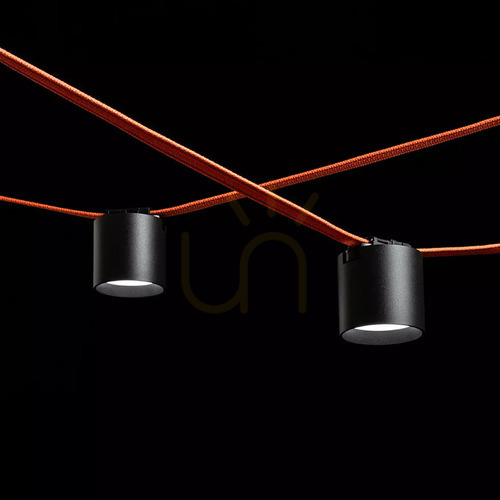
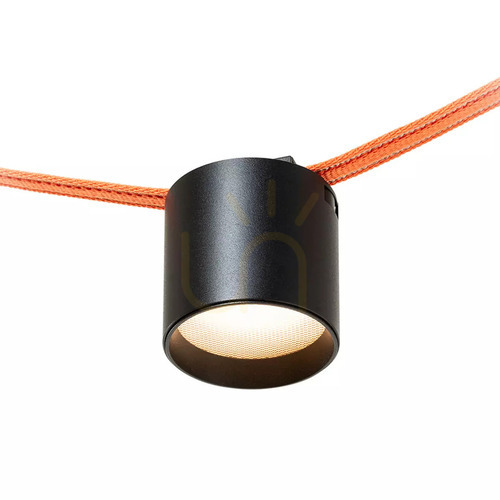
Cable lighting carries low-voltage power along two thin, tensioned wires – or a flat conductive band – stretched across a room, and the lights simply clip on wherever you want them. Often called wire lighting or tension wire lighting, it puts spotlights and small pendants exactly over a table, a worktop or a picture, even where the ceiling has no light point in the right place.
Because the conductors are so slim, the system almost disappears: what you see is a line of small lights floating in the air, which suits lofts, high and sloping ceilings and open-plan rooms in particular.
How a cable lighting system works
A transformer or LED driver turns 230 V mains into extra-low voltage, usually 12 V or 24 V. From there, power runs along the two wires, which are kept apart by spacers and pulled tight between wall or ceiling brackets with tensioners. Each light head bridges both conductors with its clips, so it can slide along the run or move to another spot later. Deflectors and ceiling drops change the direction or height of the wires, letting a run turn a corner or come down lower over a dining table.
Some systems replace the round wires with a fabric band that has the conductors woven in. It hangs in soft lines or stretches straight, and the lights clip onto it in the same way.
What to plan before you buy
| Element |
What to check |
| Voltage |
12 V or 24 V – heads, wire and transformer must match. |
| Transformer or driver |
Its rating should exceed the combined wattage of all heads, with spare capacity of roughly 20–30 %. |
| Run length and route |
Measure wall to wall and note where it must turn or drop; longer runs need solid fixing points and more tension. |
| Light heads |
Small spots for accent light, pendants over tables; with replaceable low-voltage lamps or integrated LED. |
| Ingress protection |
Most systems are IP20, for dry indoor rooms only. |
Warm white around 2700–3000 K suits living spaces, while 4000 K helps over a kitchen worktop. Some heads let you switch colour temperature or work with a smart-home app.
Installation and safety
The transformer connects to the 230 V supply, so that part is a job for a qualified electrician. The wires themselves carry safe extra-low voltage, but they must be tensioned properly and fixed into sound masonry or joists – plasterboard alone may not take the pull. Keep the run high enough that nobody can grab it or bridge the conductors with a metal object, and never hang anything other than the system's own lights on it.
Care
Dust the wires and heads with a dry cloth with the power off. If the wires start to sag over time, re-tighten the tensioners; a run that sags too much can let the heads slide together.
Frequently asked questions
What is a cable lighting system?
It is a set of tensioned low-voltage wires with a transformer, onto which you clip spotlights or pendants. The lights can be positioned freely along the run.
What type of wire is used for cable lighting?
Only the conductor wire or band made for the system, with its own brackets, spacers and connectors. Ordinary household cable or picture wire cannot be substituted.
Is tension wire lighting safe?
Yes, when installed correctly: the wires carry extra-low voltage, and the transformer is protected and connected by an electrician. Keep the run out of reach.
Can cable lighting go on a sloping ceiling?
Yes – that is one of its strengths. The wires can follow the slope or run level beneath it, with drops bringing them down where needed.
See ready-matched cable lighting sets, or individual lamps for cable lighting.