LED candles make it possible to enjoy a candlelit effect without lighting a wick. They can soften a dining table, pick out a quiet corner or add a glow inside a decorative lantern. The best choice depends on more than whether the candle is white or ivory: the shape of the flame, the finish, the viewing angle and the way you switch it on all affect how convincing and convenient it feels at home.
This category concerns self-contained electric candles, rather than candle-shaped bulbs for a chandelier or empty candle holders. Start with the place you want to decorate. A broad pillar on a mantelpiece, a slender taper in a candlestick and a tiny tealight in a glass holder each have different practical requirements. Getting that basic fit right makes it easier to compare the details that matter.
Choose the effect you want to see
A flickering LED and a moving flame are different features. Flicker changes the intensity of the light, while a moving-flame design uses a physical flame-shaped element as part of the effect. Some candles combine the two. If movement is important to you, look for an explicit description of it rather than assuming that every flickering candle has a moving part.
Think about where the candle will sit in relation to your eyes. A deeply recessed light can look attractive from above but be less visible from across a room. A raised flame may be more noticeable on a shelf. If a lantern can be seen from both sides, consider how the candle looks from those directions as well. A single front-facing product photograph cannot show every viewing angle.
For a dining table, a gentle effect may be easier to live with than very conspicuous changes in brightness. In a group, differences between the candles can become more obvious. Match the light colour and the type of effect as carefully as the colour of the bodies if you want a coherent arrangement. Alternatively, give distinct designs enough space to read as separate objects.
| Feature |
What it describes |
What to check |
| Steady light |
A relatively constant decorative glow |
Light colour and how visible the light source is |
| Flickering effect |
A changing light intensity |
The stated effect rather than an assumed moving flame |
| Moving flame |
A physical element used to imitate a flame |
Viewing sides and clearance above the candle |
| Remote control |
Operation without reaching the candle |
Compatibility and the functions actually provided |
Real wax, plastic or a glass surround?
A real-wax body can be appealing even when the candle is switched off. The surface may be smooth, textured or shaped to suggest melted wax. It is still wax, however, so heat and direct sunlight can affect it. A sunny windowsill, a position beside a radiator or a hot conservatory deserves particular care. Follow the permitted temperature and placement guidance for the individual candle.
Plastic versions can suit a lighter, more practical decorative arrangement. The material alone does not make a candle suitable for the garden. Outdoor suitability depends on the complete construction and the protection of the electrical parts. Painted or coated surfaces also need appropriate cleaning: do not assume that every household cleaning product is safe for the finish.
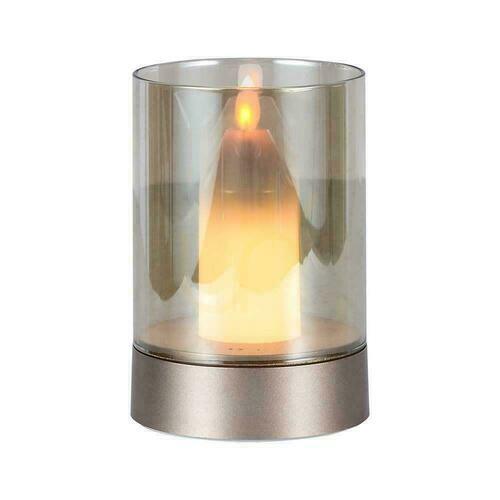
A candle enclosed in glass adds another layer to the appearance. Clear glass, coloured glass and textured surfaces each change reflections and the way the light is seen. Treat the glass and the candle as one object when checking dimensions. If you intend to put the whole piece inside another lantern, allow for the outer glass rather than measuring only the candle-shaped part.
Pillars, tapers and tealights need different spaces
Pillar candles have a broad visual presence and work well on a level tray or other suitable surface. A mixture of heights can produce an informal arrangement, but the pieces still need stable support. Leave room around each body so that its outline remains visible. A crowded display can make a subtle flame effect harder to appreciate.
Taper candles need a candlestick that fits the base. Compare the diameter of the lower section with the holder's opening and check whether the design requires a particular support. A loose taper should not be balanced in an oversized socket, and an oversized base should not be forced into a narrow one. Stability matters even though the candle does not have a burning wick.
LED tealights can create small pools of light in low holders, but they do not necessarily match the dimensions of ordinary wax tealights. Check the full height, including the flame, as well as the diameter. A deep opaque holder can conceal most of the effect. Also consider how easily you can reach the switch or remove the tealight to change its battery.
Measure a lantern from the inside
The outside width of a lantern is not the same as its usable floor space. Measure the level area on which the candle will stand, the doorway and the clear height below any roof or crossbar. Hinges, a raised inner platform or a narrow opening can reduce the available space. Check whether the quoted candle height includes the flame element.
It should be possible to insert and remove the candle without bending its flame or scraping its finish. This becomes particularly important when the switch and battery compartment are underneath. A candle that only fits when tilted sharply may look attractive once installed but be awkward to use. A little extra clearance often gives both a better view and easier handling.
On a dining table, try a simple object of similar height and width before choosing. It helps show whether people can see each other and whether there is still space for plates and serving dishes. The aim is a comfortable setting with a decorative glow, rather than an obstacle running through the middle of the meal.
Battery choice is part of the purchase
Battery-operated candles can be placed away from a socket, but their battery requirements vary. Check the exact type and number of cells. AA, AAA and button cells are not interchangeable, and two candles that look alike may have different compartments. Find out whether the batteries are included and how the cover is secured.
If you are putting together a group, add up the requirements for the entire arrangement. Each candle may need its own cells and its own settings. Easy access to the battery compartment is useful when the display sits inside a lantern or on a high shelf. Do not make a permanent arrangement that has to be dismantled simply to reach a small switch.
Rechargeable designs require the specified charging method. A charging base for one set is not automatically suitable for another candle of a similar size. Likewise, rechargeable loose batteries should only be used where the candle's instructions permit them. The correct equipment matters more than a superficial similarity between connectors or compartments.
| How you will use the candles |
A useful question before choosing |
| Every evening on a mantelpiece |
Will a timer avoid having to reach each switch? |
| Several candles on a table |
How many batteries does the whole group require? |
| Inside a tall lantern |
Can the candle be removed easily for battery changes? |
| Regular charging |
Which charger or charging station is specified? |
Understand what the timer actually does
A timer may switch a candle off after a set period, or it may run a repeating daily cycle. Those are different forms of convenience. For example, a stated six-hour-on and eighteen-hour-off cycle describes one particular setting; it is not a standard shared by all LED candles. Read the timing information for the specific model.
With a repeating cycle, the time you activate the setting usually matters. If you want the candles to glow during dinner and later in the evening, set them up at the appropriate point in the day according to the instructions. Check whether battery changes reset the programme. Knowing this beforehand makes a timed display easier to maintain.
A remote control is useful for a group of candles or an awkward shelf, but it is not automatically supplied. Confirm whether it is included, which candles it can operate and which commands are available. Dimming, choosing a flame effect and setting a timer are separate functions. A remote for one design should not be assumed to work with an unrelated one.
How bright should a decorative candle be?
LED candles are primarily decorative lights. Keep appropriate lighting for reading, preparing food and moving safely through the room. A small flame effect can be difficult to notice beside a bright table lamp, yet look much more prominent when the surrounding lighting is lower. Consider the room as a whole when deciding where to place it.
Warm light often suits the impression of a flame. If a colour temperature is stated in kelvins, it can help compare the intended tone, but a photograph is not an accurate colour measurement. The camera, screen, surroundings and any tinted glass can all alter the impression. Look for the written lighting information as well as the picture.
Outdoor use needs an outdoor-rated candle
A porch roof or a decorative lantern does not automatically protect an indoor candle from moisture. Wind-driven rain, condensation and changing temperatures can still affect it. Choose a model explicitly intended for the conditions in which it will be used, and read its protection rating together with the complete placement instructions.
Where there is a separate power supply or connection, every part needs an appropriate location. A protected candle body is not sufficient if another component is left exposed to water. In a bathroom, follow the same principle: decoration is still an electrical item, so suitability and distance from water remain relevant.
Care for the finish and the electrical parts
Use the cleaning method recommended for the material. Gentle dusting or careful wiping may be appropriate, but electrical parts should not be immersed. Avoid using the flame element as a handle and do not force a moving part. Lift the candle by its body and take particular care with glass surrounds and delicate wax surfaces.
When storing the decoration, protect it from heat, pressure and scratches. Follow the battery guidance for longer periods without use. Loose batteries, especially small button cells, must be kept away from children, and the compartment should remain correctly secured. An imitation flame does not make a decorative electrical product a toy.
Before buying, a short checklist is useful: suitable dimensions, the preferred flame effect, a finish suited to the location, the correct power source and a convenient way to operate it. A feature-rich candle is only helpful when those features serve the way you will actually use it.
Questions about LED candles
Are all LED candles made from real wax?
No. Bodies may use wax, plastic or other materials, and some designs include a glass surround. Check the description of the individual candle, especially if its daytime appearance and texture are important to you.
Is a flickering candle the same as a moving-flame candle?
Not necessarily. Flicker can come from changes in the light alone. A moving-flame design also uses a moving physical element. Look for that feature to be specifically stated.
Can I use an indoor candle outside inside a lantern?
Only where the candle itself is suitable for the conditions. A decorative lantern may have gaps and can collect condensation. It does not provide an automatic outdoor rating for whatever is inside it.
Does a timer turn the candle on again the next day?
Only if a repeating daily programme is provided. Some timers simply switch the light off after a period. Check the cycle, the activation method and any reset needed after changing batteries.
Will one remote operate all my candles?
That depends on compatibility. Similar appearance is not a guarantee. Confirm which models the remote supports and whether it controls only power or also settings such as brightness and timers.
How do I choose a candle for a lantern?
Measure the internal floor, doorway and available height. Allow room for the flame and for lifting the candle out. Easy access to the switch and battery cover is as important as the appearance.
Can real-wax LED candles sit in direct sunlight?
Follow the temperature and placement limits for the product. Wax can soften or change shape in heat, even though the candle has no burning wick. A sunny windowsill may therefore be unsuitable.
Can an LED candle replace a reading lamp?
It is usually intended to create a decorative effect. Use an appropriate lamp for reading and other tasks, and let the candle add a separate layer of softer light.
For a surrounding frame that complements the glow, explore decorative lanterns and compare their internal measurements with your chosen candle.