
Christmas Lights and Tree Lighting – How to Choose and Connect Them
Christmas lights can do more for the festive mood than all the baubles put together – as long as there are enough of them, the colour temperature is right and they don’t give up halfway through the evening. Here’s how many lights a tree of a given height really needs, what separates warm white from cool white, how to safely join several strings into one installation and what to watch out for when the lights are going outdoors.

Table of contents
- How many lights does a Christmas tree need?
- Warm or cool white – which colour to pick?
- String, micro wire, curtain or icicles – types of lights
- Connectable lights – joining several strings into one installation
- Outdoor Christmas lights – IP44, power supply and frost
- Lighting modes, timers and smart Christmas lights
- Safety and storage
- Beyond the tree – stars, LED baubles and candles
- Summary
How many lights does a Christmas tree need?
The most common mistake is buying a single 100-light string “to see how it looks” – on an average tree it disappears without a trace. A good starting point is the rule of 100 lights for every 30 cm of tree height above one metre, which in practice means:
- 120–150 cm tree – 100–200 lights (roughly a 5–10 m string),
- 180 cm tree – 200–400 lights,
- 220–250 cm tree – 400–700 lights.
Those numbers give a natural, even effect. If you’re dreaming of a tree densely “woven” with light like a shopping-mall display, feel free to double them – LEDs draw so little power that even 1,000 points cost just a few watts.
Two practical tips for decorating: run the string from the bottom upwards, spiralling deep into the branches (not just along their tips – the tree gains depth), and plan the power feed so the plug ends up at the base, not at the top.
Warm or cool white – which colour to pick?
Light colour is described by its temperature in kelvins, and it defines the whole character of the tree:
- Warm white (2200–3000 K) – golden, “incandescent” light. A classic that suits wood, red, gold and most interiors. If in doubt, pick warm white Christmas lights – it’s the safest choice.
- Cool white (6000–6500 K) – a bluish, “snowy” glow. Striking with silver-and-blue decorations and outdoors, but indoors it can feel sterile.
- Multicolour and RGB – cheerful retro vibes or (in the smart version) any colour from an app.
The most important rule: one colour per tree and per room. Mixing warm and cool white is the fastest way to make even an expensive decoration look accidental. It’s also worth checking the colour of the other lamps in the living room – next to warm household lighting, a cool-white tree will always feel out of place.
String, micro wire, curtain or icicles – types of lights
Beyond the classic string, shop shelves hide several forms, each with its own speciality:
- Classic string lights – the all-rounder for the tree, a stair rail or a wreath garland.
- Micro LEDs on wire – diodes on a thin, bendable copper wire. Invisible by day, in the evening they create the effect of “light floating in mid-air”; also perfect for vases and table arrangements.
- Light curtain – vertical strands hung in a window or on a wall; versions with baubles or moons replace the entire window decoration.
- Icicle lights – uneven drops imitating icicles, a classic for the roof eaves and the balcony.
- Light net – an even grid you simply throw over a shrub or a railing.
You’ll find all of these forms in the Christmas Lights category.


Connectable lights – joining several strings into one installation
A longer run of lights – on a tall tree, along the eaves or on a live spruce in the garden – usually means several connectable strings: the plug of one section clicks into the socket of the previous one, and the power supply is connected only once. Three rules to keep it safe:
- Only join sections of the same system and manufacturer – connectors of different brands aren’t compatible, and voltages can differ.
- Stay within the manufacturer’s segment limit (e.g. “max. 8 strings” or a total diode count). Beyond the limit, the last sections glow dimmer and the first plug works on the edge of overload.
- Cap the unused socket at the end – especially outdoors.
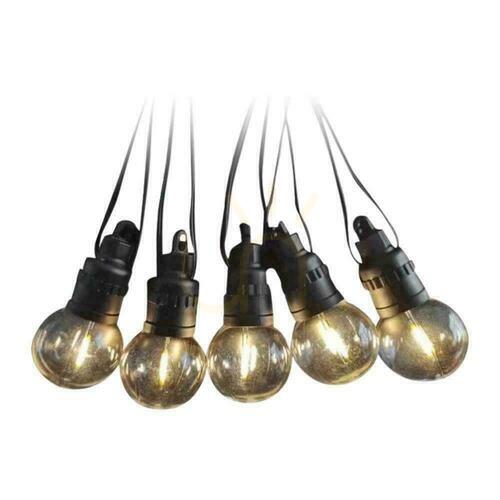
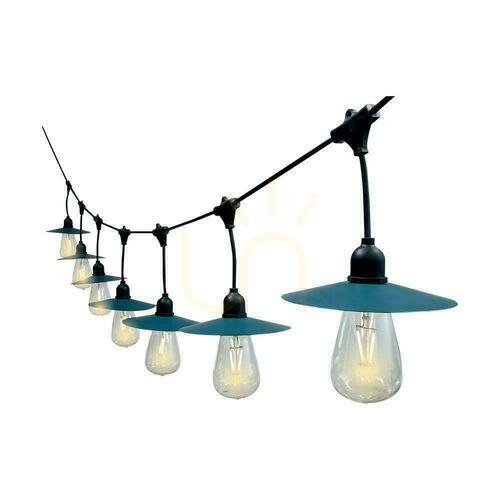
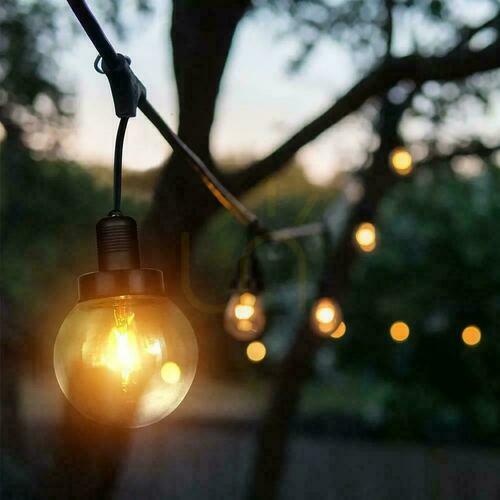
If you prefer large decorative bulbs to tiny diodes, consider a festoon garland – we covered choosing one in our garden string lights guide, and replacement bulbs live in the Bulbs for Outdoor String Lights category.
Outdoor Christmas lights – IP44, power supply and frost
Outdoor Christmas lights have to survive rain, snow and frost, so check three things before buying:
- Ingress protection of at least IP44 – splash resistance from every direction is enough under a roof overhang and on a tree. Strings lying near the ground, on a hedge or fully exposed to the sky are better off in IP65. Note: the IP rating must also cover the power supply and connectors, not just the string itself.
- Low voltage (most often 31 V via a transformer) – safer outdoors than 230 V; place the transformer above the ground, sheltered from water, and protect the circuit with a residual current device (RCD).
- Frost resistance – rubberised cables handle low temperatures far better than plain PVC, which stiffens and cracks in freezing weather.
An alternative to running extension leads is solar lights – just remember that in December the panel gets only a few hours of weak daylight, so glow time will be shorter than in summer (more in our guide to solar lamps in winter). You’ll find the full choice of weatherproof strings in the Outdoor String Lights category.



Lighting modes, timers and smart Christmas lights
Most modern lights come with a controller offering 8 lighting modes – from steady light through gentle waves to rapid twinkling. In practice, steady light or a very slow fade looks the most elegant; leave the dynamic programmes to garden decorations. Check that the controller has a memory function – without it, the lights revert to flashing every time they’re switched on and you have to set the programme again.
A 6/18 timer is enormously convenient: the lights shine for 6 hours, then stay off for 18 – you switch them on once and never think about it again. Smart Christmas lights controlled from an app over Wi-Fi or Bluetooth go a step further: schedules, dimming, colour changes and scenes on every single diode, often with voice assistant support too. You can upgrade an ordinary string in a similar way by plugging it into a socket timer.
Safety and storage
A festive installation runs for a dozen or so hours a day for over a month, so a few rules are worth taking seriously:
- Buy lights with the CE mark and the manufacturer’s details; avoid no-name strings with wires as thin as thread.
- LEDs barely warm up, and they are what belongs on a natural, drying-out tree. Old incandescent sets can get properly hot – if you still use them, replace blown bulbs (usually an E10 base) with identical ratings and never leave them unattended.
- Turn the installation off when leaving the house and going to bed – ideally let a timer do it for you.
- Don’t run cables under a rug or across a door threshold; tuck the extension lead behind the tree, but don’t bury it under the presents.
- After the holidays, wind each string onto a piece of cardboard or a spool instead of stuffing it loose into a box – you’ll save yourself hours of untangling and spare the cables.
Beyond the tree – stars, LED baubles and candles
A tree looks its best when the rest of the home plays in the same key. In the Scandinavian tradition, illuminated stars hang in the windows – paper or metal, warmly glowing star-shaped shades that greet you from the street. Windowsills belong to LED candles: safe, often fitted with a timer and a naturally flickering “flame” – you’ll find them in the LED Candles category. LED baubles with a glowing core and mini LED trees complete the picture, lighting up a hallway or a terrace.


Summary
The recipe for a tree that makes an impression: around 100 lights for every 30 cm of height (double that for a dense effect), one consistent colour – ideally warm white at 2700 K – strings connected within a single system with a margin below the manufacturer’s limit, and outdoors at least IP44 with a low-voltage supply kept above the ground. Add a 6/18 timer or app control and a matching set of decorations: stars in the windows, candles on the sill. You’ll find all the strings, curtains, icicles and stars in the Christmas Lights and Outdoor String Lights categories.
Victoria


Maybe you will be interested in products from these categories?
Christmas Lights, LED Candles, Outdoor String Lights
Tags & Blog Categories