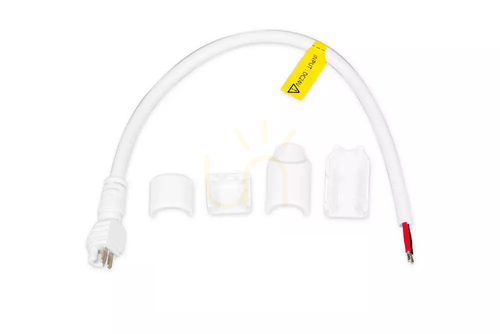
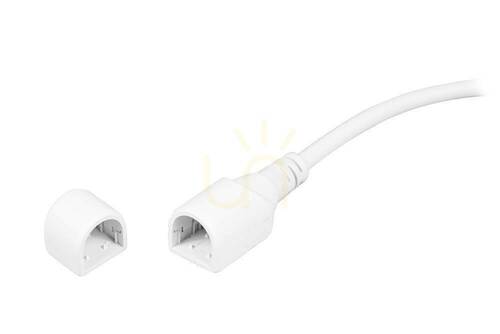
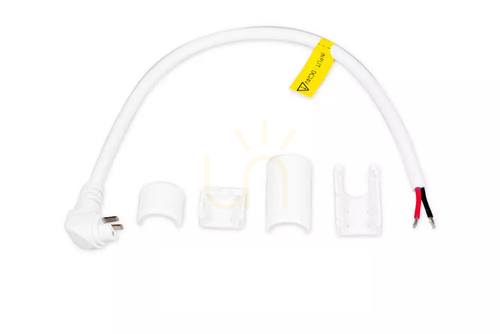
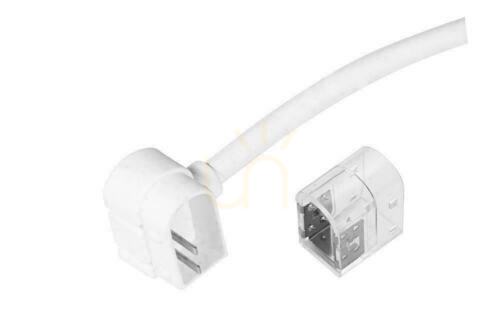
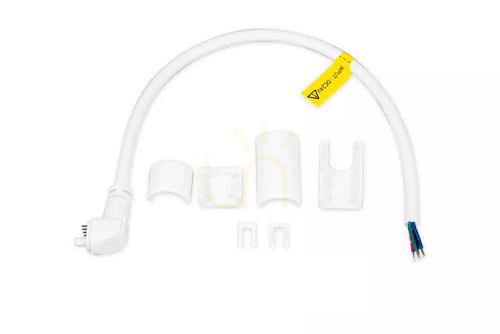
A neon flex power connector is the piece that brings current into a run of LED neon. It pushes onto the cut end of the strip, carries a short lead out to the driver and, together with an end cap at the far end, turns a length of silicone neon into a working, closed circuit.
What a power feed set consists of
A feed usually comes as a small kit rather than a single part: an end piece with metal contacts that slides into the cut end of the neon, a short lead, often around 30 cm, ending in bare conductors, and a cap that closes off the other end of the run. Some sets leave out the lead because it is sold separately, so read the description before you order.
The contacts are what matters. A single-colour strip has two conductors, so its feed has two contacts. RGB neon carries more conductors and needs its own connector, even when the profile looks identical from the outside. A feed is also made for one particular neon cross-section, and a feed from a different series will not grip or make contact properly.
Choosing the right connector
| Question |
What to check |
| Which neon is it for? |
The exact strip name and size given on the product page |
| Single colour or RGB? |
Two contacts for single colour, more for RGB |
| Where should the cable leave? |
Straight along the run, or out of the bottom into the mounting surface |
| Which side does the strip bend? |
Side-bending neon has left-hand and right-hand feeds |
| What voltage? |
Low-voltage neon typically runs on 12 V or 24 V DC; the feed must suit the strip |
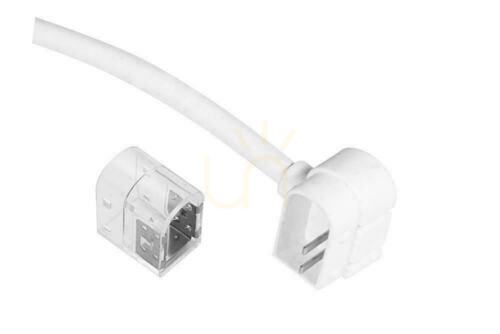
A straight output continues the line of the neon, so leave a few centimetres beyond the end for the lead and its bend. A bottom outlet suits runs that finish tight against a wall, a corner or a shelf edge, because the cable drops straight through the surface behind the strip and stays out of sight.
Fitting and sealing
Cut the neon only at its marked cutting points, and make the cut clean and square with sharp snips. Push the feed in until it stops, so that the contacts sit fully on the conductors inside. For some neon series the feed clips on without soldering; check what the maker says for yours. The lead then goes to a driver of the right voltage, sized for the total length of neon on that circuit. The driver is bought separately, and its mains side is a job for a qualified electrician.
Indoors a clipped feed is enough. Outdoors, in bathrooms or anywhere damp, fill the joint and the end cap with clear silicone adhesive. With that extra step some neon systems reach a seal up to IP67, while the plain plastic joint on its own is not waterproof.
FAQ
How do I connect neon flex to the power supply?
Fit the power connector to the cut end, then join its lead to the driver: positive to positive, negative to negative. If you use a dimmer or RGB controller, the neon goes to the controller and the controller to the driver.
Why does my neon not light after fitting the connector?
The contacts are usually not touching the conductors. Recut the end cleanly, make sure nothing is blocking the pins, and push the feed fully home.
Can I feed a run from both ends?
Some neon series allow it on long runs, so the brightness stays even along the length. You then need a feed at each end instead of a feed and a cap.
Can I use these connectors outdoors?
Yes, once the joint is sealed with silicone adhesive and the neon itself is rated for outdoor use.
Pick the strip itself from Neon Flex, and finish each run with matching neon flex end caps.