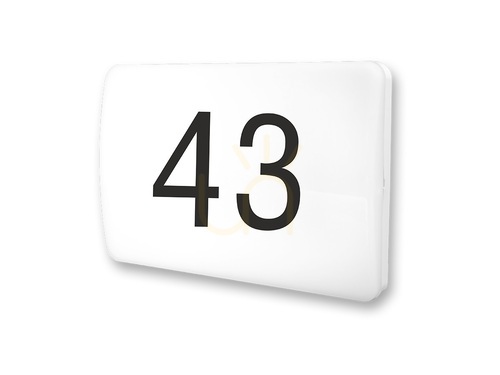
Illuminated house numbers make an address readable after dark, for guests, delivery drivers and, above all, emergency services looking for the right door. A house number light is usually a slim outdoor wall light with a translucent panel on which you stick your own digits, so the number glows together with the light that shows the way to the entrance.
Types of house number lights
-
Mains house number lights with a dusk sensor. Wired to 230 V, they switch on automatically at nightfall and off at dawn, so the number is lit all night at an even brightness.
-
Models with motion and dusk sensors. They keep the number softly lit and switch to full light when someone approaches, so the same fitting lights the path and the door. Some can be set from a phone app over Bluetooth.
-
Solar house numbers. A small solar panel charges a battery during the day and a twilight sensor turns the light on at dusk. They need no cable at all, but the light is dimmer and depends on sunshine.
Many fittings come with a set of self-adhesive digits, and some also with letters, so the same light works for a plain number or one with a letter after it.
How to choose
| What to check |
Typical values |
Why it matters |
| Power supply |
230 V mains or solar with a battery |
mains gives steady light; solar avoids digging a cable |
| Brightness |
a few to a few tens of lumens for solar, about 500–1,000 lm for mains |
a bright model also lights the path and the door |
| Colour of light |
3000 K warm white or 4000 K neutral white |
warm for a traditional house, neutral for clear contrast |
| Protection |
IP44 to IP65, impact up to IK10 |
IP54 or more on an exposed wall, IK10 where it can be knocked |
| Sensor |
dusk only, or dusk and motion |
dusk keeps the number lit all night; motion adds light on approach |
Where to mount it
Put the light where the number can be read from the street or the gate, usually beside the front door or on the gatepost, at around eye level or a little above. A dusk sensor must see daylight: do not hide it under a deep canopy or next to another lamp, which can confuse it. A solar model needs a wall that gets several hours of direct sun. Mains models are connected by a qualified electrician.
Care
Wipe the number panel and, on solar models, the solar cell from time to time, because dust and leaves cut both the light and the charge. Use digits made for outdoor use and press them on firmly on a clean, dry panel.
Questions about house number lights
Are solar house numbers bright enough?
They are bright enough to make the digits readable at night in a sunny spot, but they will not light a path. For a north-facing wall or a lit entrance, a mains model is the better choice.
Should a house number light have a motion sensor?
A dusk sensor alone keeps the number visible all night, which is what visitors and ambulances need. A motion sensor is a useful extra when the fitting also lights the door.
Are the numbers included?
Many house number lights include self-adhesive digits. Check the product page before ordering.
For lights without a number field, see outdoor wall lights.