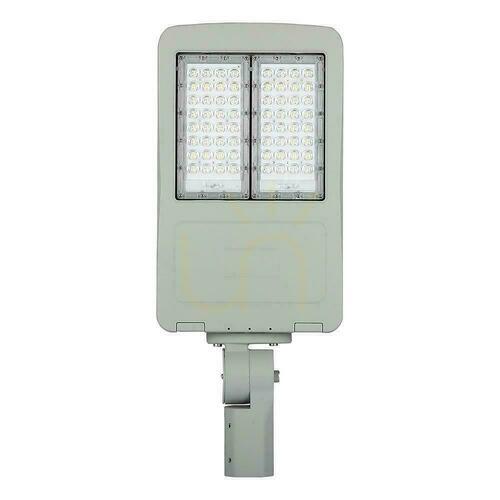
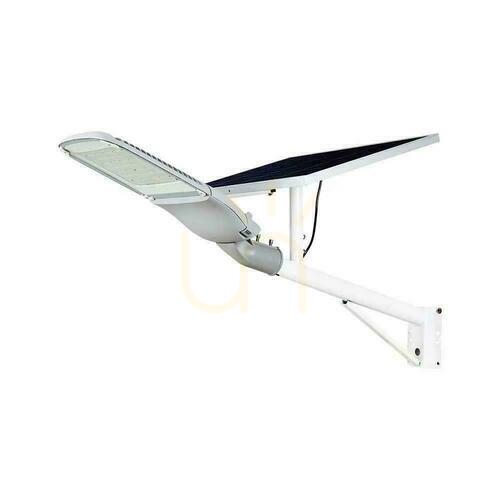
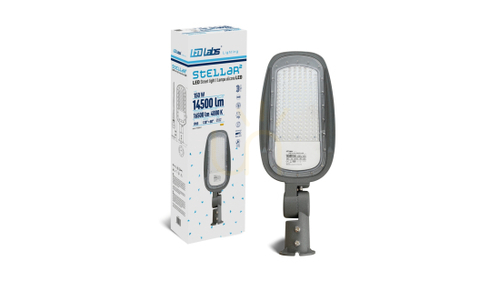
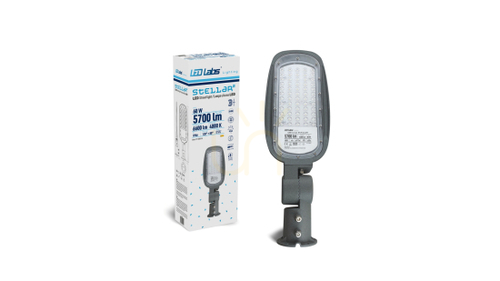
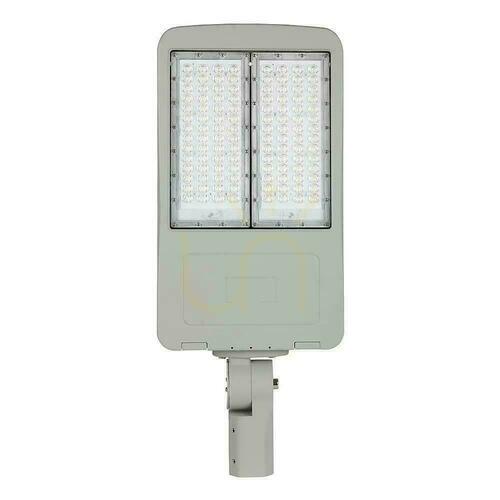
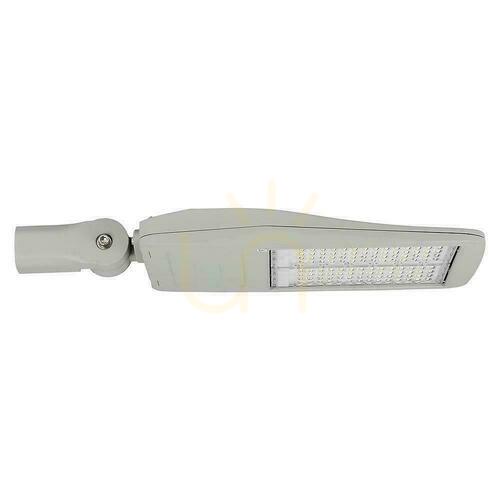
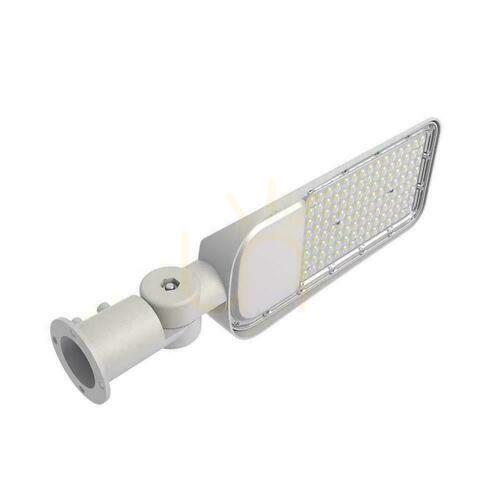
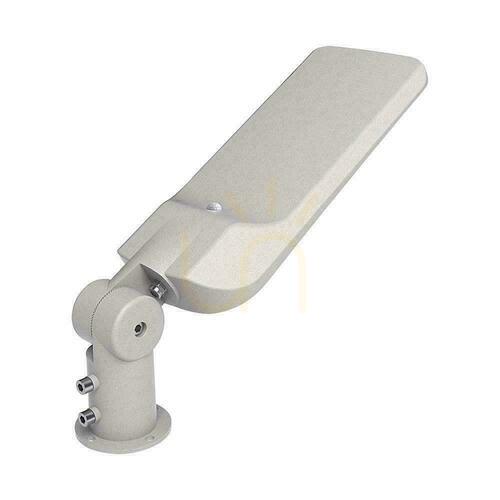
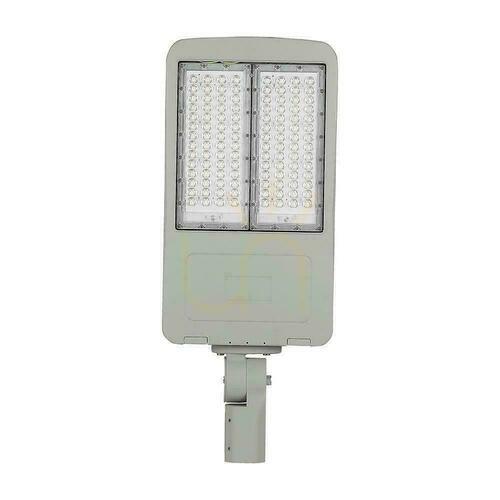
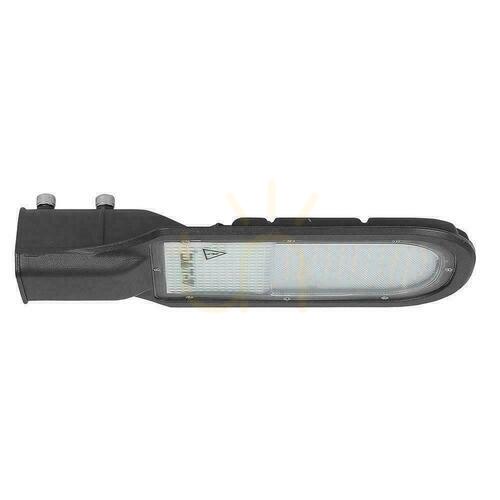
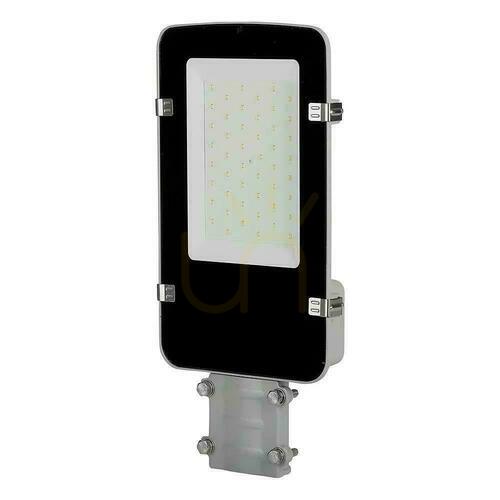
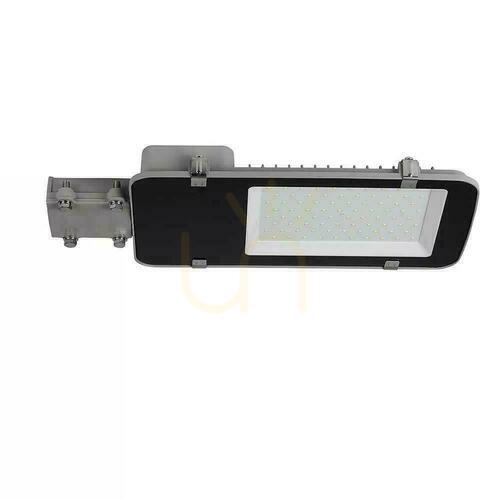
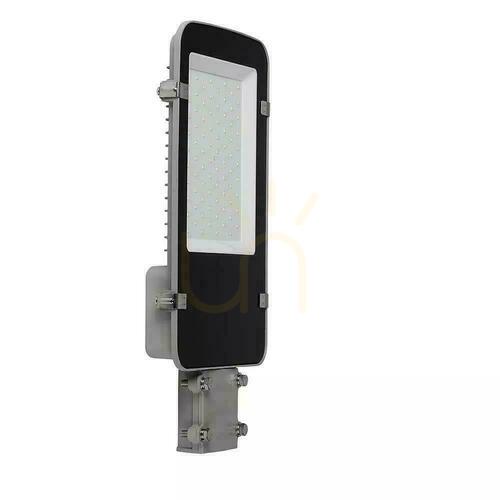
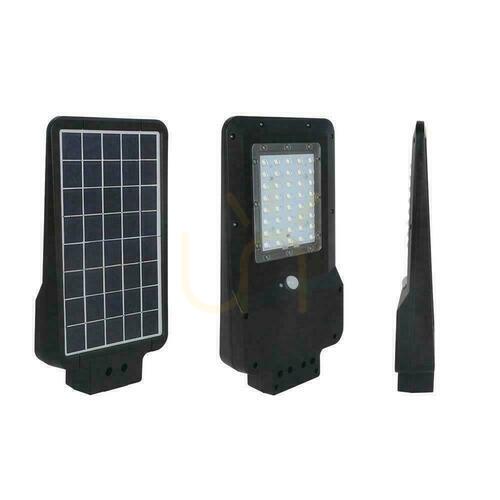
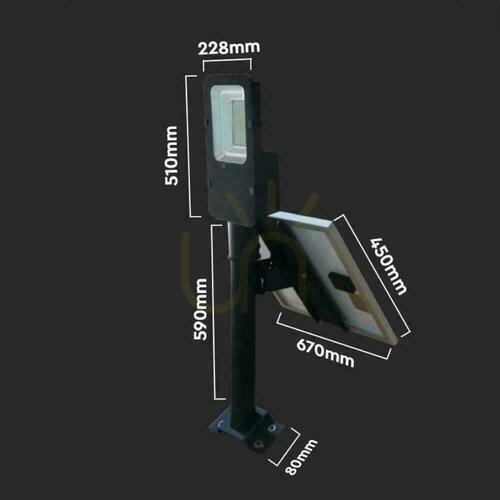
Street lights are the LED heads that sit on top of a column or at the end of a bracket and light a road, a private drive, a car park or a yard from several metres up. Here you will find mains-powered LED street lights for permanent wiring, solar street lights that run without a cable, and hybrid models that combine the two.
A good street lamp puts an even pool of light on the ground where people walk and drive, without glaring into windows or lighting up the sky. Choosing one comes down to a few questions: how high it will be mounted, how wide the area is, where the power comes from and how the light should switch on and off. The sections below take them one at a time.
What is a street light, and what is the column?
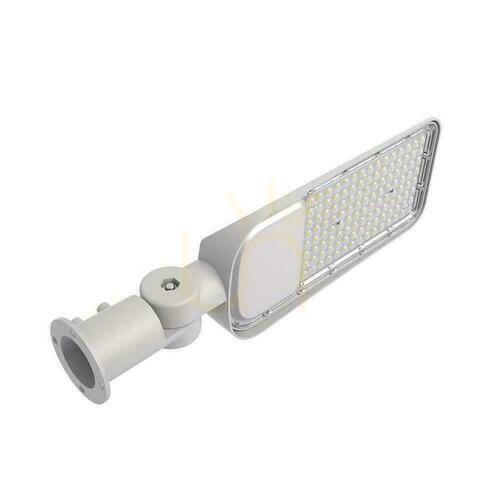
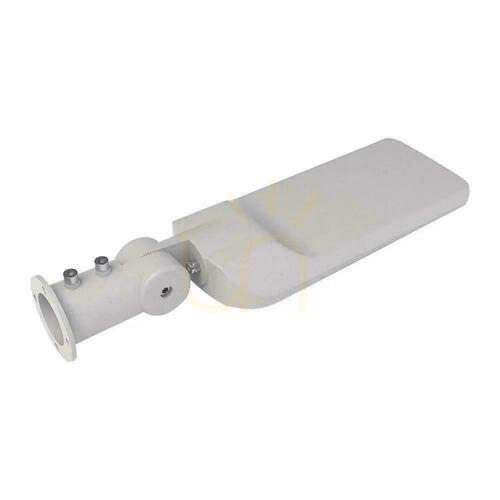
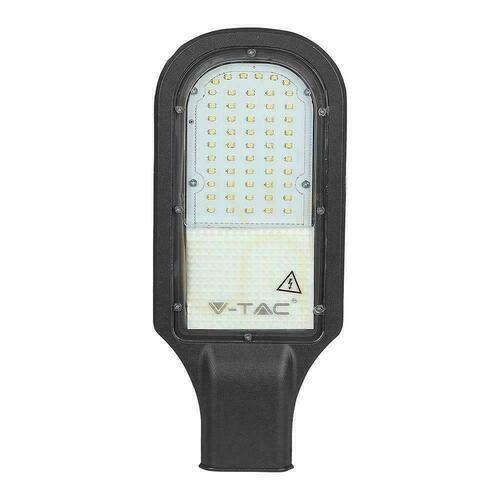
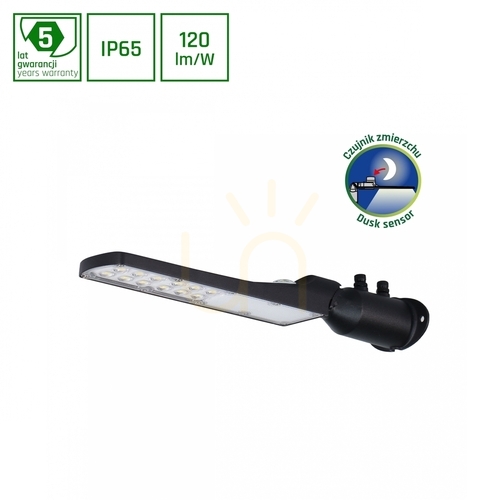
In the trade the luminaire itself is called the lantern or street light head. It holds the LED module, the driver (the electronics that turn 230 V mains into the current the LEDs need), the optic that shapes the beam, and a die-cast aluminium housing that doubles as a heat sink. The column, pole or post is a separate item, and so is the bracket arm if you want the head to reach out over a road. If you are planning a full installation, our lighting poles cover the structural side; this page is about the head that produces the light.
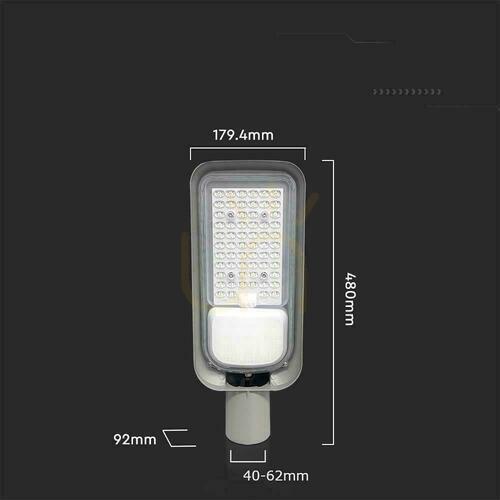
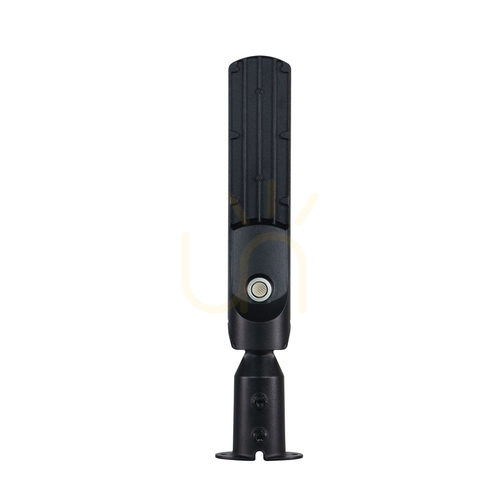
Most heads fix onto a round tube called a spigot. Many accept tubes between roughly 42 and 60 mm in diameter, with 48 and 60 mm the most common sizes. A spigot fitting usually works two ways: side-entry, where the head slides onto a horizontal arm, and post-top, where it sits on the vertical end of the column.
Mains, solar or hybrid street lights
The power source decides almost everything else: running costs, installation work and how reliable the light will be in December. Here is how the three main types compare.
| Type |
How it works |
Best for |
Watch out for |
| Mains LED street light |
Fed from 230 V through an armoured cable in the ground |
Roads, estates, car parks and drives that need full brightness every night |
Trenching, a dedicated circuit and an electrician |
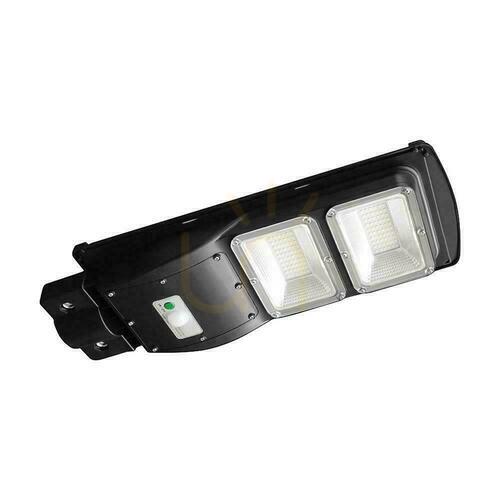
| Integrated solar street light |
Panel, battery and LEDs in one housing |
Rural tracks, farm gates, paths and sites with no power nearby |
Small panel area limits winter output |
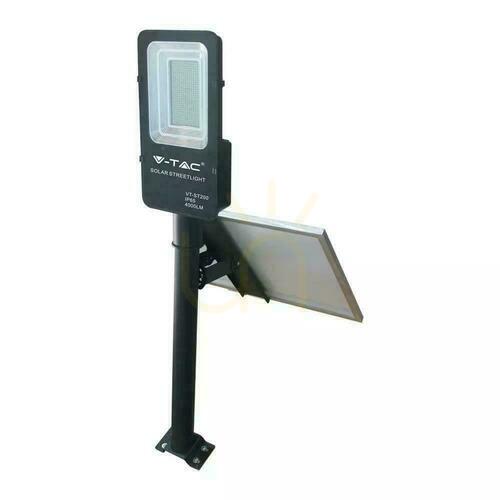
| Split solar street light |
Separate panel that can be angled for winter sun, battery in the head or a box |
Longer winter nights and sites where the head faces away from the sun |
A second item to mount and keep clean |
| Hybrid solar/mains |
Runs on solar and switches to the grid when the battery runs low |
Sites that want lower bills without blackouts in winter |
Still needs a cable, so the saving is on energy, not on groundwork |
How bright should a street lamp be?
Compare lumens, not watts. Watts tell you what the light draws from the supply; lumens tell you how much light comes out. A decent mains LED head delivers about 120–160 lm per watt, so a 30 W unit gives roughly 4,000–4,500 lm and a 60 W unit 8,000–9,000 lm. Solar products are often sold with inflated "equivalent" wattages, so check the lumen figure and the battery capacity instead.
Mounting height and output go together. A bright head mounted low will glare and leave hot spots under the column; the same head mounted too high spreads its light so thinly that the ground looks dim. As a starting point:
| Mounting height |
Typical output |
Mains LED power (approx.) |
Typical use |
| 3–4 m |
1,500–3,000 lm |
15–25 W |
Private drives, footpaths, gateways |
| 4–6 m |
3,000–6,000 lm |
25–50 W |
Estate roads, farmyards, small car parks |
| 6–8 m |
6,000–10,000 lm |
50–80 W |
Residential streets, larger car parks |
| 8–10 m |
10,000–16,000 lm |
80–120 W |
Industrial yards, wider access roads |
| 10–12 m |
15,000–25,000 lm |
120–200 W |
Main roads, logistics yards, big open areas |
For spacing, a common rule of thumb on residential roads is three to four times the mounting height between columns, so 5 m heads end up roughly 15–20 m apart. A single row on one side of the road works well when the road is no wider than about the mounting height; wider roads need staggered or opposite rows. For a private drive, one or two heads at the entrance and at bends usually beat a long row of weak ones.
Optics: putting the light where you need it
The lens or reflector matters as much as the lumen figure. Road optics are asymmetric: they throw light forward and sideways along the road while sending little behind the column into gardens and bedrooms. A typical road beam is described as something like 140°×70°, wide along the road and narrower across it. Symmetric round or square beams suit car parks, squares and yards where the column stands in the middle of the area.
Keep the head close to level. Tilting it up throws light further, but it also increases glare and sends light into the sky. A flat glass or flush lens with the head mounted horizontally keeps upward light to a minimum, which is what dark-sky guidance asks for.
Colour temperature, light pollution and wildlife
Most street lights come in neutral white around 4000 K or cool white around 5700–6500 K, with warm white 3000 K common in residential areas. Cooler light looks crisp on CCTV and suits industrial yards and security lighting. Warmer light is gentler on neighbours, attracts fewer insects and scatters less in the night sky, which is why many councils and protected landscapes prefer 3000 K or below near homes and countryside. Some heads let you switch the colour temperature on site, which is handy if you are not sure what will look right.
Built for weather and knocks: IP, IK and electrical class
-
IP65 keeps out dust and water jets; IP66 also copes with heavy, driven rain. Either is fine for a column-mounted head in the UK climate.
-
IK rating shows impact resistance. IK08 withstands a 5 J impact, IK09 10 J and IK10 20 J. Choose IK09–IK10 where balls, branches or vandals are a risk.
-
Class I heads must be earthed; Class II heads are double insulated and need no earth connection, which simplifies wiring on some metal columns.
-
Surge protection of 4–10 kV in the driver helps against lightning-induced spikes on long cable runs. An extra surge protector in the column base is cheap insurance on exposed sites.
Mounting and alignment
Check three things before you order: the spigot diameter of your column or bracket, whether the head needs to sit side-entry or post-top, and how much tilt adjustment the fitting offers. Many fittings rotate in steps, so the head can be set level on a horizontal arm or on an upright post. Bring the supply cable up inside the column to a fused connection box at the base, and leave enough slack to lower the head for servicing. Solar heads also need a clear view of the southern sky, free of shade from trees and buildings all day, especially in winter when shadows are long.
Switching and dimming
-
Photocell (dusk sensor): switches the light on at dusk and off at dawn. It is the standard control for street lights and needs no programming.
-
Timer or part-night dimming: drops output to a lower level after midnight, which saves energy and reduces light spill when nobody is around.
-
Motion sensors: PIR sensors react to body heat and work best at lower mounting heights; microwave sensors detect movement through the housing and cover a wider area. On solar models a dim-to-bright motion mode is the best way to stretch battery life.
-
Dimmable drivers: 1–10 V or DALI drivers let a controller set the light level, useful when several heads run together.
Sizing a solar street light for UK winters
Solar street lights do work in Britain, but the battery has to carry the light through the longest nights after the shortest days. In December much of the country gets well under eight hours of daylight, the sun stays low and the panel collects only a fraction of its summer output. Three figures tell you whether a light will cope:
-
Panel power in watts. Bigger is better, and a separate panel that you can tilt steeply (around 50–60° from horizontal) catches more of the low winter sun than one lying flat on top of the head.
-
Battery capacity in watt-hours, or amp-hours with the voltage. LiFePO4 (lithium iron phosphate) cells are the standard: they last around 2,000 charge cycles or more and tolerate heat and cold better than older chemistries.
-
Autonomy, the number of nights the light runs from a full battery without sun. Two to three nights is a sensible minimum.
A quick check: a light running at 20 W for four hours and then at a third of that until dawn uses roughly 150 Wh a night. To cover a grey spell of two to three nights, the battery needs around 300–450 Wh. If a product promises hundreds of watts from a small panel, it will not run at that output for long. For guaranteed full brightness all winter, choose mains or hybrid.
Regulations and installation
Public highway lighting is designed to EN 13201, which sets lighting classes for roads, footways and residential areas. A private drive or yard has no such requirement, but the lower residential classes, roughly 2–15 lux on average, are a useful target. Car parks used at night typically aim for about 5–20 lux depending on traffic.
A mains street light needs a dedicated outdoor circuit with RCD protection and buried armoured cable. In England and Wales that is notifiable work under Part P of the Building Regulations, so have it installed by a registered electrician who can certify it. Solar models need no wiring at all, only a solid column and foundation.
Lifetime and maintenance
Quality LED modules are commonly rated at 50,000 hours or more before they drop to 70% of their original output, which is well over ten years of dusk-to-dawn use. Drivers and batteries usually wear out first, so heads with a replaceable LED module, a replaceable driver or an accessible battery compartment are easier to keep going. Once or twice a year, clean the lens and the solar panel, check the seals and gasket and make sure the head is still tight on its spigot.
Frequently asked questions
What are the different types of street lights?
LED has become the standard light source. The main split is by power source: mains LED street lights wired to the grid, integrated or split solar street lights, and hybrid units that use both. Older sodium and metal halide lamps are being replaced by LED because it uses far less energy and lasts much longer.
How tall is a street light in the UK?
Residential streets typically use columns of about 5–6 m, main roads 8–12 m. Private drives and paths are usually lit from 3–5 m.
Are solar-powered street lights any good?
Yes, if they are sized properly. A well-specified solar street light with a decent panel, a LiFePO4 battery and a motion or dimming profile will run all year in most of the UK. Cheap units with tiny panels tend to fade in winter.
How long will solar street lights last?
The LEDs and housing commonly last ten years or more. The battery is the wear part: LiFePO4 cells typically last around five to eight years before they need replacing.
What is the best type of light for a driveway?
A street light head of 1,500–3,000 lm on a 3–4 m column with a photocell gives even, glare-free light. For a long rural drive with no power nearby, a solar model with a motion sensor avoids a long cable run.
Can I install a street light myself?
You can erect a solar street light yourself. A mains street light needs a dedicated circuit, so connection should be done by a qualified, registered electrician.
What colour temperature is best for street lights?
4000 K is the usual all-round choice. 3000 K is friendlier near homes and wildlife; 5700–6500 K suits industrial and security lighting where maximum contrast matters more than atmosphere.
How many lumens do I need for a car park?
For a small car park lit from 5–6 m, heads of roughly 4,000–8,000 lm spaced around 15–20 m apart are a common starting point. Larger areas lit from 8 m or more need 10,000 lm and above.
Planning a whole garden or yard rather than a single road? Browse our full range of outdoor lights to light paths, walls and entrances in the same style as your street lights.