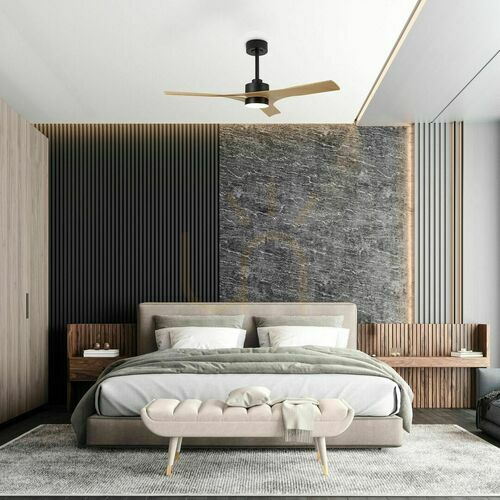
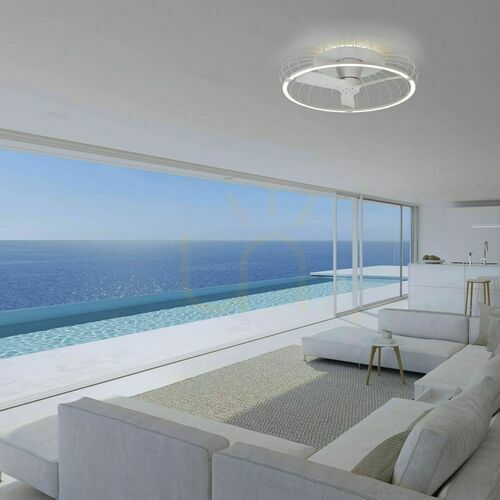
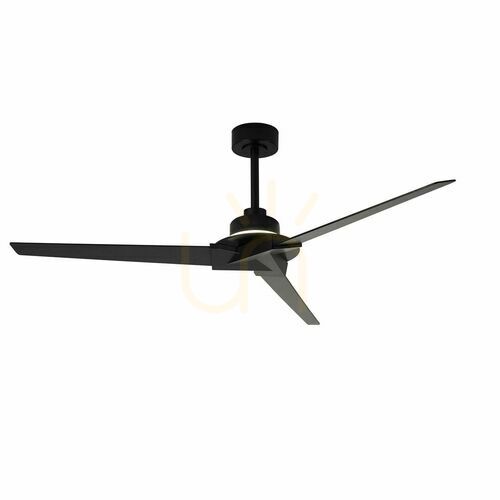
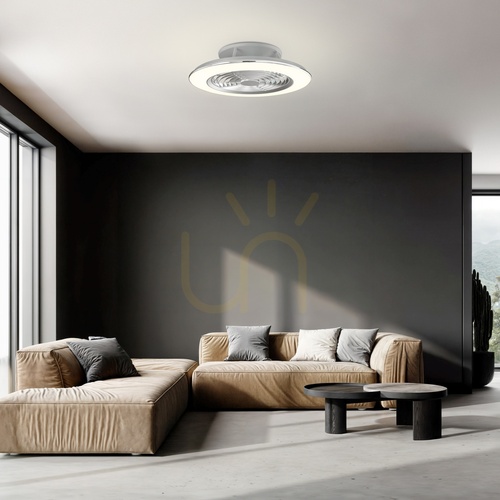
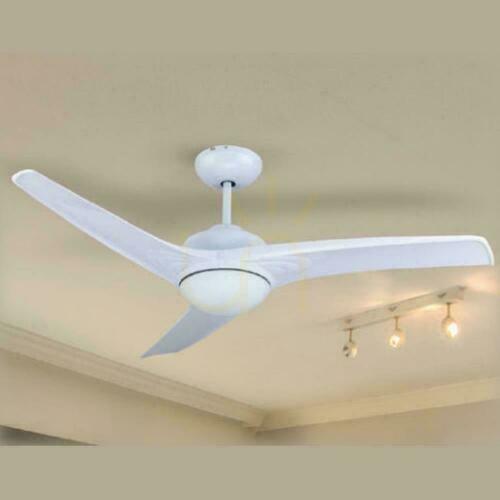
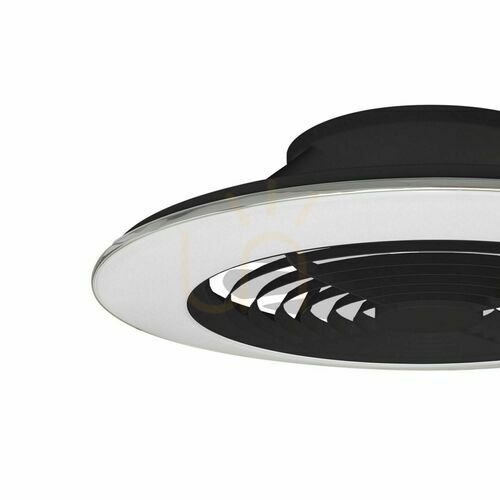
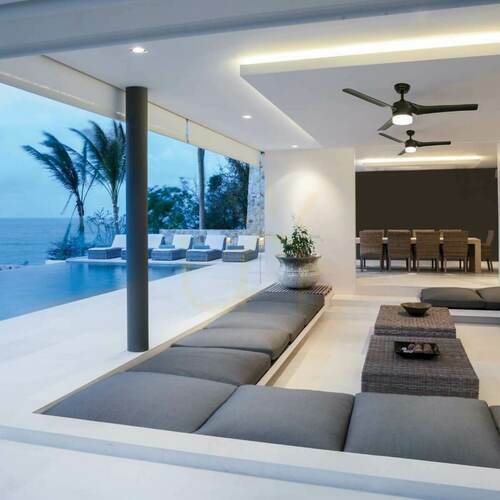
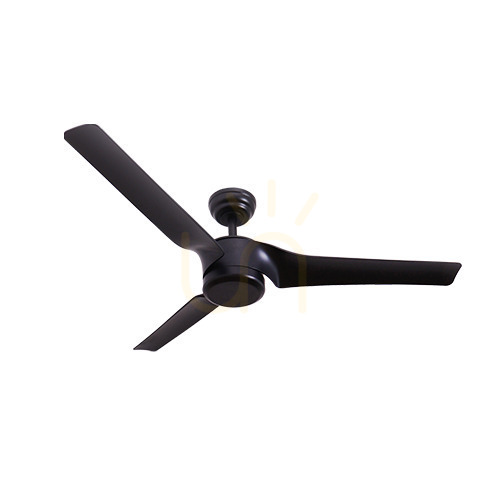
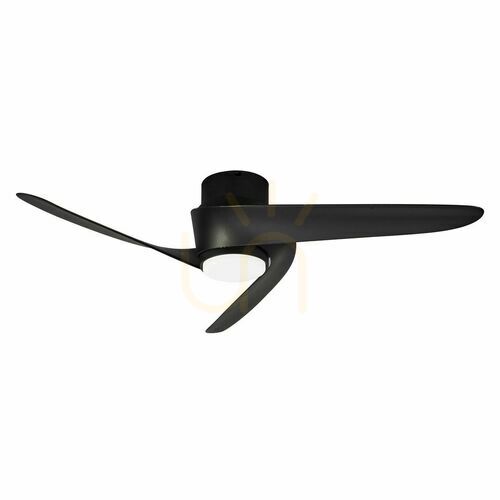
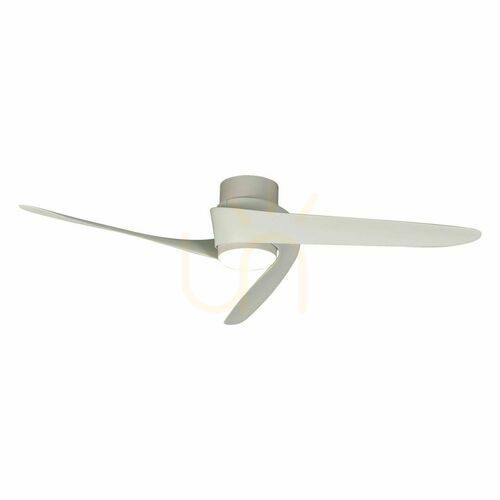
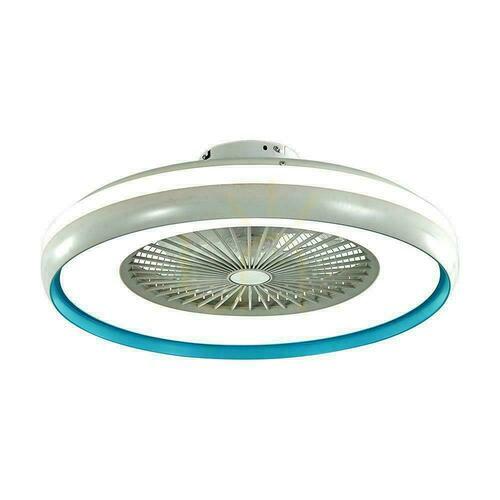
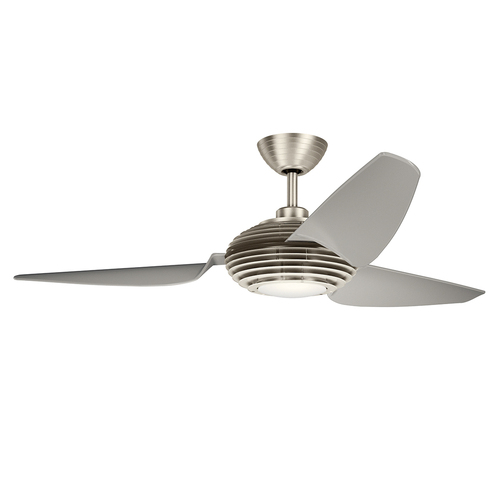
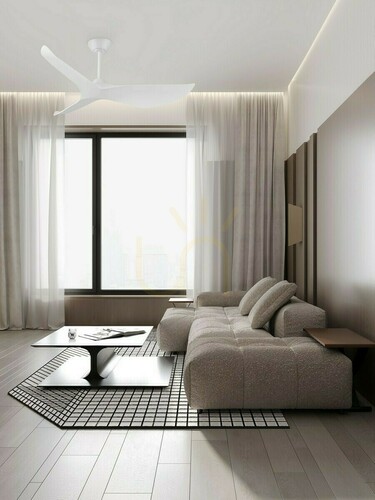
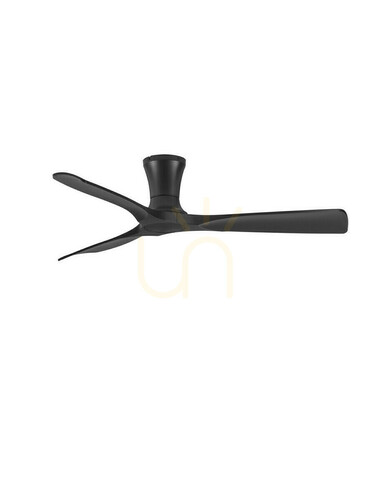
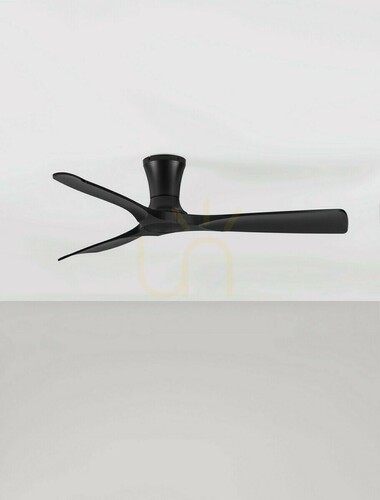
A modern ceiling fan with a light is the version that looks like a designer pendant rather than a tropical-hotel relic: a slim motor housing, a few clean-edged blades (or blades that fold away entirely) and one flat LED disc behind an opal diffuser. Beyond the look, the modern style usually brings a quiet DC motor, a remote instead of a pull cord and light you can switch from warm to cool white.
What sets the modern look apart
The traditional fan-light is easy to picture: five dark wooden blades, brass trim and a cluster of tulip glass shades on small screw-in bulbs. Contemporary designs strip most of that away. Three or four straight blades are typical, the light is integrated rather than bulb-based, and finishes stick to matt black, white, satin nickel, grey or pale wood such as oak and walnut, often paired with black or white. Many blades are two-sided, so you can pick one of two finishes when the fan goes up.
Two other forms are worth knowing about. Fans with retractable blades look like an ordinary flush ceiling light until the motor starts and the blades swing out. Compact low-profile fans sit only around 20 cm below the ceiling, which matters a lot in British homes.
Choosing the right style for your room
‘Modern’ covers fans of very different sizes and strengths. The figures below are typical guidance, not hard limits, and they assume the blades stay at least 2.3 m above the floor.
| Style |
Typical blade span |
Best for |
Trade-off |
| Small low-profile fan with LED panel |
50–80 cm |
Box rooms, studies, kitchens up to about 12 m² |
Moves less air; fine for a standard 2.4 m ceiling |
| Retractable-blade fan light |
90–110 cm when open |
Bedrooms up to about 18 m² |
Less airflow than fixed blades of the same span |
| Minimal three-blade fan |
105–132 cm |
Bedrooms and living rooms of 15–30 m² |
Best with 25–30 cm clearance below the ceiling |
| Large statement fan |
132–152 cm |
Open-plan spaces over 30 m² |
Above about 40 m², two fans work better than one |
Fitting one into a British home
Most new-build houses and flats have ceilings of about 2.4 m, so a flush-mounted or low-profile model is usually the only safe choice; a downrod would bring the blades too close to raised hands. Victorian and Edwardian houses with ceilings of 2.7–3 m or more are the opposite case: a downrod drops the blades into the zone where you actually feel the breeze. In a loft conversion, check the maximum ceiling slope the fan is designed for.
The fan replaces a ceiling rose and needs live, neutral and earth. It must hang from a joist or a proper fan-rated bracket, never from plasterboard alone, because a turning rotor puts dynamic load on the fixing. Have a qualified electrician fit it to BS 7671. Remote-controlled models keep their receiver in the canopy, so the wall switch should stay on.
Light, motor and controls
The integrated LEDs in modern fans are often bright enough to be the room’s main light, with some compact models giving several thousand lumens. Look for adjustable colour temperature, for example 3000 K in the evening and 4000 K for a home office, and dimming from the remote. DC motors usually draw somewhere between 5 and 35 W depending on speed and offer five or six settings, against roughly 50–80 W at full speed for an older AC motor. A reverse setting pushes warm air back down from the ceiling in winter.
Things to check before you buy
- Whether the LED module can be replaced. On many fans it is built in.
- Whether the fan and light can be switched separately. On some models they only work together.
- Noise at top speed: most sit around 35–50 dB, and a larger fan turning slowly is quieter than a small one at full tilt.
- Upkeep: matt black and dark wood show dust quickly. Wipe the blades with a dry or slightly damp cloth, and tighten the screws or use a balancing kit if the fan starts to wobble.
Frequently asked questions
What is the current trend in ceiling fans?
Quiet, pared-back designs that read as a light fitting first: three slim blades or hidden blades, integrated colour-changing LEDs, black or pale-wood finishes and app or voice control alongside the remote.
What makes a good modern ceiling fan with a light?
A span matched to the room, a DC motor with several speeds and a reverse mode, light you can dim and switch between warm and cool white, separate control of fan and light, and a mounting style that suits your ceiling height.
What are people replacing ceiling fans with?
Often with fans that do not look like fans. Retractable-blade designs and slim low-profile fans pass for a flush ceiling light when switched off, so the old bulky fan-light gives way without losing the summer breeze.
Is a small modern ceiling fan with a light worth it?
In a box room, study or kitchen, yes. A 50–80 cm fan moves enough air for a small space and its LED panel can light the whole room. In a larger room it would have to run flat out, which means more noise.
Do I need a remote for a modern ceiling fan with a light?
Most modern models come with one, and it is the easiest way to set speed, timer and light colour without extra wiring. Some also pair with an app or a voice assistant.
Can a ceiling fan go in a bathroom?
Only a model rated for damp areas, typically IP44, and only where the bathroom zones allow it. Most indoor fans are IP20 and belong in dry rooms.
More on sizes, motors and installation in general: ceiling fans with light. Planning one for a large lounge? Read more about living room ceiling fans with lights.