
Light color: 2700K, 4000K, or 6000K? How to read the Kelvin rating on a light bulb package
Two identical lamps can create completely different interiors—all it takes is a 2700 K bulb in one and a 6000 K bulb in the other. Color temperature is, alongside power, the most important parameter of a light source, yet it is also the one most often overlooked when making a purchase. We explain the difference between warm and cool light tones, what color temperature to choose for your living room, kitchen, and bedroom, and why 6000 K is almost never a good idea for your home.

Table of Contents
- What is color temperature?
- Warm, neutral, and cool colors – ranges
- What light color for specific rooms?
- 6000K light color – where does it make sense?
- Kelvins vs. lumens and watts
- CRI – another parameter worth knowing
- Flicker and color consistency (SDCM)
- Light bulbs with adjustable color temperature (CCT)
- Summary
What is color temperature?
Color temperature describes the hue of white light —ranging from yellowish, resembling a candle flame, to bluish, reminiscent of daylight on a cloudy day. It is expressed in kelvins (K) and, somewhat counterintuitively, works "opposite" to common intuition: the lower the kelvin value, the warmer (more yellow) the light, and the higher the value, the cooler (more blue).
For reference, here are a few points of comparison:
- a candle flame – approx. 1,800 K,
- traditional tungsten bulb – approx. 2700 K,
- sunlight at noon – approx. 5000–5500 K,
- cloudy sky – 6000–7000 K.
Warm, neutral, and cool color temperatures – ranges
Manufacturers divide light into three conventional groups:
- Warm color (2700–3300 K) – yellowish, cozy, closest to a traditional incandescent bulb. It creates a relaxing atmosphere and warms up the interior colors.
- Neutral color temperature (3500–4500 K) – pure white with no distinct tint, promotes concentration. Standard in kitchens and offices. In stores, you'll most often see a value of 4000 K. (Color accuracy is determined not by color temperature alone, but by the CRI—more on that later.)
- Cool color temperature (5000–6500 K) —white with a blue tint, maximally stimulating. In living spaces, it looks "hospital-like," but it does have its technical uses.
It’s worth knowing that in the evening, light with a high blue component (i.e., cool light) inhibits the release of melatonin—the sleep hormone. It's physiology, not a fad: warm lighting after dark really does make it easier to fall asleep.
What light color is best for each room?
| Room | Recommended color | Why |
|---|---|---|
| Living room | 2700–3000 K | Relaxation, warm colors of wood and fabrics |
| Bedroom | 2700 K | calm before bedtime |
| Kitchen – general lighting | 3000–4000 K | a balance between coziness and functionality |
| Kitchen – work surface | 3500–4000 K | accurate product colors, precision |
| Bathroom – bath | 2700–3000 K | relaxation |
| Bathroom – mirror | 3500–4000 K | natural skin tone for makeup and shaving |
| Home office | 4000 K | concentration while working |
| Garage, basement, workshop | 4000–6500 K | Maximum visibility of details |
The most important rule of thumb: stick to one color within a single room. A warm chandelier next to cold LED lights is the most common way for a well-designed interior to fall apart at the last minute.
6000K light color—when does it make sense?
6000K bulbs are tempting because they seem “the brightest”—the bluish white subjectively gives the impression of stronger light. In the living room or bedroom, however, this is the surest way to end up with a cold, uninviting interior and trouble falling asleep.
Cool white, on the other hand, has its place:
- garage and workshop —when working with tools, contrast and visibility of details are key,
- the basement and utility rooms – here we aren’t setting the mood, just looking for a jar of preserves. A bright, cool, high-efficiency LED light is the cheapest way to illuminate a dark room,
- display lighting for select materials (chrome, glass, white) in commercial spaces.
So if you’re looking for the answer to the question “what LED bulbs for the basement or garage”—you’ve just found it: 4000–6500 K, as many lumens as possible, CRI is of secondary importance.
Kelvins vs. lumens and watts
These three parameters are often confused, yet they describe completely different things:
- Kelvins (K) – the color of light (warm/cool),
- Lumens (lm) – the amount of light, i.e., the actual “brightness,”
- Watts (W) – power consumption, which, since the advent of LEDs, no longer says anything about brightness.
Approximate equivalents of old incandescent bulbs:
| Old incandescent bulb | Luminous flux | Today’s LED |
|---|---|---|
| 40 W | approx. 470 lm | 4–5 W |
| 60 W | approx. 806 lm | 7–9 W |
| 75 W | approx. 1055 lm | 9–11 W |
| 100 W | approx. 1521 lm | 12–15 W |
The characteristic 806 lumens listed on the packaging simply corresponds to the old “60-watt bulb”—the most popular light bulb in Polish homes.
CRI – the second parameter worth knowing
CRI (Ra), or Color Rendering Index, indicates how accurately colors appear under a given light, on a scale of up to 100. Two light bulbs with the same color temperature of 3000 K can render colors quite differently:
- CRI 80+ – standard, sufficient for hallways and utility rooms,
- CRI 90+ – noticeably more vivid colors, worth the extra cost in the living room, kitchen, and near a mirror,
- CRI 95+ – the standard for art studios and anywhere where color accuracy is critical.
A low CRI is the reason why food can look gray and skin in the mirror can look unhealthy, despite “correct” color temperatures.
Flicker and color consistency (SDCM)
Two parameters not listed on the front of the package, yet capable of ruining even a bulb with good color rendering and a high CRI:
- Flicker – cheap LEDs pulse at the mains frequency. The eye “doesn’t see” it, but the brain registers it: after hours of exposure to flickering light, eye strain and headaches set in, and phone recordings show streaks scrolling across the screen. Look for terms like “flicker-free” or a low flicker rate. The problem worsens with an incompatible dimmer (see below).
- Color consistency (SDCM / MacAdam) – “3000 K” from one manufacturer may differ in hue from another (one leans toward pink, the other toward green). The SDCM (MacAdam steps) parameter indicates how closely the color is matched: ≤3 SDCM is the value at which adjacent bulbs look identical. That’s why you should buy all the bulbs for a single room—especially when using a row of bulbs or a chandelier—from the same series and the same batch.
Dimmers and LEDs: for a bulb to dim smoothly without flickering or “buzzing,” it must be labeled as dimmable, and the dimmer itself must be LED-compatible ( trailing-edge type, with support for low loads). An old light bulb dimmer usually doesn't work with a few-watt LED.
Light bulbs with adjustable color temperature (CCT)
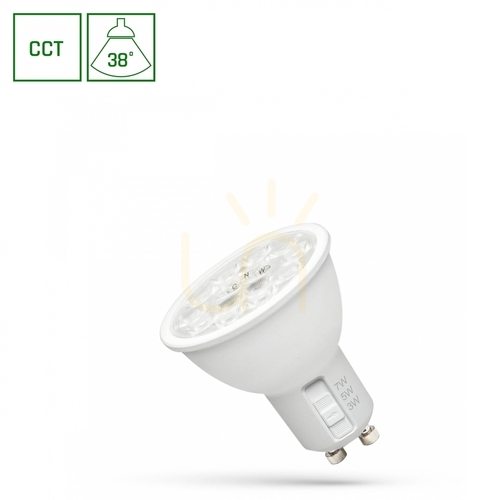
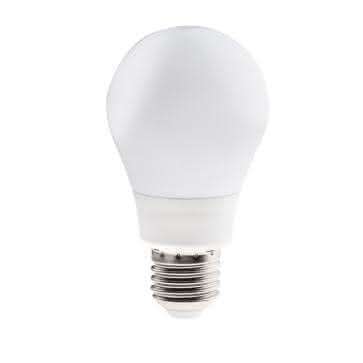
If a single room serves multiple purposes—such as a room that functions as an office during the day and a bedroom at night—consider light sources with adjustable color temperature (CCT). Controlled via remote or app, they allow you to smoothly transition from a neutral 4000 K white during the day to a warm 2700 K in the evening. Many modern ceiling lights and LED lamps have this feature built in, and for lamps with an E27 base, all you need to do is replace the bulb with a smart model.




Summary
Kelvin is easy to understand: 2700–3000 K for relaxation, 4000 K for work, 6000 K for the garage. Add to that a decent number of lumens (806 lm is the old “60-watt equivalent”) and a CRI of 90+ where colors matter, and the light in your home will start working for you, not against you. You can find light sources in all colors in the Light Sources category.
Victoria


Maybe you will be interested in products from these categories?
Light Bulbs
Tags & Blog Categories