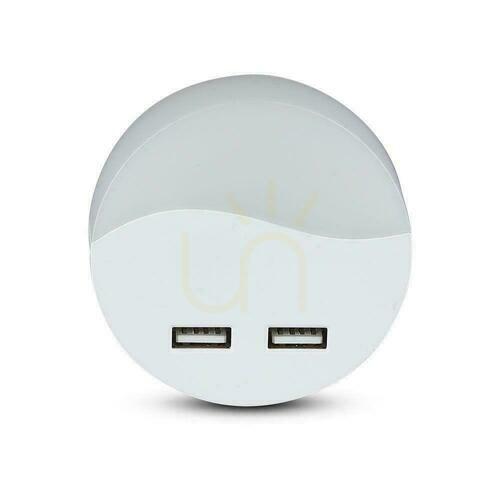
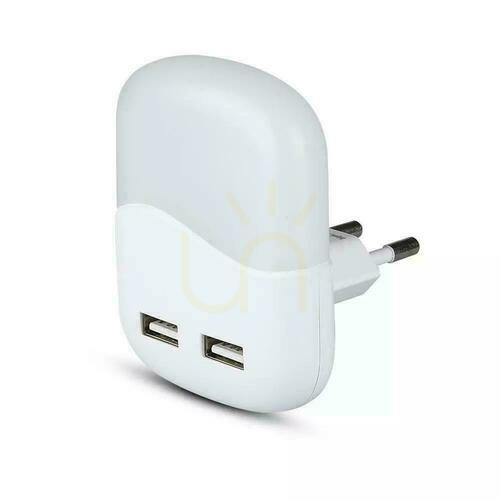
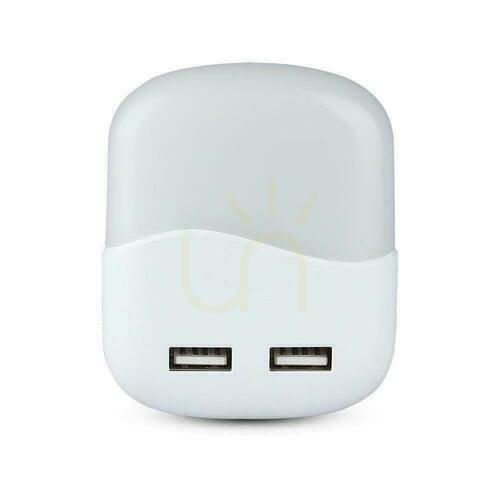
A plug-in night light runs straight off a wall socket and gives out just enough glow to find the bathroom door, the top step of the stairs or a baby’s cot without switching on the main light. Because it draws power from the mains, there are no batteries to swap and nothing to recharge, and unlike a wall light it needs no drilling and no electrician.
Most are compact LED units, usually 6–9 cm across, that sit flush on the socket. The same mains-powered group also takes in ordinary bedside lamps with a flex, an inline switch and a plug at the end. What both share is a constant 230 V supply, so the light can stay on all night and a sensor never gives up halfway through winter because a battery has run flat.
Where they earn their keep
-
The landing – the classic spot. A light in a low socket picks out the edge of the stairs and the bathroom door, and it stays out of your eyes.
-
Nurseries and children’s rooms – a faint, warm glow means the room is never pitch black, and there is enough light for a night feed or a nappy change.
-
Adults’ bedrooms and hallways – plug-in night lights are not just for kids. Shift workers, light sleepers and anyone who gets up in the night benefit from a path lit at floor level.
-
Older relatives – a couple of points of light between bed and bathroom cut the risk of a trip or fall in the dark.
What mains power means in a British home
The night light shines wherever the socket is. In older houses sockets sit low on the skirting, while newer homes usually have them at least 450 mm above the floor. Both heights work: the light reaches the floor and the edges of furniture but never shines in your face from pillow level.
A UK plug-in has a three-pin 13 A plug with a fuse inside, so check it sits square in the socket and that the socket switch is left on. Most British sockets are switched, and a light that ‘doesn’t work’ is often just switched off at the wall. A bulky unit can block the second outlet on a double socket, so look for a slim design or one with a plug-through socket or USB charging port. UK bathrooms normally have only a shaver point rather than a standard socket, so for night-time bathroom trips the light belongs on the landing outside.
Socket light or bedside lamp on a flex?
A night light that plugs straight in is tiny, cheap to run and stays put, but its height is fixed by the socket and it is built for guidance rather than reading. A plug-in bedside lamp on a flex sits on the bedside table, throws light down from above and is bright enough for a chapter before sleep, usually with an inline or touch switch and often taking a bayonet (B22) or small Edison screw (E14) bulb. If all you need is to see the floor at 3 am, the socket light wins. If you want something to reach for and switch on by hand, choose the lamp.
How to choose: typical values
| Feature |
Typical range |
What it means for you |
| Power draw (LED) |
0.3–1 W |
older incandescent night lights used 4–7 W |
| Brightness |
5–50 lm |
a handful of lumens is enough to see by; above about 100 lm it feels like a reading lamp |
| Colour temperature |
2200–3000 K |
warm white or amber disturbs sleep less than cool white |
| Motion sensor (PIR) |
2–3 m range, 20–60 s on-time |
covers a landing or hallway, then switches itself off |
| Dusk sensor |
dusk till dawn |
on when the room gets dark, off at daylight |
| Ingress protection |
usually IP20 |
dry rooms only |
Start by deciding when the light should be on. A switched model stays on until you turn it off. A dusk-till-dawn sensor gives a steady glow all night with no thought from you. A PIR sensor lights up only when someone walks past, which suits stairs and long hallways. Many combine the two and react to movement only after dark.
Pitfalls and care
A dusk sensor should not ‘see’ a street light, the television or its own reflection in a glossy white wall, otherwise it may never switch on or may flicker. Don’t hide the light behind a curtain or furniture, and don’t plug it into an extension lead under the bed where its glow helps nobody. In a toddler’s room choose a casing small fingers can’t prise open. To clean it, unplug it first and wipe with a dry cloth.
Frequently asked questions
Do plug-in night lights use a lot of electricity?
No. An LED night light usually draws under 1 W, so even left on round the clock it uses less than 9 kWh a year. With a dusk sensor it is more like 2–4 kWh.
Are plug-in night lights safe to leave on all night?
A well-made LED night light is designed for exactly that: it stays cool to the touch and has no bulb to overheat. Unplug any unit with a cracked casing or a loose fit in the socket.
What is the best plug-in night light for a landing?
One with a dusk sensor or a combined dusk and motion sensor, warm white light and a low socket position near the top of the stairs, so the first step is always visible.
Are there plug-in night lights for adults?
Plenty. Plain white or wood-effect designs with a warm, dimmable light suit hallways and bedrooms just as well as the cartoon shapes suit a nursery.
Which colour night light is best for sleep?
Warm white around 2200–2700 K, amber or red. Light with a lot of blue in it is the most likely to wake you up properly.
Should I choose a dusk sensor or a motion sensor?
A dusk sensor for a constant glow, for example in a nursery, and a motion sensor for places you only pass through, such as the stairs or a downstairs hall.
For more on lighting beside the bed, from table lamps to socket lights, see bedside lamps. If there’s no socket within reach of the bed, cordless bedside lamps solve the same problem without a plug.