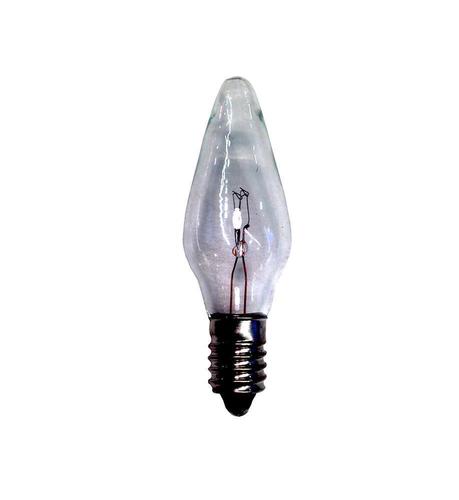
An E10 bulb is a miniature lamp with a 10 mm screw cap, sold in the UK as MES – miniature Edison screw. It is the little bulb in school science circuits, older torches, dolls’ houses, model railways, dashboard panels, fairground signs and many Christmas candle arches, and the cap tells you only half the story: the same thread is made for anything from 1.5 V to 230 V.
So when you replace one, match the voltage first and the shape second. Get the voltage wrong and the new bulb either pops the moment it lights or barely glows.
What sets MES bulbs apart
The E stands for Edison, the number for the rough thread diameter in millimetres. E10 is the smallest screw cap most people meet at home. It will not go into an E14 (SES) holder, used for candle bulbs and fridge lamps, or an E27 (ES) holder, and it does not fit the American E12 candelabra cap either, even though that is only 2 mm wider. Older torches sometimes use a flanged P13.5S base instead, which pushes in rather than screws.
Glass shapes vary a lot under the one cap. Round bulbs of about 11 × 24 mm are the classic school and torch type, slimmer 10 × 28 mm and tubular versions turn up in indicators and panels, and Christmas sets use flame-tip, pointed or pyramid shapes up to about 45 mm long. Incandescent MES bulbs usually draw from a fraction of a watt to around 3–5 W; LED replacements typically draw 0.1–0.8 W.
Choosing the right voltage
Almost every old bulb has its rating stamped on the cap or the side of the glass, such as 2.5 V 0.3 A or 34 V 3 W. Take a photo of it before you shop. As a rough guide:
| Where it’s used |
Typical bulb voltage |
Watch out for |
| Torch with two cells |
2.2–2.5 V |
LEDs only work the right way round on DC |
| Torch with three or four cells |
3.5–4.8 V |
an under-rated bulb burns out quickly |
| School circuit boards |
1.5–6.5 V |
current usually 60–300 mA |
| Dolls’ houses and models |
3.5–16 V |
miniature LEDs from around 20 mA |
| Classic car and panel lamps |
12 V |
check the wattage to match brightness |
| Christmas candle arches |
14–55 V |
series wiring; copy the rating plate |
| Fairground and retro signs |
24 V or mains-wired groups |
mains wiring is a job for an electrician |
| Mains indicator lamps |
230 V |
only bulbs marked for mains use |
Candle arches and fairy lights: why every bulb matters
Traditional candle arches, window candle bridges and old-style tree sets wire their bulbs in series. The mains voltage is shared between them, which explains the odd ratings: seven bulbs on 230 V get about 34 V each, ten get 23 V, sixteen get 14 V. When one fails, the whole set goes dark.
A replacement must match both voltage and wattage. A mismatched bulb upsets the share, so the others either glow dimly or run too hot and fail early. LED replacements for arches often accept a wide range, such as 8–55 V or 23–55 V, but it is safest to swap the whole set at once rather than mix LED and filament bulbs in one series string – unless the LED maker says it is designed for that.
Torches, science kits and models
In a torch the bulb voltage follows the number of cells. An LED replacement gives brighter, whiter light and makes batteries last longer, but it is polarity-sensitive. If the torch stays dark after the swap, flip the bulb or the batteries before assuming it is faulty. For classroom kits, keep bulbs and battery packs matched – a 1.5 V bulb on a 6 V pack will blow straight away. MES holders come in panel-mount versions with a nut, PCB and solder types, and with flying leads, so they fit almost any project.
Safety and care
- Unplug an arch or light set before changing a bulb: each bulb runs at low voltage, but the holders are still connected to the mains.
- Let a filament bulb cool before unscrewing it.
- Many LED replacements are not dimmable; if your arch sits on a dimmer, look for one sold as dimmable.
- Hard-wired mains indicators and 60 V sign bulbs wired in groups straight to the mains should be installed by a qualified electrician to BS 7671.
E10 bulb FAQs
What is the difference between E10 and E12 bulbs?
E10 has a 10 mm thread and is a European and British miniature cap; E12 is the 12 mm American candelabra cap. They are not interchangeable, even though they look similar.
Will an E14 bulb fit an E10 holder?
No. E14 (SES) is 14 mm across and E27 (ES) 27 mm, so neither will screw into an MES holder. Each cap needs its own matching holder.
Can I get an MES bulb in LED?
Yes. LED MES bulbs exist for low-voltage DC – commonly 3 V, 6 V and 12 V – and as wide-range types for candle arches. They use far less power and stay cool.
How do I find the right MES bulb replacement?
Read the voltage and current or wattage on the old bulb, then match the glass shape so it fits the reflector or candle sleeve. If the marking has worn off, count the bulbs in a series set and divide 230 V by that number.
Is there an E10 LED bulb for 240 V mains?
Yes, for indicator lamps and small mains fittings – UK mains is nominally 230 V. Never put one into a series candle arch or a torch.
What size is an E10 bulb?
The thread is about 10 mm across. The whole bulb is usually 24–45 mm long, depending on the glass shape.
For other caps and bulb types, head to light bulbs. If you are not sure whether your old lamp is E10 or the slightly wider American size, compare it with E12 bulbs.