A green table lamp by the bed is one of the easiest ways to add colour to a bedroom without repainting or changing the bedding. Before you settle on a shade of green, though, work out where the colour sits – base, lampshade or glass – because that decides whether the lamp gives you good reading light or just a pleasant glow.
Green on the outside, white light on the page
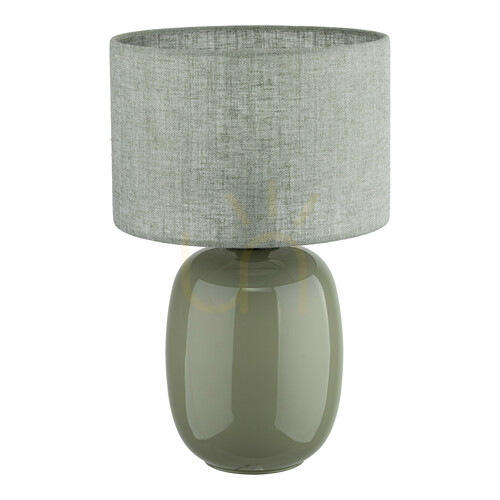
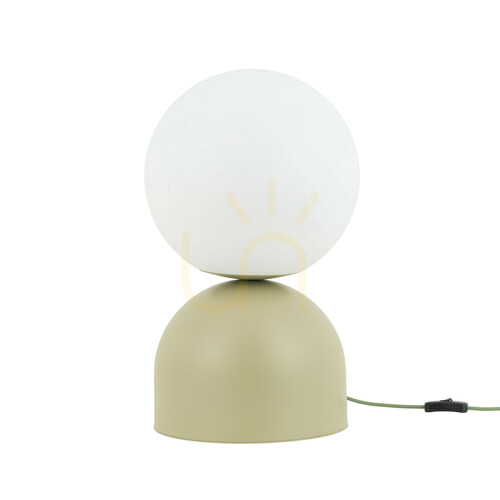
A lacquered metal base, a glazed ceramic body or painted wood is opaque, so the green is purely decorative and the bulb throws ordinary white light onto the bedside table. Pair it with a white, cream or opal shade and you have a lamp that reads like any other but looks far more interesting.
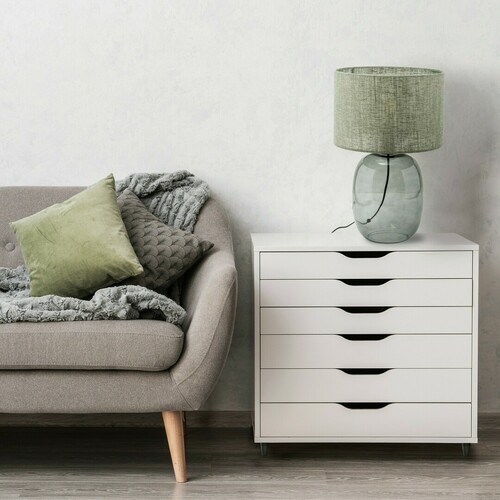
Glass behaves differently. Opal glass, milky and often mouth-blown, spreads the light evenly and keeps it white. Clear glass tinted green colours the light itself: the room takes on a greenish wash, and much less useful light reaches your book. Fabric sits in between – a thick cotton or linen shade lined in white glows green at the sides and still sends white light downwards, while a thin unlined green shade tints everything around it.
Which green, and what to pair it with
Search for green lamps and you quickly meet a whole spectrum: sage, olive, emerald, bottle, mint. Each one leans towards a different kind of bedroom.
| Shade of green |
Works well with |
Lampshade that suits it |
| Sage, olive, moss |
pale oak, linen, white, terracotta, rattan |
natural linen or ivory drum |
| Emerald, bottle, forest |
brass, dark wood, marble, navy |
pleated or velvet shade, or opal glass |
| Mint, pistachio |
white, soft pink, light grey |
white cotton, simple tapered drum |
| Green and gold |
deep wall colours, velvet, walnut |
cream empire or a glass dome |
| Vintage bottle-green glass |
traditional and eclectic rooms |
banker's-style cased glass shade |
A useful rule from lampshade makers: the width at the bottom of the shade should be roughly equal to the height of the base, up to the bulb holder. Go much wider and the lamp looks top-heavy and can tip; go narrower and it looks pinched. Empire shapes suit traditional rooms, straight drums suit modern ones. In a busy, patterned bedroom keep the shade plain; in a very simple one, a patterned shade over a green base adds life.
Size, brightness and the bulb
Bedside lamps are usually around 30–60 cm tall. Sitting up against the headboard, the bottom edge of the shade should be about level with your chin, so light lands on the page rather than in your eyes. For reading, aim for roughly 250–450 lumens in warm white, 2700–3000 K – a 3–5 W LED bulb in an E14 or E27 holder. Warm 2700 K nudges green towards olive and yellow; 3000 K keeps it truer. If the exact colour matters, look for a bulb with a colour rendering index of CRI 90 or above.
One thing to avoid is green as the light colour at night. The eye is most sensitive to green, so a green glow looks brighter than its wattage suggests, and it affects melatonin more than amber or red light does. Keep the green on the lamp and the light warm white.
Switches and everyday care
- An inline cable switch, a touch base with several steps or a dimmer saves fumbling under the shade in the dark.
- Never exceed the maximum wattage marked on the lamp, especially under a fabric shade.
- Green fabrics and lacquers fade in strong sun; a lamp on a south-facing windowsill will drift towards yellow.
- Clean glass only when cool, wipe ceramic and lacquer with a damp cloth, and brush velvet with a soft brush.
- Most bedside lamps are rated IP20, which means dry indoor rooms only – not the bathroom.
Frequently asked questions
Why is the green lamp so popular?
Largely because of the banker's lamp, the brass desk lamp with a green glass shade that appeared in the early 20th century. The shade is green outside and white inside, so it casts clean light downwards without glare, and its look has become shorthand for libraries and studies.
Is sage green or emerald better for a bedroom?
Sage is quieter and blends with light wood and linen; emerald is richer and works as a focal point next to brass or dark wood. Both read well against white or grey walls.
Does a dark green table lamp work in a small room?
Yes, if it has a pale or opal shade. A dark base with a white shade looks smart and still gives plenty of light; an all-dark lamp can feel heavy on a narrow bedside table.
Are touch bedside lamps worth it?
For a bedside, usually yes. You can find the base in the dark and step from reading light down to a low glow without hunting for the switch on the cable.
Can you read by a green glass lamp?
By a cased or opal glass shade, comfortably. By clear tinted glass, only briefly – the light is weaker and coloured, so it is better as mood lighting.
What goes with a vintage green lamp?
Brass, walnut, leather and warm white bulbs. A single vintage piece also sits happily in a modern room if the rest of the bedside is kept simple.
For the basics of height, bulb holders and switches whatever the colour, see bedside lamps. If you would rather have the classic banker's look on a desk, carry on with green desk lamps.