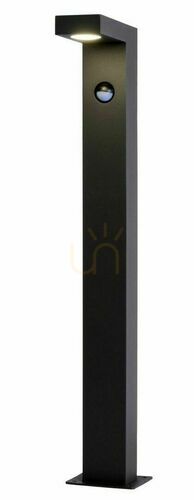
A bollard light with PIR is a low post light with a passive infrared sensor built into its head: it switches on when someone walks up the path or drive and switches itself off a little while after they have gone. Compared with an ordinary post light, the sensor turns an all-night glow into light on demand, so the garden stays dark and the path is lit only when it is actually in use.
Why a sensor behaves differently on a post
Most PIR lights are fixed to a wall at around 1.8–2.5 m, where they look down over a wide fan in front of the house. On a bollard the sensor sits much lower, typically 30–110 cm off the ground. Its detection zone is flatter and shorter, usually somewhere around 3–8 m, but it is aimed squarely at the path rather than at the pavement beyond the hedge. Taller post lights of 2 m or more see further and suit a long driveway or a parking area.
One quirk worth knowing: a PIR picks up movement across its field of view far more readily than movement straight towards it. A bollard set to the side of the path catches visitors earlier than one standing at the far end, facing them head-on.
Choosing a PIR post light
| Spec |
Typical range |
What to look for |
| Height |
approx. 30–110 cm; lamp posts 2 m and up |
a taller post means a larger detection area |
| Detection angle |
90–180° on one side; up to 360° with a top-mounted sensor |
360° suits a junction of paths, 180° a fence line |
| Detection distance |
roughly 3–8 m on a low bollard |
manufacturers quote range for a specific mounting height |
| Time-on setting |
about 10 seconds to 5 minutes |
1–2 minutes is usually plenty at a front gate |
| Impact rating |
IK08–IK10 in public or busy areas |
resists knocks and vandalism, not cars; keep posts clear of the turning line or protect them with a kerb |
| Body |
powder-coated aluminium; 304 or 316 stainless steel |
316 marine grade near the coast |
| IP rating |
IP44 minimum; IP54–IP65 by a drive |
sprinklers and pressure washers find weak seals |
| Colour temperature |
2700–3000 K warm white; 4000 K neutral |
warm is kinder to wildlife; neutral reads as security lighting |
Integrated LED is the norm, though some posts take an E27 or GU10 lamp. If yours does, pick an LED bulb that plays nicely with electronic sensors: some cheap combinations give a faint glow after switch-off. The dusk setting matters as much as the sensor: set it in twilight, not in full darkness, or the path stays dark just when people come home in winter.
Features that change how you use it
-
Two-level lighting: the bollard glows dimly all night and jumps to full output when it detects movement.
-
Master and slave: on some designs one sensor post can switch further lights on the same circuit, so a whole path lights up together.
-
Manual override: flicking the wall switch off and on quickly usually holds the light on until you reset it.
-
Solar versions: no trench needed, but shorter running time in a British winter. More on that under solar garden lanterns.
Installation in the UK
A mains bollard bolts onto a concrete pad through its base plate or is set into the ground on a root anchor. The supply is usually steel wire armoured (SWA) cable, commonly buried around 450–600 mm deep, deeper under a driveway, with warning tape above it. BS 7671 calls for 30 mA RCD protection on domestic lighting circuits, and in England a new outdoor circuit is notifiable work under Part P. In practice that means a registered electrician who can self-certify the job. Along a path, posts spaced roughly 3–6 m apart give even pools of light.
Living with the sensor
A low sensor sees cats, foxes and swaying shrubs at its own height, so trim planting in front of the head and, if the fitting allows, mask part of the lens. Cold weather is not a problem; PIR responds well in winter because body heat stands out against cold surroundings. Snow and frost on the lens are, and on very warm nights range drops noticeably. Wipe the diffuser with a soft damp cloth rather than solvents, and check each spring that the post has not been nudged out of plumb.
Frequently asked questions
Can a PIR sensor be connected to any light?
A separate PIR detector can switch most mains outdoor lights, provided its rated load suits the fitting and the LED driver. Some LED lamps flicker or glow with certain sensors, so check compatibility first.
How do I add PIR to an existing post light?
Either swap the head or lid for a sensor version where the design allows, or have an electrician fit a separate PIR detector on a wall or post that switches the existing light. A PIR bulb is another option for posts with a standard lamp holder.
What are the regulations for bollards in the UK?
For garden lighting at home, the rules that matter are electrical: BS 7671 and, for new circuits in England, Part P. Light that shines persistently into a neighbour's windows can also count as a statutory nuisance, so aim and shield the beam.
What is the best outdoor security light with a motion sensor?
It depends on the job. A floodlight covers a whole driveway; a PIR bollard guides people safely along a path without dazzling them. Many homes pair both.
Are 12 V bollard lights safer to install?
Low-voltage systems run from a transformer and are easier to lay out, but output and cable runs are limited. Mains bollards suit longer drives and brighter light.
How bright should driveway bollard lights be?
Low path bollards are about orientation, not floodlighting, so a few hundred lumens per post is usually enough. Brightness matters less than even spacing and no glare at eye level.
If the shape of the post matters more than the sensor, read more about garden lanterns and their styles.