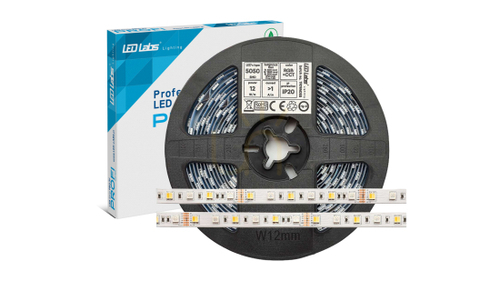
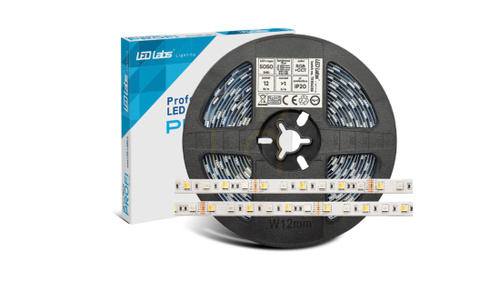
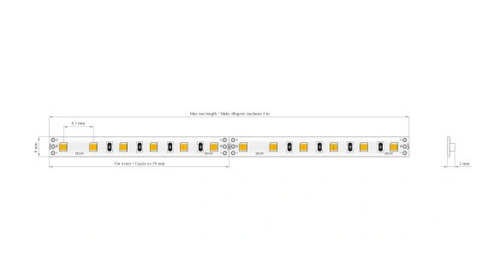
An RGB CCT LED strip is the tape to choose when one run has to do two jobs: give a room proper, usable white light and, when you feel like it, a wash of colour. The CCT half means that white can be tuned from a cosy, yellowish tone to crisp daylight, usually somewhere around 2700–6500 K. Plain CCT tape, sold as tunable white or dual white, does the white part only and suits anyone who never needs colour.
In British homes this kind of tape usually ends up in the same handful of places: under kitchen wall units, along a plinth, on top of coving, around a bathroom mirror and, in waterproof form, out in the garden. Each spot asks for a different IP rating, mounting method and driver position, so it pays to plan by location rather than by spec sheet.
Planning by location
| Where |
Tape that works |
IP rating |
Driver and control |
| Kitchen plinth (kickboard) |
SMD, 24 V; CCT is enough here |
IP65 near the floor, where mops and spills reach |
driver in a void behind the plinth, kept accessible; plug-in connectors so a plinth section can come off |
| Under wall units |
COB or dense SMD, CRI 90+ |
IP20, or IP65 behind the hob or sink |
driver on top of the wall units; RF or wall panel so it works without a phone |
| Coving and ceiling coves |
SMD, 24 V, RGB+CCT if you want colour |
IP20 |
feed both ends on long runs; Wi-Fi or Zigbee for scenes |
| Bathroom, zones 1 and 2 |
CCT, CRI 90+ for the mirror |
IPX4 minimum, IP65 or IP67 in practice |
driver outside the zones; electrician only |
| Bathroom, outside the zones |
CCT or RGB+CCT for a bath-time mood |
IP44 or higher, given the steam |
driver in a ventilated cupboard or loft void |
| Garden, decking, pergola |
sleeved or silicone-filled tape |
IP65 under cover, IP67 where rain hits |
outdoor-rated driver in a weatherproof enclosure |
Kitchens: plinths and wall units
Plinth lighting goes at the top of the kickboard, pointing down, so the floor glows and the tape itself stays out of sight. A small angle trim glued to the back of the plinth gives the strip the right tilt. Plinths get removed to reach pipework, so join sections with connectors rather than one long soldered run. Next to dishwashers and fridges, where the plinth is cut away, the tape can go under the base units instead.
Under wall units, fix the profile towards the front edge and angle it back. Mounted against the wall, it throws glare off glossy worktops and lights the splashback more than the chopping board. This is where tunable white earns its keep: cooler while you cook, warmer once the kitchen turns into the place where everyone sits in the evening.
Bathrooms and outdoors: the rules that matter
BS 7671 divides a bathroom into zones around the bath and shower. Anything in zones 1 and 2 needs at least IPX4, and the driver belongs outside the zones. In England, adding to a circuit inside those zones is notifiable work under Part P of the Building Regulations, so the 230 V side is for a registered electrician. Low-voltage tape on the far wall is less restricted, but steam still gets everywhere, so a sealed IP rating and an opal diffuser over the tape make sense.
Outside, IP65 silicone-coated tape copes under a pergola or soffit; where it takes direct rain or sits in a channel that can flood, go for IP67. Seal every cut end with the matching end caps, house the driver in a weatherproof box, and leave the supply from the house to an electrician.
Cores, controllers and drivers
RGB+CCT has five channels – red, green, blue, warm white, cool white – plus a common feed, so it runs on 6-core cable. CCT needs three cores, RGB four. A controller has to match: two channels for CCT, five for RGB+CCT. An RGB or RGBW receiver will leave the whites dark, and a basic dimmer will dim the strip but leave the colour temperature fixed.
Controls range from a handheld RF remote to a wall-mounted panel that sits where a light switch would, Wi-Fi apps that link to voice assistants, and Zigbee for smart-home hubs. In larger refurbishments DALI DT8 handles tunable white. Pick 24 V tape wherever you can: it draws half the current of 12 V, so you can get about 10 m from one feed before the far end dims. Longer coving runs are fed from both ends. Size the constant-voltage driver at the strip's total wattage plus around 20% headroom, and feed it from a fused spur.
Getting the white right
At full warm or full cool only half the LEDs are lit, so brightness drops to roughly half of the figure quoted for mixed white. Allow for that if the tape is your main light. Reels from different batches can look slightly green or pink at the same setting, so buy one continuous run's worth together. Behind an opal diffuser in an aluminium profile the warm and cool dots blend into one line, and the tape runs cooler and lasts longer than when it is stuck straight onto timber.
Questions people ask
Are LED strip lights good for under kitchen cabinets?
Yes, as long as they sit in a profile with a diffuser and have CRI 90 or more. You get even light over the worktop with no hot spots, and with CCT tape you can switch between bright task light and a softer evening tone.
Where should I place LED strip lighting under my kitchen cabinets?
Near the front edge of the wall unit, angled towards the wall. Placed right at the back, it reflects off glossy worktops and lights the tiles more than the work area.
What are the disadvantages of LED light strips?
Without a profile you see dots and the tape runs hot. Voltage drop dims long 12 V runs. Adhesive backing can give up on rough or greasy surfaces. Tunable tape also loses brightness at either end of its range.
Is a CCT light better than a non-CCT light?
Not brighter, just more flexible. If the room is used for different things through the day, tunable white helps. If one colour temperature always suits, single-white tape is simpler and gives more light per metre.
Is CCT the same as lumens?
No. CCT is the colour of the light in kelvin, lumens are the amount. Two strips at 4000 K can differ widely in brightness.
Can I fit LED strip lights myself?
The low-voltage side, yes: sticking the tape, fitting profiles and plugging in connectors. Connecting the driver to the mains is a job for a qualified electrician, and work in a bathroom's zones has to be notified under Part P.
If you only need tunable white without colour, read more about CCT LED strip lights. Profiles, drivers and other tape types are covered under LED strips and profiles.