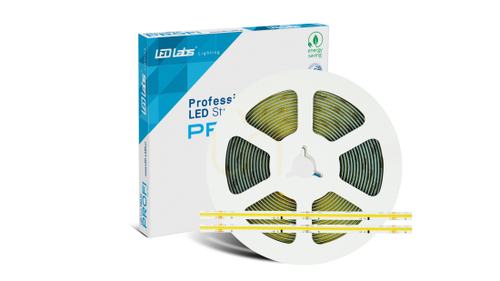
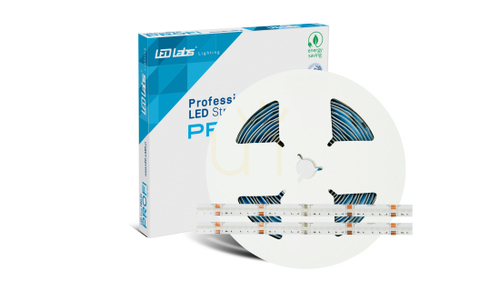
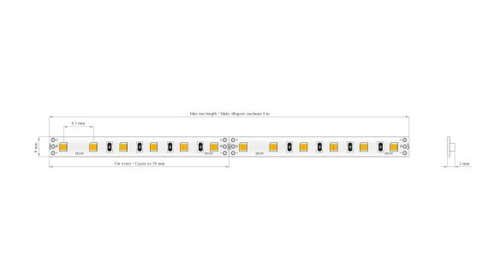
A CCT LED strip carries two rows of white LEDs, one warm and one cool, and a controller blends them to whatever shade of white you want. Turn it towards warm for a soft evening glow, towards cool for bright task light over the worktop, and the same strip does both jobs without rewiring.
You will also see it sold as tunable white or dual white. Compared with a single-colour strip, it needs a third wire, a two-channel controller and a driver sized for both channels running together.
How a tunable white strip works
CCT stands for correlated colour temperature, measured in kelvin. On the strip, warm-white chips (typically around 2700 K) and cool-white chips (around 6500 K) alternate or share one package. Both share a common positive, and each has its own negative channel. The controller dims each channel independently, so the mix moves smoothly along the scale rather than jumping between fixed settings.
That is the key difference from fittings marked 3CCT, such as many downlights, where a small switch on the driver lets the installer pick one of three whites before fitting. A strip with a CCT controller can be changed any time from a remote, a wall plate or a phone.
Colour temperature chart for strip lighting
| Setting |
Kelvin |
Where it suits |
| Candlelight / warm dim |
1800–2200 K |
late evenings, bedrooms (only on extended-range strips) |
| Warm white |
2700–3000 K |
living room coving, dining, bedrooms |
| Neutral white |
3500–4500 K |
kitchen worktops, utility rooms, wardrobes |
| Cool white |
5000–6500 K |
home office, garage workbench, make-up mirror |
Most strips span 2700–6500 K or 3000–6000 K; a few start at 2200 K. A wide range gives you more mood, though the middle of the scale can look a touch less crisp than either end.
What to check before you buy
-
Voltage: 12 V or 24 V DC. 24 V runs roughly 10 m from one feed, 12 V around 5 m before the far end dims and shifts colour.
-
Power: usually 10–20 W/m, quoted with both channels on. Size the driver at watts per metre × length plus about 20% headroom: 5 m at 15 W/m is 75 W, so pick a 90–100 W driver.
-
Output: roughly 600–1500 lm per metre. Coving for ambience needs far less than a strip doing the job of a ceiling light.
-
COB or SMD: COB strips pack 500 or more chips per metre and give an unbroken line; SMD strips need a deep aluminium profile with an opal diffuser to hide the dots.
-
CRI: 80 is fine for coving; 90+ makes food, wood and skin look right in kitchens and bathrooms.
-
IP rating: IP20 for dry rooms, IP65 for kitchen splash areas, IP67 where water can reach it.
Controllers and drivers
A standard single-channel dimmer cannot balance two whites, so you need a CCT (dual-white) controller between the driver and the strip. Options range from RF remotes, which work through cabinet doors, to wall-mounted touch or rotary panels, Wi-Fi and Bluetooth receivers with an app, and Zigbee units for an existing smart-home hub. Larger installations may use DALI DT8. Check the maximum current per channel and add an amplifier on long runs rather than overloading one controller.
Fitting tips and common mistakes
Classic spots in a UK home are under kitchen wall units, along plinths, in coving or a recessed ceiling detail, behind a bathroom mirror and around a home-office desk. Mount the strip in an aluminium channel: it pulls heat away from the LEDs, which is what shortens their life. Use three-core cable, keep strips from one batch in a continuous run so the whites match, and power long lengths from both ends. The 230 V side of the driver should be connected by a qualified electrician to BS 7671, and in bathrooms the zone rules decide where the driver and strip may go. Leave the driver somewhere you can reach later.
Brightness at each end of the scale
The lumen figure on a CCT strip's spec sheet is normally measured with both channels at full. Slide the controller all the way to warm or all the way to cool and only half the LEDs are working, so expect roughly half that output. For a kitchen worktop lit at a neutral setting that rarely matters. If you want plenty of light at 2700 K in a living room, choose a strip with more lumens per metre or run two strips side by side in a wider channel.
Controllers also behave differently in the middle of the scale. Some hold overall brightness steady as you shift the colour; others simply add the two channels, so the mid-point looks brighter than either end. Try the controller with a short length on the bench before anything goes up, and wipe the diffuser with a dry cloth now and then rather than using solvents on a silicone-coated strip.
FAQ
What is 3 CCT in LED lighting?
It describes a fitting with a selector offering three fixed whites, often 3000 K, 4000 K and 6000 K, chosen once during installation. A CCT strip is continuously adjustable instead.
Is CCT the same as lumens?
No. CCT is the colour of the light, in kelvin; lumens measure how much light there is. A strip can be very bright at 2700 K or dim at 6500 K.
How do I know if my LED strip is 12 V or 24 V?
The voltage is usually printed on the strip near the solder pads or on the reel label. Cut intervals help too: 24 V strips are often cut in longer sections than 12 V ones of the same density. If in doubt, check the driver output rather than guessing.
Where can I safely cut an LED strip?
Only across the marked copper pads, usually every 2.5–10 cm. Cutting anywhere else kills that section.
How many wires does a CCT strip have?
Three: common positive, warm white and cool white. RGB uses four and RGB+CCT six.
Can I add colours later?
Not to a CCT strip. If you want colour as well as tunable white, look at RGB LED strip lights in an RGB+CCT version from the start.
Still weighing tunable white against a fixed colour? More on strip types, power and fitting in general: LED strip lights.