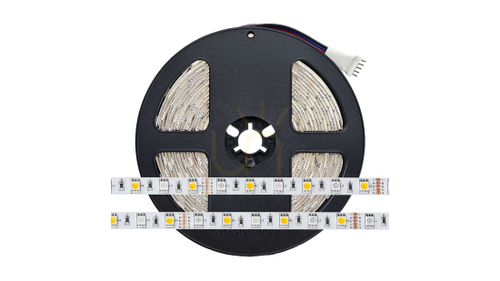
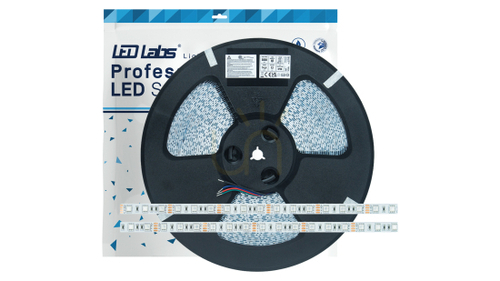
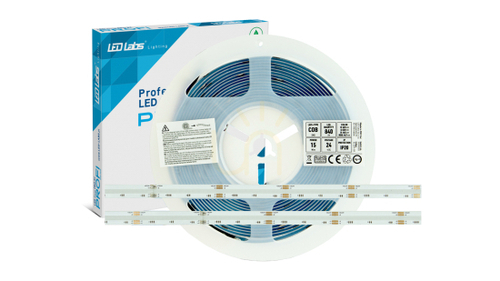
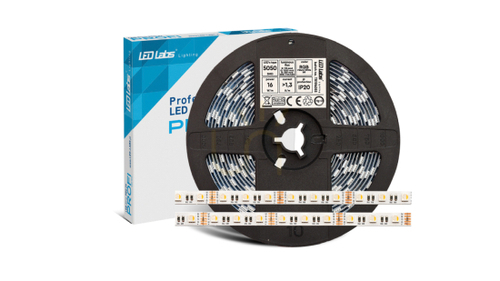
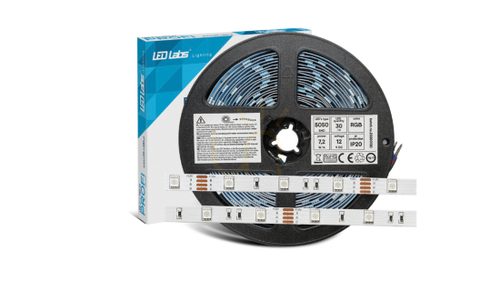
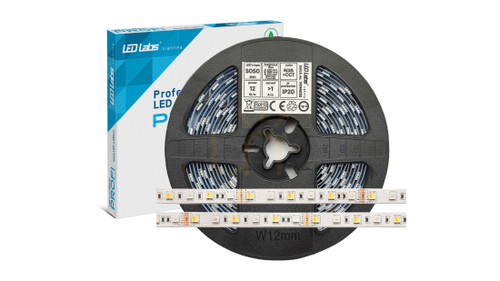
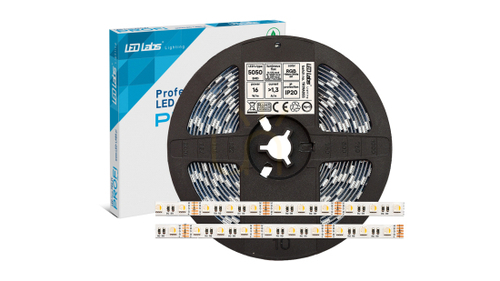
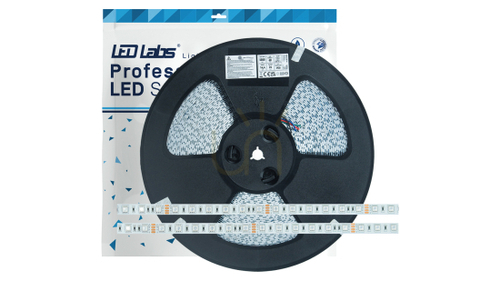
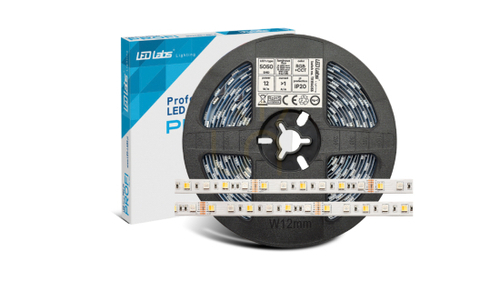
An RGB LED strip blends red, green and blue diodes to produce almost any colour you like, changed from a remote, a phone app or a wall panel. The same length of tape can wash a ceiling cove in soft amber on a Sunday evening, then glow deep blue behind the TV for a film.
Compared with a single-colour strip, going RGB changes three things: the strip needs a controller, the cable carries more cores, and its ‘white’ is a mix rather than a true white. Get those right before you buy and the driver, controller and profile all fall into place.
How RGB strip lights work
Most RGB strips use 5050 SMD chips, each holding a red, a green and a blue die in one package. The strip has a shared positive and three colour channels, so four wires. The controller dims each channel independently and your eye reads the blend as one colour: red plus green looks yellow, all three at full output look roughly white.
That white is the catch. It tends towards blue or pink and makes objects look a little flat. If the strip will sometimes act as ordinary light – over a kitchen worktop, along a hallway – choose RGBW (a separate white diode) or RGB+CCT (tunable white, roughly 2700–6500 K) from the start. You cannot add a white channel to an RGB installation later.
Choosing a strip: the numbers that matter
| Spec |
Typical range |
Why it matters |
| Voltage |
12 V or 24 V DC; 5 V USB kits |
24 V runs further from one feed |
| Single-end run |
about 5 m at 12 V, about 10 m at 24 V |
beyond this, colours drift at the far end |
| LED density |
30, 60 or 120 LEDs/m; COB 800+ per metre |
fewer visible dots as density rises |
| Power |
roughly 7.2–19.2 W/m |
brightness, driver size, need for a profile |
| Output |
around 280–800 lm/m |
mood and accent light, not main lighting |
| IP rating |
IP20 dry rooms, IP65 kitchens and bathrooms, IP67/IP68 outdoors |
where it can go |
| Cut points |
every 25–100 mm |
how neatly it fits a shelf or recess |
Sizing the driver is simple: length times watts per metre, plus about 20% headroom. Five metres at 14.4 W/m draws 72 W, so pick a 90–100 W driver. Never put a 12 V strip on a 24 V supply, and don’t reuse an old halogen transformer – it gives AC, not DC.
RGB, RGBW and controllers
An infrared remote is the cheapest option but needs line of sight to its receiver. RF remotes work through cupboard doors and plasterboard, so the controller can be tucked away. Wi-Fi and Bluetooth controllers add an app with scenes, schedules and voice-assistant control, and some have a music mode. Larger smart-home set-ups tend to use Zigbee, DALI or DMX.
The controller must match the strip: a four-wire RGB controller cannot drive the white diode on an RGBW strip, so ‘RGBW strip with controller’ kits are sold as matched pairs for a reason. For long runs an RGB amplifier repeats the signal and adds power.
Where RGB strips work best
Hidden light looks best. Think coving and ceiling recesses, the back of a floating shelf, a kitchen plinth, under the bed frame, stair treads, a gaming desk. Behind a TV, a soft glow reduces the contrast between a bright screen and a dark wall. In bathrooms, choose IP65 or higher and keep the driver outside the wet zones.
Clean and degrease the surface first – adhesive on dust lets go within weeks. Anything above about 10 W/m belongs in an aluminium profile, which draws heat away while an opal diffuser hides the individual LEDs. For RGB, a slightly deeper profile gives the colours room to blend. Plug-in drivers are a DIY job. Hard-wiring a driver into a 230 V circuit is work for a qualified electrician under BS 7671.
Common problems and care
Long runs fade or turn reddish at the far end. That is voltage drop: blue and green need more voltage, so they dim first. Feed power from both ends, upsize the cable (0.5–0.75 mm² up to 5 m, up to 2.5 mm² for 10–20 m) or switch to 24 V. If colours come out swapped, the controller’s wire colours simply don’t match the strip’s pads – test before soldering. Click-on connectors are handy but less reliable than solder at higher loads or in damp spots.
Want each section to show a different colour, with chasing rainbow effects? That takes a digital strip rather than plain RGB – see addressable LED strip lights.
RGB LED strip FAQs
How long do LED strip lights last?
Quality strips are often rated at 25,000–50,000 hours. Heat is what shortens that most, so a profile and a correctly sized driver matter more than the brand on the reel.
How do you check an RGB LED strip?
Set the controller to pure red, then green, then blue. If one colour is missing along the whole strip, check that channel’s wire; if a single segment is dark, look for a cracked joint or damaged pad.
Why is one LED strip a different colour?
Usually voltage drop on a long run, a swapped channel wire, or two reels from different production batches. Feeding from both ends cures the first; matching reels avoids the last.
What is the brightest strip light?
High-density 24 V strips, typically around 19–24 W/m or more, are among the brightest; RGB mixed white is dimmer than a dedicated white strip of the same wattage.
Is 24 V RGB LED strip better than 12 V?
For runs over about 5 m, yes: it draws half the current, so voltage drop and colour shift are smaller. For short furniture runs 12 V works fine.
More on plain white and other strip types: LED strip lights.