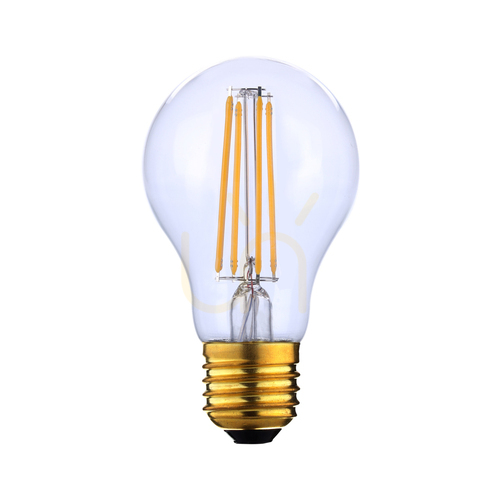
Edison bulbs are retro-style light bulbs made to look like the carbon-filament lamps of the late Victorian era, with clear or tinted glass and a glowing filament you can actually see. Almost all of them now use LED filaments inside, so you get the old-fashioned look in a bare pendant or open fitting while using a fraction of the electricity an original would.
Choosing one is less about watts and more about the room: a squirrel-cage bulb over a scaffold-board table, an opal globe in a mid-century pendant and a candle bulb in a period chandelier are all ‘vintage’, yet each needs a different bulb.
Edison bulb or Edison screw?
The two get mixed up constantly. Edison screw is a type of cap: ES (E27) is the larger thread, SES (E14) the smaller one. An Edison bulb is a style – long, clear or amber glass, visible filament – and it can come with an ES, SES or bayonet cap.
That matters in British homes, where most pendant lampholders and many older lamps take a B22 bayonet rather than a screw. Most retro bulbs are made with an E27 cap, so before you fall for a particular shape, check what your fitting takes. If you're wiring a new pendant on a fabric flex, choosing a screw-cap lampholder from the start opens up far more shapes. Anything connected to the mains is a job for a qualified electrician.
Matching the bulb to the room
Start with the fitting and the look you're after, then pick glass and colour temperature to suit. These pairings work well in typical UK homes and hospitality spaces:
| Setting |
Bulb shape |
Glass and colour |
Typical output |
| Warehouse conversion, bare pendant on fabric flex |
ST64 squirrel cage or tubular |
amber, 1800–2200 K |
150–400 lm |
| Victorian or Edwardian terrace, period chandelier |
candle C35, small globe G45 (SES) |
clear, 2200–2700 K |
250–470 lm each |
| Mid-century pendant or table lamp |
GLS or globe G95 |
opal or crown-silvered, 2700 K |
400–800 lm |
| Pub, café or high-ceilinged dining room |
large globe G125, long tube |
amber or smoked, 1800–2200 K |
200–600 lm |
| Kitchen island, three or more drops |
ST64 or globe |
clear, 2700 K |
400–800 lm each |
As a rough guide, a 4 W decorative filament bulb gives about the glow of an old 35–40 W incandescent. A clear 7–8 W filament GLS reaches roughly 700–1,000 lumens, which is enough to light a hallway or a table properly.
Glare, glass and a bit of honesty about brightness
A clear bulb hanging at eye level can be dazzling, especially over a dining table where people sit and look across it. There are a few ways round this. Amber glass softens the light and makes it look like candlelight. Smoked glass dims it further and suits dark-painted walls. Opal glass spreads the light evenly with no visible filament at all. Crown-silvered bulbs have a mirrored tip that throws the light upwards or back into a reflector, which is why they were so popular in sixties and seventies fittings.
The other thing to be honest about is brightness. Many amber Edison bulbs give 100–400 lumens: lovely in the evening, too dim for reading. In a living room they work best alongside a floor lamp or wall lights, or as a cluster of three to five drops rather than a single pendant.
Fittings, care and common mistakes
-
Size, not just cap. An ST64 is around 14 cm long and big globes are longer still, so check that the bulb fits inside a shade or cage, and allow for the extra drop under a low ceiling.
-
Keep it visible. Inside an opaque shade an Edison bulb looks like any other. Bare pendants, cages, clear glass and open chandeliers are where it earns its place.
-
One colour per fitting. In a chandelier, use the same bulb in every arm. Mixing 2200 K and 2700 K is very noticeable.
-
Old lamps. A genuine antique lamp may have perished wiring or a worn lampholder. Have it checked and rewired before use.
-
Dust. Clear glass shows everything. Wipe it with a dry, soft cloth once it's switched off and cool.
-
Outdoors. Most retro bulbs are rated IP20 and belong indoors; outside they need a fitting or festoon with a suitable IP rating.
Edison bulb questions
Are incandescent light bulbs still illegal?
It isn't illegal to own or use them. Traditional incandescent and most halogen bulbs for general lighting were phased out of sale, which is why nearly every Edison bulb now uses LED filaments. Carbon-filament replicas still turn up as decorative lamps, but they draw around 40 W for very little light and run hot.
What type of bulb is an Edison bulb?
Today it's usually an LED filament bulb: rows of tiny diodes on thin strips that mimic a glowing wire. They draw roughly 2–8 W, stay warm rather than hot, and are typically rated for 15,000–25,000 hours.
How do I tell what light bulb I need?
Look at the old bulb or the lampholder. Two lugs on the side of a smooth cap mean bayonet – usually B22 (BC), sometimes the smaller B15 (SBC); a thread means screw – 27 mm for ES, 14 mm for SES. Then check the space inside the shade and decide how much light you need.
What sizes do Edison screw bulbs come in?
For retro bulbs the common caps are E27 (ES) and E14 (SES). Shapes vary more than caps: GLS, ST64, globes from 45 mm to 125 mm and beyond, tubes and candles.
Can you dim Edison bulbs?
Only those marked dimmable, and only on an LED-compatible dimmer, usually a trailing-edge type. Otherwise you may get flicker or a faint buzz.
Is 2200 K too yellow for a kitchen?
For worktops, yes. Use 2700–3000 K bulbs there and keep the amber ones for the dining end or the evening.
For bulbs beyond the retro look, head to light bulbs. And if the bulb is going into a standing lamp with the same character, have a look at retro floor lamps.