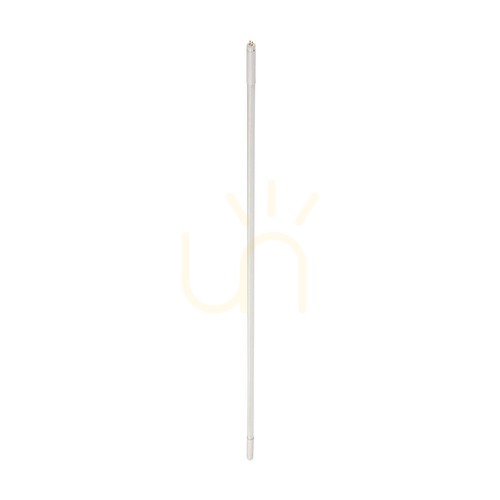
A T5 fluorescent tube is the slim 16 mm tube with a G5 bi-pin cap, used in office panels, kitchen under-cabinet lights, bathroom mirror cabinets and display units. To replace one you need two facts: its exact length, and whether the fitting runs it from an electronic ballast or older control gear. Those decide whether a straight fluorescent swap or an LED replacement will work.
General-purpose linear fluorescent tubes are being taken off the market under UK and EU rules on mercury, so most people searching for a T5 equivalent today end up choosing between LED retrofit tubes and a new LED batten.
Are all T5 fluorescent tubes the same length?
No – and length is tied to wattage, so a fitting takes one size only. The quickest check is the print near one end of the glass, such as ‘T5 28 W 840 HE’. Failing that, measure the tube without its pins.
| Length without pins |
Trade name |
Fluorescent wattage |
Typical LED equivalent |
| approx. 288 mm |
12 in mini (often sold as 300 mm) |
8 W |
4–5 W |
| approx. 517 mm |
21 in mini |
13 W |
7–9 W |
| approx. 549 mm |
2 ft |
14 W HE / 24 W HO |
7–10 W |
| approx. 849 mm |
3 ft |
21 W HE / 39 W HO |
10–15 W |
| approx. 1149 mm |
4 ft |
28 W HE / 54 W HO |
16–26 W |
| approx. 1449 mm |
5 ft |
35 W HE / 49 W or 80 W HO |
20–35 W |
HE means high efficiency, HO high output – same length, very different brightness. A 28 W HE tube gives roughly 2,600–2,900 lm, its 54 W HO sibling around 4,500–5,000 lm. Swap like for like, or compare lumens when moving to LED. Tiny 4 W and 6 W tubes (about 136 and 212 mm) also exist for cabinet lights.
What T5 actually means
"T" stands for tubular and the number is the diameter in eighths of an inch: 5/8 in is about 16 mm. A T8 is 26 mm with a G13 cap and roughly 5 cm longer than the matching T5, so the two aren't interchangeable without a converter or a new fitting. The G5 cap has two pins 5 mm apart; you slide the tube into the lampholders and turn it 90° until it locks.
The same two characters also label circular T5 tubes, which use a four-pin 2GX13 cap, and tiny W2x4.6d wedge bulbs from car dashboards. Neither fits a linear T5 fitting, so check the cap before ordering.
T5 fluorescent tube replacement: the LED options
Standard T5 HE and HO tubes only run on an electronic (high-frequency) ballast. The small 8 W and 13 W tubes in older under-cabinet lights often sit on a wire-wound choke with a starter instead. Your LED choice follows from that:
-
Type A – runs on the existing electronic ballast; you just swap the tube. Check the maker's ballast compatibility list, and bear in mind that when the ballast dies, the tube goes dark with it.
-
Type B – runs straight off the mains. The ballast is removed and the fitting rewired, which is a job for a qualified electrician working to BS 7671. Label the converted fitting so nobody fits a fluorescent tube in it later.
-
Type A+B – works either way, so you can fit it now and bypass the ballast once it fails.
-
Integrated LED batten – a complete T5-style fitting with its own mains lead, often a switch, and linkable in runs. Usually the tidiest fix when an old under-cupboard light is past its best.
Colour, warm-up and beam
The three-digit code tells you colour rendering and colour temperature: 830 means CRI 80+ at 3000 K warm white, 840 is 4000 K cool white for kitchens and offices, and 865 is 6500 K daylight for workshops and garages. Fluorescent T5 tubes are designed to peak at around 35 °C, so in a cold garage they start slowly and look dim; LED gives full output from the moment you switch on.
LED tubes light in one direction, typically over 150–240°, whereas a fluorescent glows all round. In cove lighting or reflector fittings, rotate the tube in its holders until the LEDs face where the light is needed.
Frequently asked questions
Which is better, LED or fluorescent?
For almost every home use, LED. It needs about half the wattage for similar light, starts instantly in the cold, contains no mercury and typically lasts 30,000–50,000 hours against around 20,000 for a standard T5 fluorescent.
Can I test a fluorescent tube with a multimeter?
You can check the cathode at each end: with the power off and the tube out, measure resistance across the two pins at one end, then the other. An open circuit means a broken filament. A tube that passes but still won't light usually points to the ballast or starter.
What is the LED replacement for a T5 8 W 300 mm tube?
An LED T5 of the same 288 mm (300 mm with pins) length, usually 4–5 W. If the light has a starter, choose a tube made for wire-wound gear, which normally comes with a replacement starter.
Why does my T5 tube flicker?
Blackened ends and a slow, flickering start mean the tube is at end of life. A new LED tube that flickers is usually a ballast compatibility issue.
How do I dispose of old T5 tubes?
They contain mercury, so take them to a household waste recycling centre or a retailer take-back point, never the general bin. If one breaks, ventilate the room and pick up the pieces with damp paper rather than a vacuum.
Older fittings with the thicker tube are covered under T8 tubes, and other caps and lamp types under light bulbs.