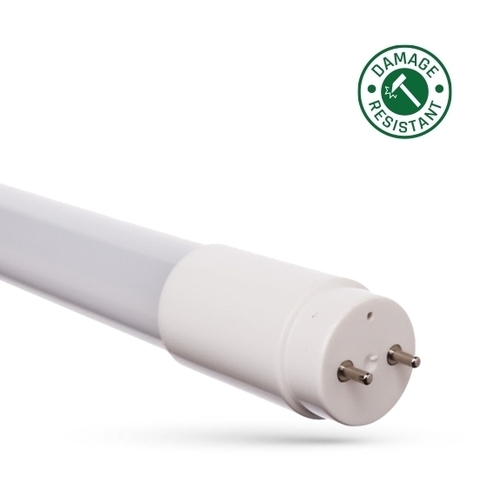
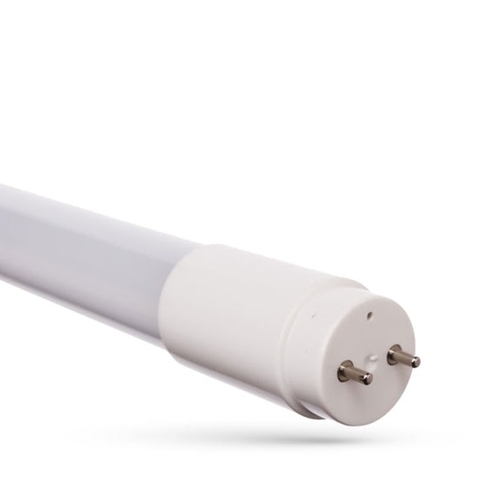
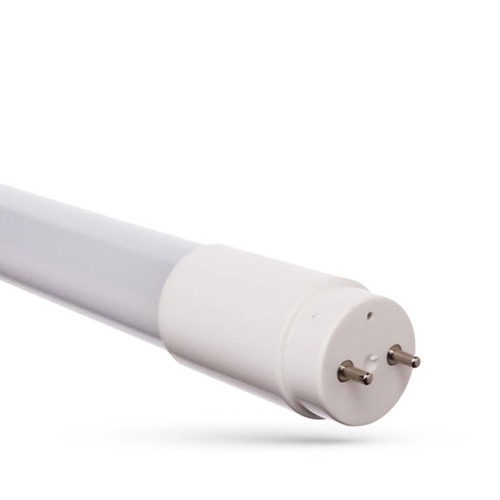
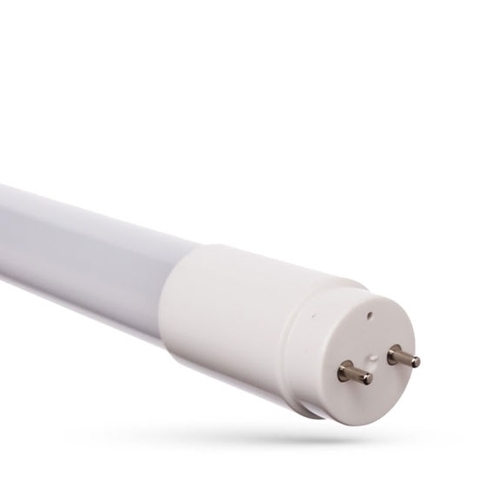
A T8 fluorescent tube is the 26 mm-wide, two-pin G13 tube found in garage battens, workshop strip lights and older suspended-ceiling office panels. These days the T8 name covers both the original mercury-filled fluorescent and its LED replacement, which shares the exact size and cap but draws roughly half the power.
So the real decision is not which tube looks right but which gear sits inside your fitting. Get that right and a swap takes minutes; get it wrong and the new tube either stays dark or fails early.
Sizes first: measure the old tube
T8 tubes are sold by length in feet, and the length decides the wattage. Measure from pin tip to pin tip and match it, because a longer tube simply will not fit a shorter batten. When comparing an LED tube with the fluorescent it replaces, look at lumens rather than watts.
| Nominal size |
Length incl. pins |
Fluorescent |
Typical LED equivalent |
| 2 ft |
approx. 600 mm |
18 W |
8–10 W, 800–1400 lm |
| 3 ft |
approx. 900 mm |
30 W |
12–14 W, 1200–2000 lm |
| 4 ft |
approx. 1200 mm |
36 W |
14–20 W, 1800–2900 lm |
| 5 ft |
approx. 1500 mm |
58 W |
20–25 W, 2500–3300 lm |
| 6 ft |
approx. 1800 mm |
70 W |
around 24–30 W |
A 5 ft fluorescent puts out more raw lumens than most LED tubes of the same length, but it shines in every direction, including straight up into the batten. An LED tube aims its light downwards across roughly 120–180°, so on the workbench the two usually look closer than the numbers suggest.
Can you still buy fluorescent T8 tubes?
New fluorescent T8 tubes in the standard 2 ft, 4 ft and 5 ft lengths can no longer be placed on the market in Great Britain or the EU, because of their mercury content and efficiency. Stock that was already in the supply chain can still be sold, and tubes already installed can stay in use until they fail. A few special versions linger, but for an ordinary garage or office batten, LED is now the practical replacement.
Swapping to LED: work out what is in the batten
Switch the fitting on and watch. A click and a few flashes before it lights means a switch-start fitting with a magnetic ballast and a small plug-in starter. An instant, silent start usually means an HF electronic ballast.
-
Switch-start – use an LED tube made for magnetic ballasts and swap the starter for the LED (dummy) starter supplied with it. The ballast stays in place.
-
HF electronic ballast – only a tube listed as compatible with that ballast will work reliably. Otherwise the ballast has to be bypassed.
-
Mains-direct (ballast bypass) – the ballast and starter are removed and 230 V goes straight to the lampholders: both wires to one marked end on a single-ended tube, or line at one end and neutral at the other on a double-ended one.
Rewiring a fitting is a job for a qualified electrician working to BS 7671. Once it is done, label the batten clearly. A fluorescent tube pushed into a converted fitting, or a mains-direct LED tube in an unconverted one, can damage the tube or the fitting.
Where T8 tubes earn their keep
Garages, workshops, sheds with power, stockrooms, plant rooms and communal stairwells – anywhere you want flat, even light over a large area for little money to run. In an unheated garage the change is obvious on a cold morning: fluorescents start sluggishly and take a while to brighten, while LED tubes come on at full output straight away. For damp or dusty spaces, fit the tube in an IP65 anti-corrosive batten; the tube itself is normally only IP20.
Colour is printed as a three-digit code. The first digit is the colour rendering band (8 for CRI 80–89, 9 for 90 and above), the last two give the colour temperature in hundreds of kelvin. 840 (4000 K) is the usual choice for garages and workshops, 830 (3000 K) feels softer in a utility room, and 865 (6500 K) gives the crisp daylight look many prefer in warehouses.
Pitfalls and care
- Opal diffusers spread the light evenly; clear ones give slightly more output but show the individual LEDs.
- Polycarbonate tubes don't shatter like glass – worth having over a workbench or near food.
- Old G13 lampholders go brittle and loose; a poor contact often looks like a faulty tube.
- Spent fluorescent tubes contain mercury. Take them to a household recycling centre rather than the bin, and if one breaks, air the room and pick the pieces up without a vacuum cleaner.
Frequently asked questions
What does T8 mean on a fluorescent tube?
The T stands for tubular and the number is the diameter in eighths of an inch. Eight-eighths makes one inch, about 26 mm.
Can I replace a fluorescent T8 with LED?
Yes. In a switch-start batten it is usually just the tube and the starter. With an HF ballast you need a compatible tube or a bypass done by an electrician.
Can I put a T5 tube in a T8 fixture?
Not directly. A T5 is 16 mm wide, has a G5 cap and comes in different lengths, so it neither fits the lampholders nor matches the ballast.
How long is a 5 ft T8 tube in mm?
Around 1500 mm including the pins. A 4 ft tube is about 1200 mm and a 2 ft one about 600 mm.
Do LED T8 tubes need a starter?
Only in the sense that a switch-start fitting needs something in the starter socket to close the circuit – that is the LED starter supplied with the tube. Mains-direct and HF-compatible tubes need no starter at all.
Why does my fluorescent tube flicker?
Usually a worn starter or a tube near the end of its life, often with blackened ends. Cold temperatures and loose lampholders can cause it too.
If your fittings take the slimmer 16 mm tubes instead, read about T5 tubes. For other caps and shapes, from E27 to GU10, see light bulbs.