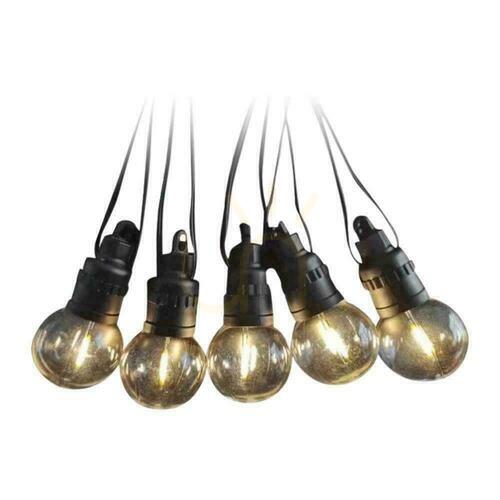
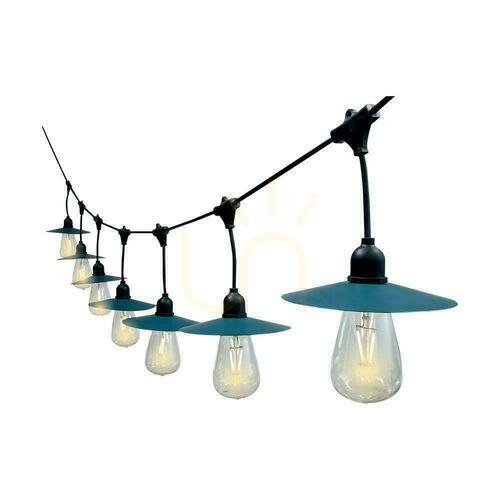
Solar string lights charge a small battery from a solar panel during the day and switch themselves on at dusk, so you can hang them anywhere the sun reaches the panel – no socket, no extension lead trailing across the lawn. For outdoor string lights, that changes where they can go: along the back fence, over a pergola at the far end of the garden, round a balcony railing in a flat, or through the branches above a bench.
The trade-off is the British weather. How long the lights stay on in the evening depends far more on where the panel sits than on how many bulbs the string has, and a grey November week will always show it.
Do solar-powered string lights work well?
For decorative light from spring to early autumn, yes. On a sunny summer day a decent set charges fully and runs for 6–10 hours, and larger sets with bigger panels can last up to around 15 hours. In the darkest months the same lights may manage only 2–4 hours, because the panel gets weak, low sun for a short time.
It also helps to be clear about the job they do. A solar string gives atmosphere, not task light: enough to see faces across a patio table, not enough to light a path safely or read by. For that you still want proper garden lighting.
How they work
A set has three parts. The panel, usually monocrystalline, sits on a ground stake or a bracket. Inside its housing you will normally find the rechargeable battery and a light sensor that turns the string on at dusk and off at dawn. A lead cable, typically 1.5–3 m long, runs from the panel to the first light.
That lead is what makes solar strings flexible. The panel can stand in the sunniest corner of the lawn while the lights hang in shade under a veranda or a tree. Many panels tilt, and some sets add a USB socket so you can top the battery up after a run of overcast days.
Batteries are usually NiMH cells (1.2 V, roughly 600–2000 mAh) or 3.7 V lithium-ion. Fine wire strings with micro LEDs run happily on a panel well under 1 W; festoon-style sets with larger bulbs need panels of several watts, up to about 10 W.
Fairy lights or festoon lights?
Solar fairy lights – tiny LEDs on thin copper or PVC wire – wrap round shrubs, trellis, railings and tree trunks and give a soft, scattered sparkle. Solar festoon lights have larger bulbs, often round G50 shapes, spaced roughly 0.5–1 m apart, and hang in loose swags over a dining area. They throw noticeably more light per bulb, which is why they come with bigger panels. You will also see nets and curtains for covering a hedge or a wall.
Choosing solar string lights
| Spec |
Typical range |
What it means in practice |
| Lit length |
2–20 m |
Add the panel lead, usually 1.5–3 m |
| Number of lights |
10–200 LEDs, or 10–20 festoon bulbs |
More lights on the same panel means shorter run time |
| Colour |
1800–2200 K amber, 2700–3000 K warm white, cool white, multicolour |
Warm white suits planting and timber |
| Weather rating |
IP44, sometimes IP65 or IP67 |
IP44 copes with rain; IP65 for fully exposed spots |
| Summer run time |
6–10 hours |
Often 2–4 hours in midwinter |
| Charge time |
6–8 hours of direct sun |
Partial shade means a partial charge |
Look for an on/off switch (handy for holidays and winter storage), a remote with a timer, and a dimmer setting, which stretches the run time. Cable colour matters more than you might think: black flex stands out against a pale render or white fence, while clear or green cable disappears into foliage.
How to display solar lights in the garden
Put the panel where it gets at least 6–8 hours of direct sun, facing south and tilted at roughly 30–45°, a little steeper in winter when the sun is low. Then plan the string around it. Along a fence, fix small hooks or clips every metre or so and let fairy lights run along the top rail. Over a patio, zigzag a festoon between posts or the house wall and a pergola. Round a tree, spiral up the trunk and out along one or two main branches rather than smothering the canopy.
Keep the panel away from porch lights and street lamps, or the sensor will think it is still daytime. A north-facing balcony is hard going for any solar panel; more on lighting railings and small outdoor spaces: balcony string lights.
Common mistakes and care
- Not giving the battery a first charge: leave a new set switched off in sun for a day or two.
- Forgetting the protective film on the panel.
- Letting the panel get grimy. Wipe it with a damp cloth every few weeks; pollen and bird droppings cut charging.
- Fitting the wrong replacement battery. Use the same chemistry and voltage – ordinary alkaline batteries will not charge and can leak.
- Leaving everything out all winter. Bringing the panel and battery indoors for the darkest months helps the cells last longer.
FAQs
Which solar fairy lights are the best?
The ones that suit your spot. Check the IP rating (IP44 at least), the length of the panel lead, whether the battery can be replaced, and whether the panel size matches the number of lights. A long string on a tiny panel will always disappoint.
Are solar string lights waterproof?
Outdoor sets are weatherproof rather than waterproof. IP44 means protection against splashing from any direction, which covers normal rain. IP65 adds protection against jets of water and dust. None should sit in a pond or puddle.
Can you leave solar lights out in winter?
You can – frost and snow won't harm a weatherproof set – but on short days expect only a few hours of light. Clear snow and leaves off the panel, and bear in mind that lithium cells charge poorly below freezing. If the lights are really for summer evenings, packing the panel and battery away from late autumn to early spring gives the cells a longer life.
How do you string up solar lights on a fence?
Start with the panel: fix it to the top of a post on the sunniest stretch using the bracket supplied, or push its stake into the border in front. Then run the string along the top rail with cup hooks, screw eyes or outdoor adhesive clips every 50 cm to 1 m so it doesn't sag. Don't staple through the cable or pull it tight round sharp corners. Fairy lights can weave through trellis panels; festoons look best looped from post to post. If it's a shared boundary fence, have a word with your neighbour before screwing anything into it.
Why are my solar string lights not working?
Check the switch, the protective film and whether the panel is in shade or lit by another lamp. If an older set dies soon after dusk even after a sunny day, the battery has probably reached the end of its life – typically after two or three seasons.
If you have an outdoor socket, or want lights that run all night whatever the weather, read more about types and lengths of outdoor string lights.