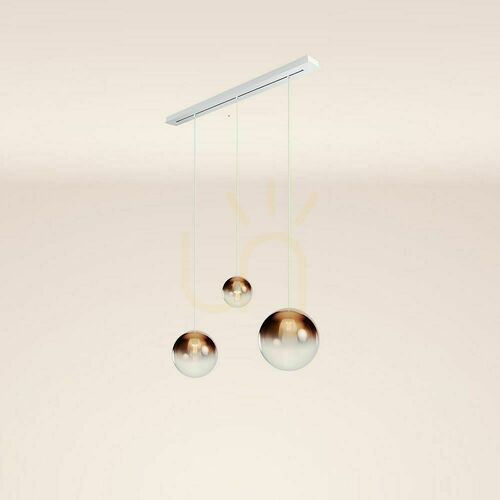
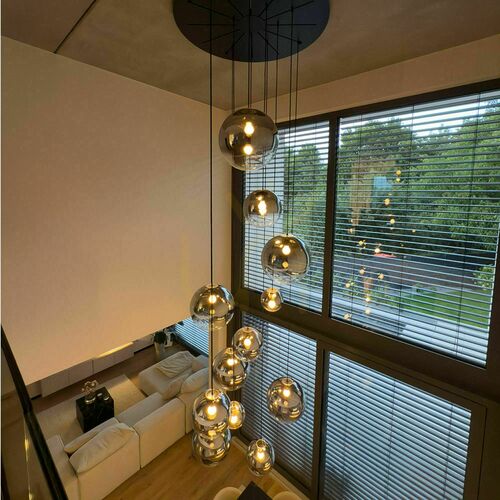
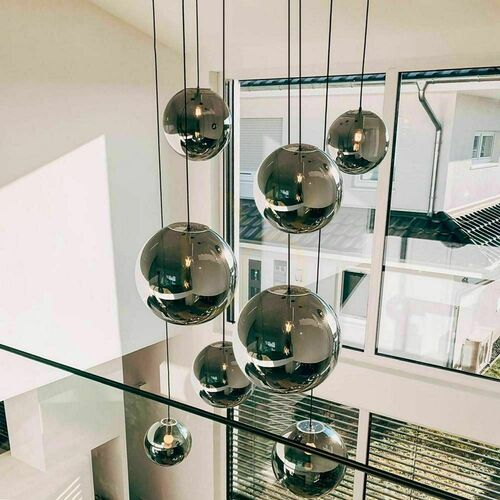
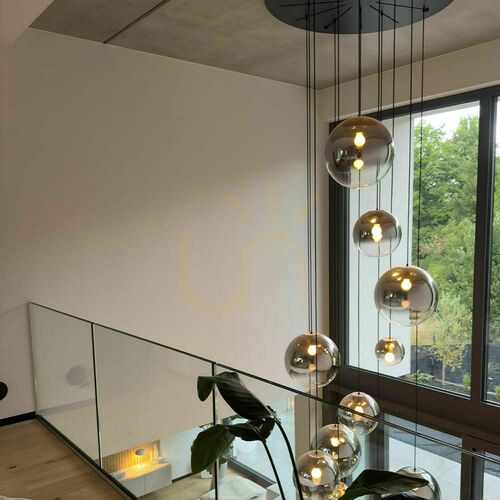
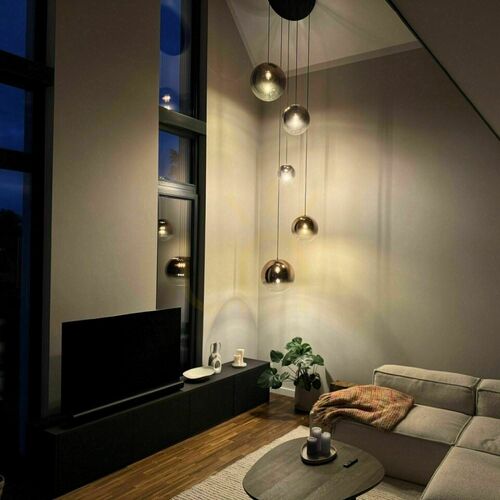
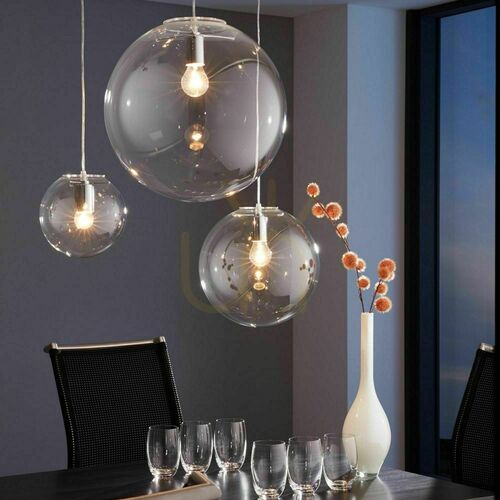
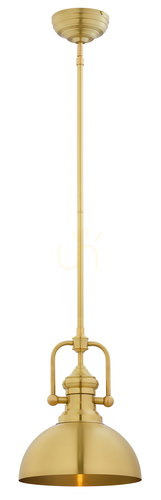
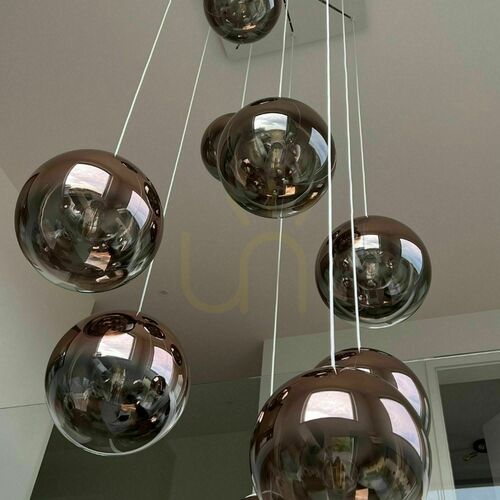
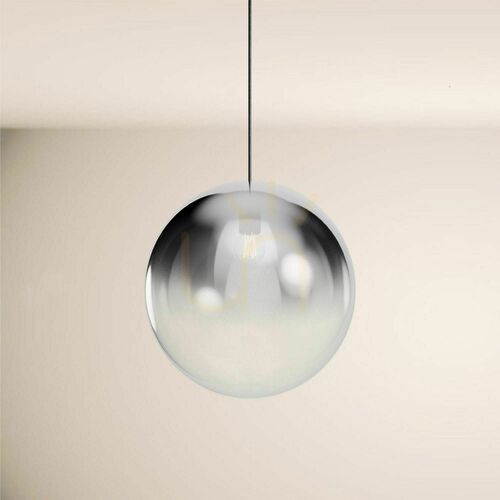
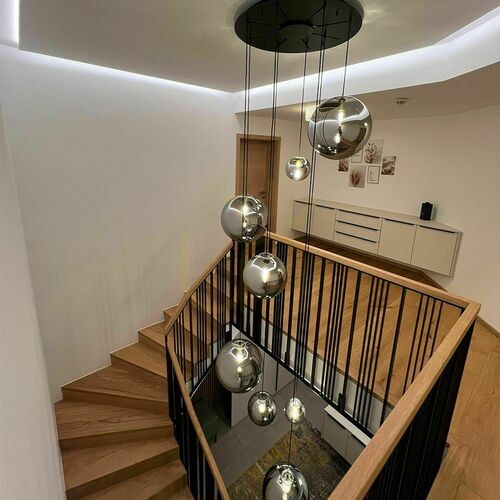
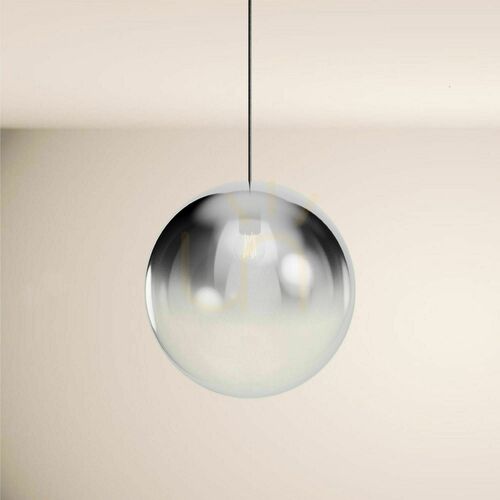
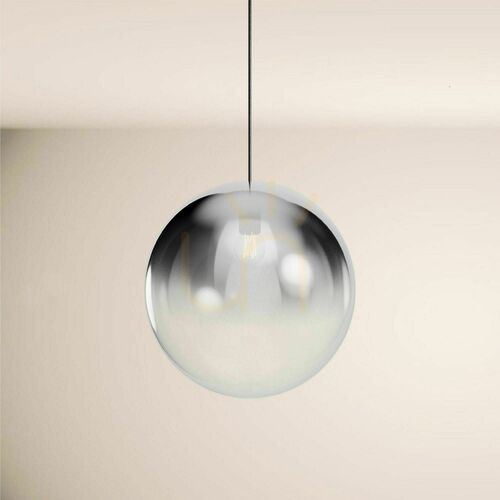
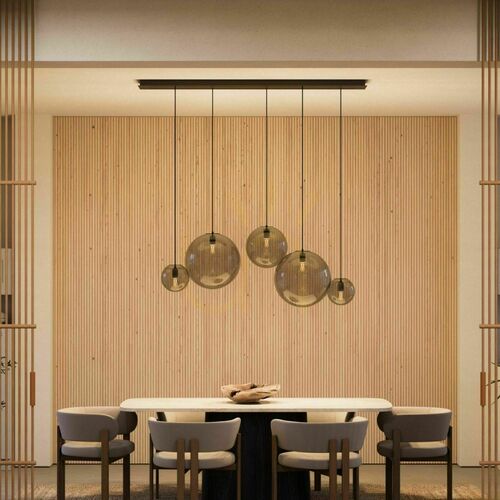
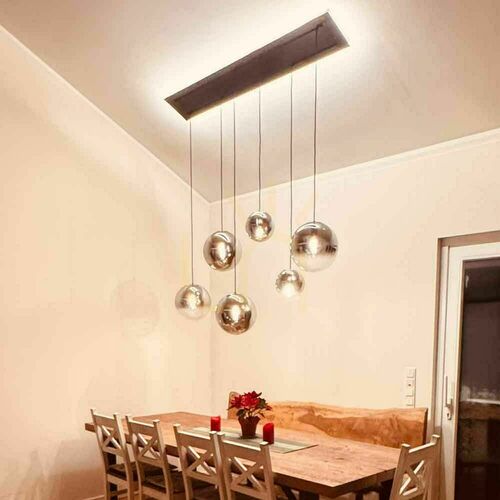
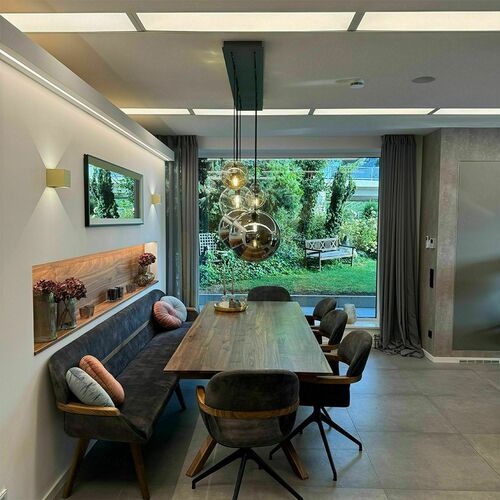
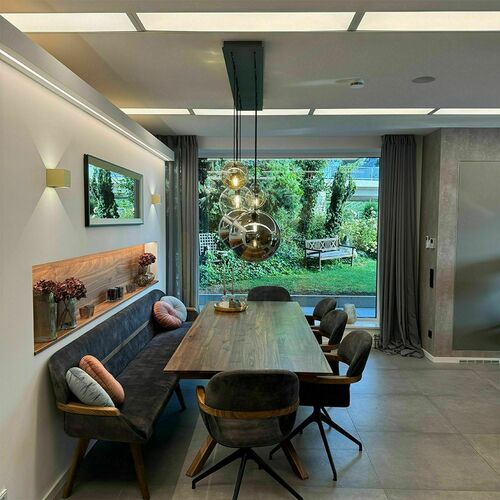
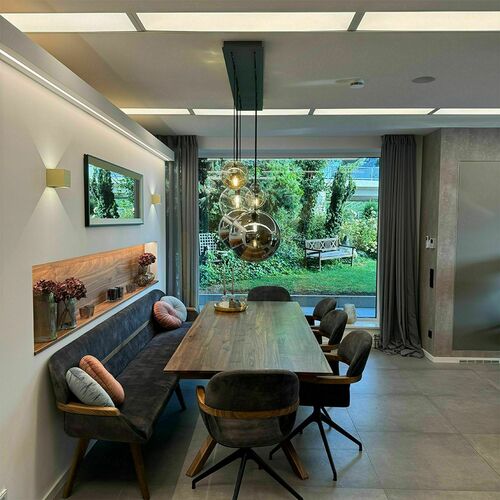
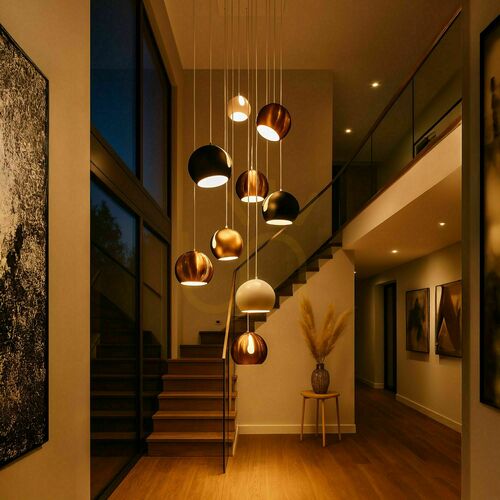
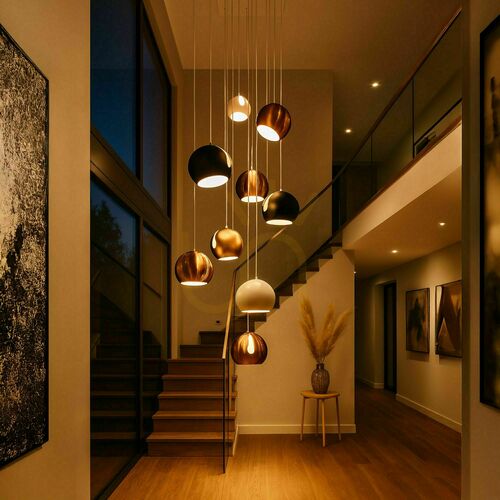
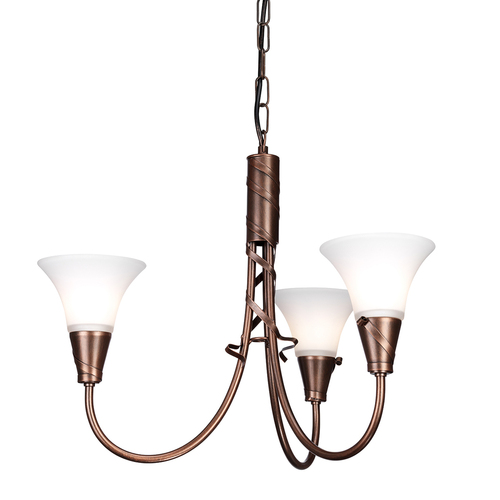
A copper pendant light hangs from a single drop, while a copper chandelier spreads several arms or shades from one ceiling point. Both rely on the same thing: copper's reddish, slightly golden tone, which warms a room in daylight and throws an amber glow onto the ceiling once the bulbs are on.
‘Copper’ on a light fitting covers more than one material. It might be solid, hand-beaten metal, a steel or aluminium frame electroplated with copper, a copper-tone powder coat or lacquer, or glass shades metallised on the inside. Each behaves differently over time, so it pays to know which one you're looking at before you fall for the colour.
Solid copper, plated or copper-tone?
Solid copper is soft, heavy and expensive, so you'll mostly find it in hammered shades and artisan pieces. Most copper chandeliers use steel or aluminium for the frame, which keeps the arms straight, with a copper finish on top. If that finish is lacquered, the colour stays put. Bare copper doesn't: it darkens to a brown tone first and, in damp air, may eventually turn green with verdigris. Some people want exactly that lived-in look – there are even oxidised copper pendants sold with the patina already applied – while others prefer a finish that never changes.
Choosing the right size and drop for a UK home
Ceiling height decides more than style. Many newer UK homes have ceilings of around 2.4 m, while Victorian and Edwardian rooms often reach 2.7–3 m or more. A quick way to size a chandelier: add the room's length and width in metres and multiply by 10 for a rough diameter in centimetres.
| Where |
Typical ceiling |
What usually works |
| Living room, modern build |
about 2.4 m |
compact multi-arm design or semi-flush fitting; keep at least 2.1 m clear underneath |
| Living room, period property |
2.7–3.2 m |
larger frame on a longer drop, centred on the room or the fireplace wall |
| Over a dining table |
any |
bottom 75–90 cm above the tabletop; width about half to two-thirds of the table |
| Kitchen island |
any |
a row of two or three copper pendants, or one linear bar fitting |
| Hallway or landing |
2.4 m and up |
slim or flush design; tall stairwells suit a long drop |
With fully metal shades, the light goes mostly downwards, so a living room will also need a lamp or two. A copper lining reflects a warmer, slightly orange light, while a white lining gives cleaner light for reading or eating.
Bulbs and light colour
Copper looks its best under warm white light at 2700–3000 K. Cooler 4000 K light drains the red out of it and the metal can look oddly grey. Multi-arm designs often take E14 candle bulbs, larger shades use E27, and industrial copper pendants pair well with exposed filament-style LED bulbs. If you plan to fit a dimmer, check that the bulbs are dimmable.
Styling copper
A vintage copper chandelier with dome shades suits mid-century and traditional rooms, while a modern copper design with clean lines works in Scandinavian schemes alongside white walls and pale oak. Black-and-copper fittings with cage shades are the industrial classic, especially next to brick, concrete or reclaimed timber. Repeat the copper two or three times in the room – a mirror frame, a vase, a cushion – so the fitting doesn't look like an orphan.
Installation and safety
Metal chandeliers are usually Class I, which means they need an earth connection; double-insulated Class II fittings don't. Wiring a ceiling light should be left to a qualified electrician, and the work must comply with BS 7671. Most chandeliers are rated IP20, which suits dry rooms only, so a bathroom needs a fitting with the right IP rating for its zone. Check that the ceiling fixing can take the weight, particularly with a solid copper piece. When you handle bare copper, wear cotton gloves, as finger marks can etch into unlacquered metal.
Frequently asked questions
What is the best way to clean copper light fixtures?
Switch off the power and let the bulbs cool first. For lacquered copper, a dry or barely damp microfibre cloth is all you need, and go gently on any plated finish, as the copper layer is thin. Bare copper can be brightened with a paste of lemon juice and bicarbonate of soda, or vinegar and salt, then wiped clean and dried thoroughly.
What should you not clean copper with?
Avoid abrasive pads, wire wool and harsh multi-surface sprays. On lacquered copper, skip metal polish and acidic home remedies too: they dull or strip the coating, and the metal underneath then tarnishes in patches.
How do I clean badly tarnished copper?
On bare copper, apply a dedicated copper cleaner or the vinegar-and-salt paste, leave it for a few minutes, then rub gently with a soft cloth and dry well. If the tarnish sits under a lacquer, cleaning won't reach it; the piece needs stripping and relacquering.
What colours complement copper?
Blues and blue-greens – navy, teal, petrol blue – sit opposite copper on the colour wheel, so they make it pop. Charcoal, deep green, warm white and terracotta are softer partners.
Will a copper pendant light go green?
Only if the copper surface is unprotected – bare or plated without a clear coat. Lacquered and powder-coated finishes hold their colour indoors. Humid rooms speed up oxidation on untreated metal.
Is a copper chandelier right for a living room with a low ceiling?
Yes, if you choose a compact or semi-flush design and keep about 2.1 m of headroom beneath it in walkways.
For copper beyond the ceiling, read more about copper lights for walls, tables and floors, or read up on choosing chandeliers in any finish and style.