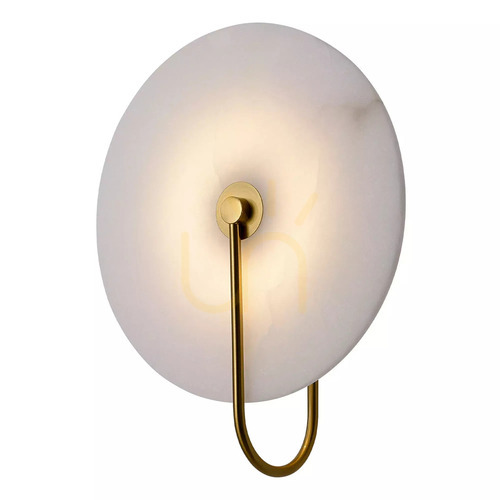
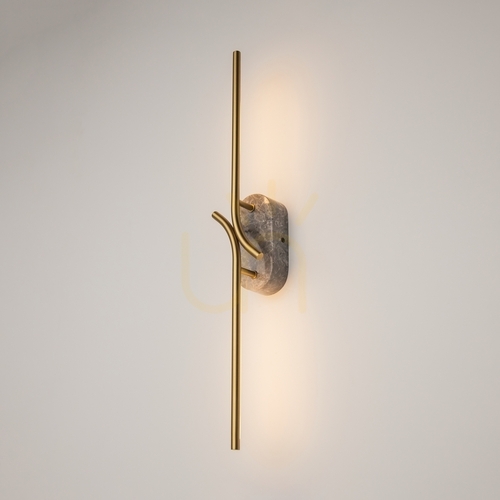
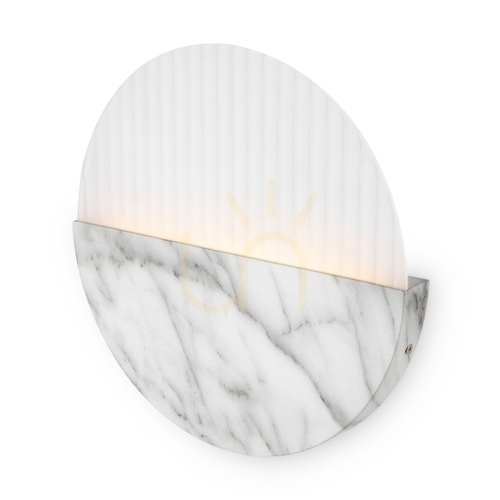
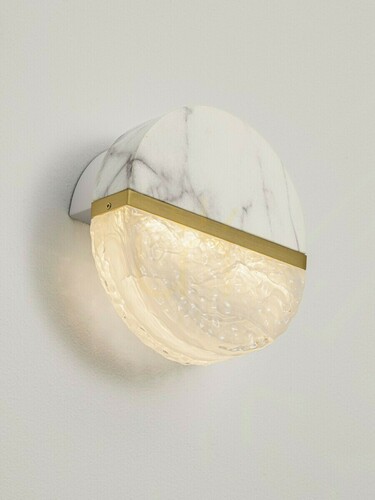
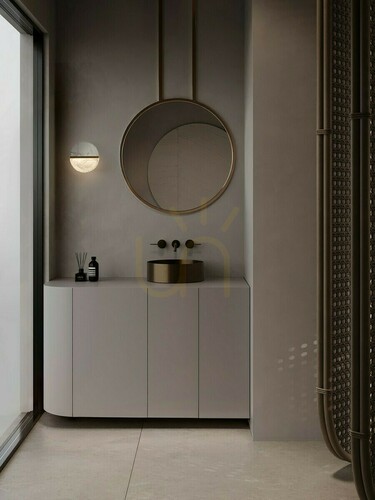
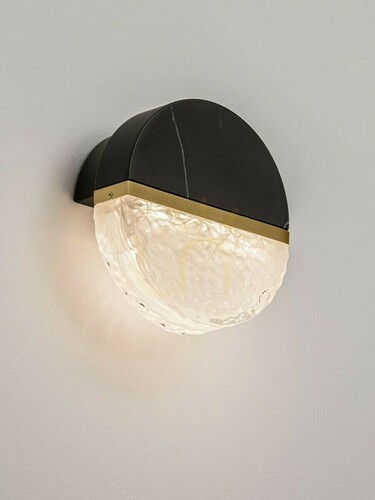
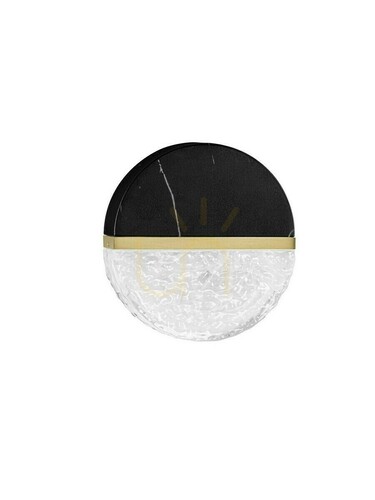
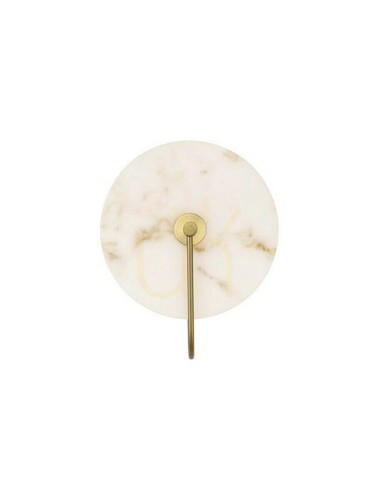
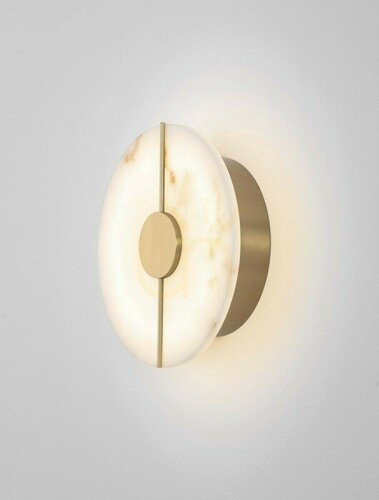
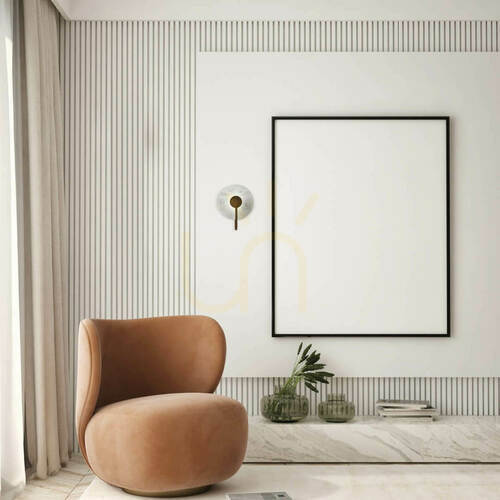
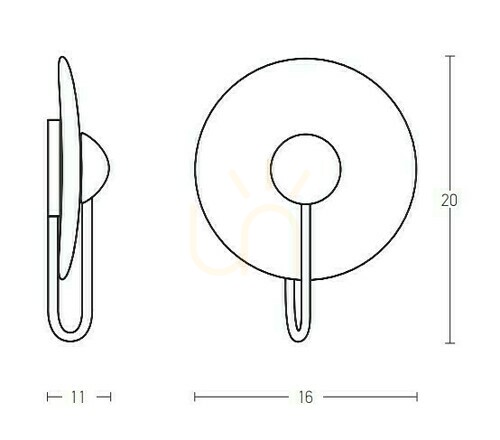
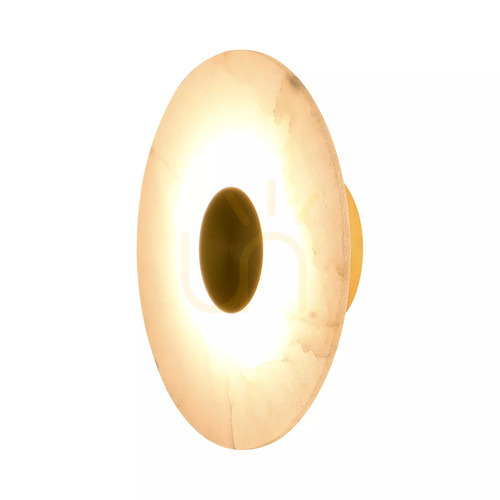
A marble wall light uses real marble or a marble-effect finish as part of the fitting itself – a disc, a tube, a backplate or the base of a glass globe. Because ordinary marble is opaque, the stone doesn't glow; it shapes where the light goes, washing the wall around a disc, throwing beams up and down, or sitting behind a softly lit opal shade.
That makes the choice less about "marble or not" and more about form, finish and fixing. A white marble wall light reads very differently from a black or green one, a heavy stone disc needs a sturdier fixing than a fabric sconce, and a bathroom version needs the right IP rating, whatever it is made of.
Where marble meets the wall light
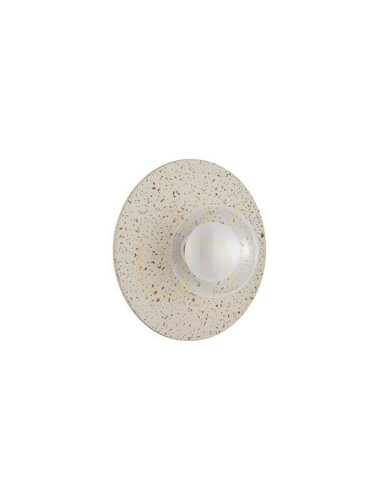
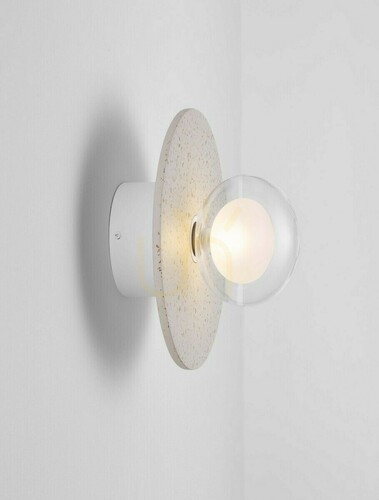
Four designs cover most of what's out there. A round marble disc with a concealed LED lights the wall behind it and leaves a soft halo – lovely for mood, no good for reading. A short marble cylinder with a GU10 lamp sends a beam up and a beam down, which flatters panelling, brick or textured plaster. A marble mount with an opal or clear glass globe gives the widest, most even light and works well by the bed. Long linear designs, upright or horizontal, run light along the edge of the stone and suit a mirror.
The stone is usually paired with brass, gold-tone, black or chrome metal and with glass. White marble with grey veining sits happily in pale, Scandinavian or classic rooms; black marble gives Art Deco and modern glamour schemes their contrast; green and brown stone look best against timber and warm white light. Twin-arm or "double" marble wall lights spread the light further across a chimney breast or a wide headboard wall.
Choosing for each room
| Room |
Typical mounting height |
Good fit |
Light |
| Living room |
about 160–180 cm (5 ft 3 in–5 ft 11 in) from the floor |
disc or up/down tube, often in pairs |
2700–3000 K, dimmable |
| Bedroom |
about 50–60 cm above the mattress |
globe on a marble mount, switched |
2700 K |
| Hallway and stairs |
about 180–200 cm above the floor or tread |
slim disc or tube, shallow projection |
2700–3000 K |
| Bathroom mirror |
at face height, about 150–170 cm |
linear, IP44 or higher |
3000–4000 K, high CRI |
Pairs need a little planning. Either side of a bed, line the lights up with the bedside tables rather than the headboard, so each side gets its own pool of light. Flanking a mirror, fix them just outside the frame so your face is lit evenly from both sides, without shadows under the eyes. Along a hallway, spacing of roughly 2–3 m keeps the glow continuous instead of patchy.
Lamp caps vary: integrated LED, GU10, G9, E14 and, on some British-made fittings, B22 bayonet. A replaceable lamp lets you change colour temperature or beam angle later; with integrated LED, check the lumen output, CRI and whether it works with your dimmer.
Fitting a heavy stone light
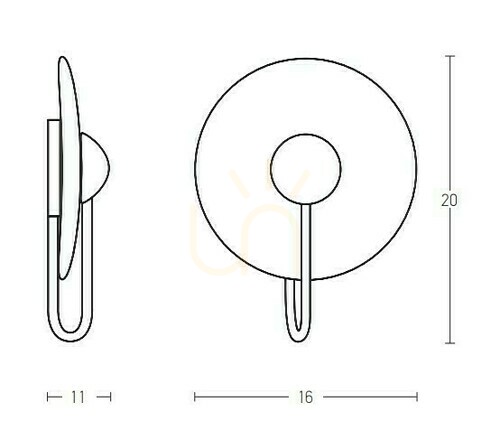
Marble weighs roughly 2.7 g per cubic centimetre, so a disc 30 cm across and 1.5 cm thick is already close to 3 kg. On masonry, standard wall plugs are fine; on plasterboard stud walls, common in newer UK homes, use proper cavity fixings or screw into a stud or noggin. Check the projection too – in a narrow hallway a deep fitting is easy to knock.
Hard-wired wall lights should be installed by a qualified electrician to BS 7671. In a bathroom the zones matter: zone 2, the area within 0.6 m of the bath or shower, needs at least IPX4 (IP44 in practice); beside a basin outside the zones IP44 is still a sensible choice, and the stone itself does nothing to keep moisture away from the lampholder or driver.
FAQ
Will a white marble wall light stain or yellow?
Marble is porous and soft, so it can mark. Acids are the main enemy: vinegar, lemon, limescale removers and many bathroom sprays etch the polish and leave dull patches. Switch off, dust with a soft dry cloth and, for marks, use a barely damp cloth with a pH-neutral stone cleaner. Sealing helps against stains, not against etching.
Are antique marble wall lights safe to use?
Often, but treat any vintage fitting with care. Old cable and lampholders may need replacing, and older lights may lack an earth. Have an electrician check and rewire it before it goes back on the wall.
Do marble wall lights give good light?
They give good ambient and accent light. Most are designed to glow on the wall rather than light a whole room, so pair them with a ceiling or floor light where you need brightness.
Is a marble wall sconce different from a marble wall light?
Not really. "Sconce" traditionally meant a wall-mounted holder for a candle or a single decorative light; today the two terms are used interchangeably.
What makes a modern marble wall light look modern?
Mostly shape and finish: a plain disc or slim linear form, honed rather than glossy stone, concealed LEDs and black or brushed metal. Curved brass arms, fluted glass and candle-style lamps push the same stone towards a traditional look.
How can I tell real marble from marble effect?
Real stone feels cool, is heavy for its size and has veining that never repeats, so two lights in a pair won't match exactly. Marble-effect ceramic, resin or printed finishes are lighter and easier to look after, but the pattern tends to repeat.
Can I get a battery-operated marble wall light?
Rechargeable wall sconces exist, and some use marble or a marble-effect finish, which saves chasing a cable into the wall. Expect lower output and regular charging; for light you use every evening, a wired or plug-in fitting is more practical.
For wall lighting beyond stone, from reading lights to hallway fittings, see wall lights. To carry the same stone onto a pendant, ceiling light or table lamp, have a look at marble lamps.