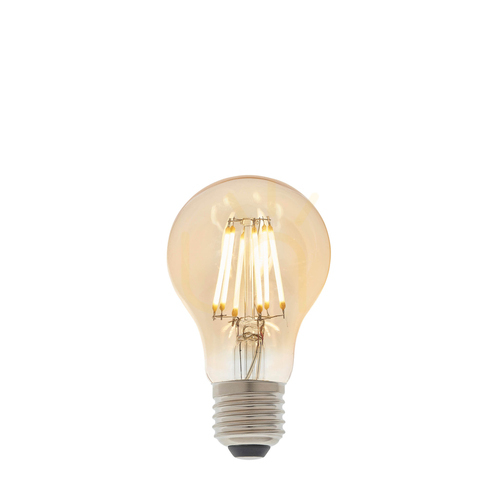
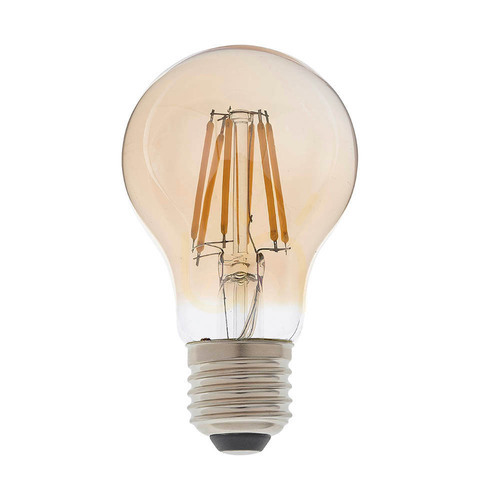
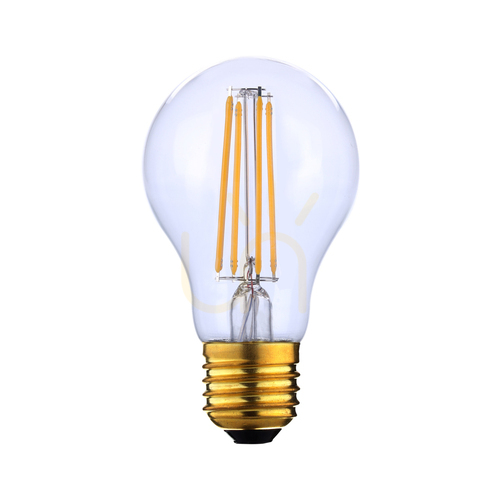
An Edison bulb is a decorative light bulb with clear or tinted glass and a visible filament, made to look like the carbon-filament lamps of the late 19th century. It's meant to be seen, so it usually hangs bare from a fabric flex, sits in a cage fitting or glows inside a clear glass shade rather than hiding under a lampshade.
The vintage look is the whole point here. Choosing one is less about raw brightness and more about the shape of the glass, its colour, the pattern of the filament and how all three suit the fitting it goes into.
What makes an Edison bulb different
The originals used a carbon filament wound into loops, drew 25–60 W and turned most of that into heat. Nearly every vintage bulb sold today is an LED filament lamp instead: rows of tiny LEDs mounted on thin strips, arranged in straight lines, spirals, loops or a squirrel-cage pattern so they read as an old-fashioned element. They typically use 2–8 W and are usually rated for around 15,000–25,000 hours.
A regular LED bulb has a frosted or opal globe that spreads the light and hides the workings. An Edison-style bulb does the opposite, which is why it has become a design piece in its own right in kitchens, bars and loft-style living rooms.
Caps, shapes and sizes
Check the cap before anything else. In the UK you'll come across three: the B22 bayonet that most British pendants and ceiling roses use, the E27 large Edison screw (ES) common on continental and industrial-style fittings, and the smaller E14 screw (SES) for chandeliers and wall lights. The shape code is a letter for the form and a number for the diameter in millimetres.
| Shape |
Diameter |
Typical length |
Usual caps |
Works well in |
| A60 classic pear |
60 mm |
about 10–11 cm |
E27, B22 |
table lamps and wall lights with an exposed bulb |
| ST64 teardrop |
64 mm |
about 14 cm |
E27, B22 |
bare pendants, cage and industrial fittings |
| T30 / T45 tube |
30–45 mm |
12–19 cm |
E27, E14 |
slim glass shades, wall lights |
| G45 golf ball |
45 mm |
about 7–8 cm |
E14, E27 |
multi-arm chandeliers |
| G95 globe |
95 mm |
about 13–14 cm |
E27, B22 |
single pendants over a table or island |
| G125 and larger |
125–200 mm |
17 cm upwards |
E27 |
statement pendants in tall rooms and stairwells |
Measure the inside of a shade before you buy. Large globes and long tubes fit the cap but not always the glass around it, and a bulb that touches its shade runs hotter.
Glass colour and how much light you get
Amber or gold glass gives a honeyed 1800–2200 K glow, close to candlelight. Clear glass usually sits at 2200–2700 K and shows the filament at its best. Smoked glass cuts the output right down and is purely for effect. You can find filament bulbs at 3000 K or cooler, but the vintage character fades fast as the light gets whiter.
Judge brightness by lumens. Mood bulbs often give just 50–250 lm, roughly an old 10–25 W bulb. If a pendant over the dining table also has to light the meal, look for 400–800 lm, about the same as a traditional 40–60 W lamp. Tinted glass always swallows some of that.
Hanging and grouping them
Over a dining table or kitchen island, the bottom of the bulb usually sits 60–75 cm above the surface. Use one model and one colour temperature across a group or a chandelier; mixing shapes can work if the glass tint and filament style match. Think of Edison bulbs as the atmosphere layer of a room and pair them with downlights or a ceiling light where you need to read or cook.
-
Dimmers: only bulbs marked dimmable belong on a dimmer, and the switch itself should be an LED-compatible trailing-edge type. Older dimmers designed for incandescent loads often cause flicker or buzzing.
-
Enclosed fittings: the driver in the cap doesn't like heat, so avoid sealed glass jars and tight shades unless the bulb is rated for enclosed use.
-
Outdoors: the bulb itself isn't weatherproof. In a garden or on a patio it needs a fitting or festoon set with a suitable IP rating.
-
Care: switch off and let the glass cool before changing or dusting it, and use a dry microfibre cloth. New wiring or a new ceiling fitting is a job for a qualified electrician working to BS 7671.
FAQs
What is special about Edison bulbs?
They're made to be looked at. The clear or amber glass and the visible filament turn a plain lamp holder into a feature, and the very warm light flatters wood, brick and brass.
Are Edison bulbs being discontinued?
Traditional incandescent versions have largely disappeared from sale under energy-efficiency rules. LED filament Edison bulbs aren't affected, which is why they now make up almost the whole market.
Can you get Edison bulbs with a bayonet fitting?
Yes. Popular shapes such as the A60, ST64 and G95 are commonly made with a B22 bayonet cap, so you don't need to change a British pendant to get the look.
What does an E14 Edison bulb suit?
Smaller fittings: chandeliers, wall lights and table lamps with a narrow holder. Expect small shapes such as candles, G45 globes and slim tubes.
Are Edison bulbs bright enough for a whole room?
Usually not on their own. Even stronger models rarely pass 800 lm, and the light goes in every direction, so treat them as accent lighting.
Do LED Edison bulbs get hot?
Far less than the old carbon-filament lamps, since they draw only a few watts. They get warm, not scorching, though they still need some air around them.
If you're after the filament look in other glass finishes too, read more on LED filament bulbs. Other caps and everyday bulb types are covered under light bulbs.