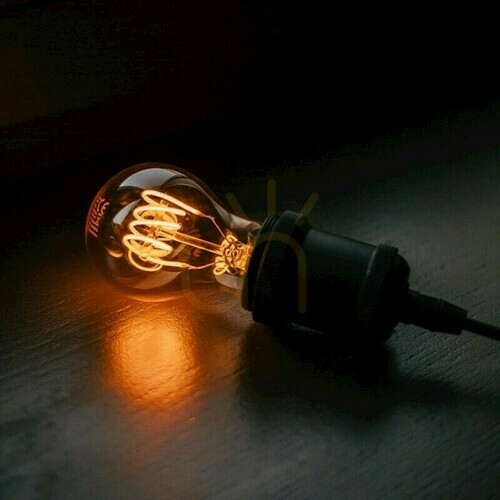
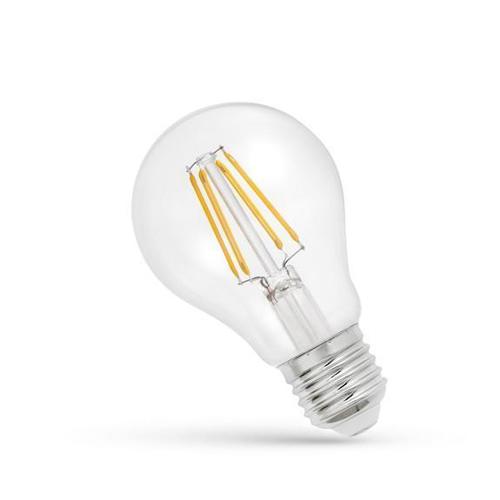
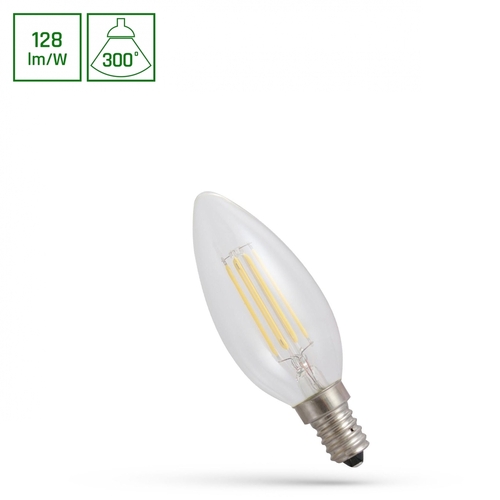
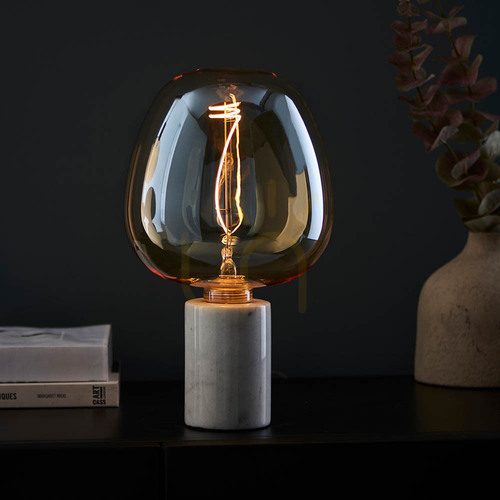
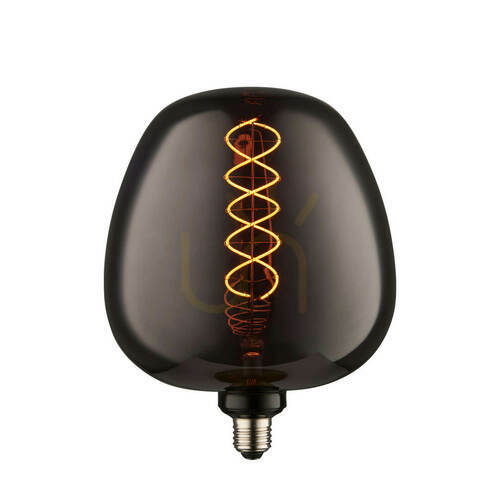
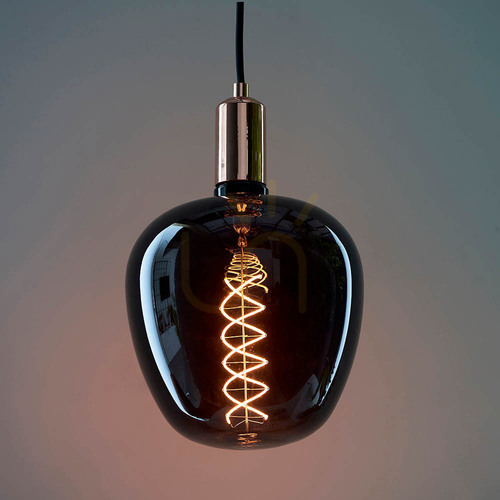
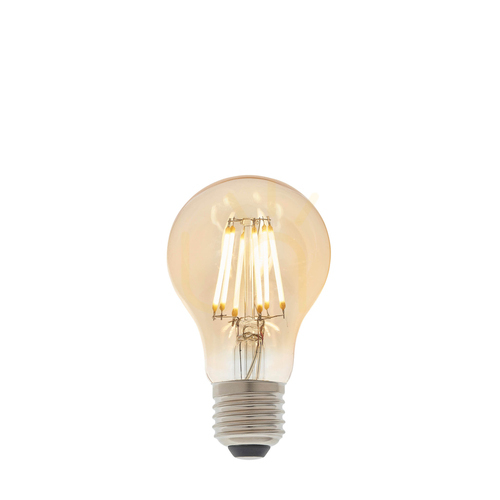
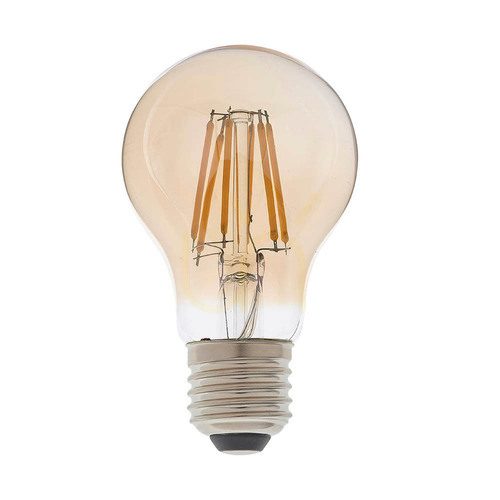
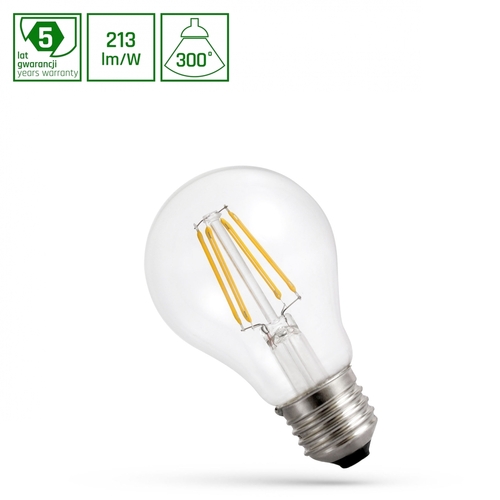
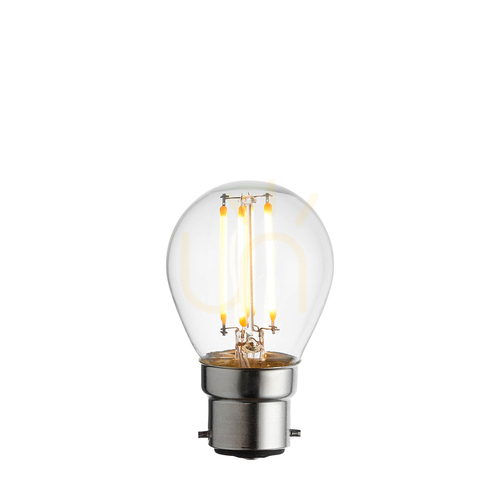
A filament bulb used to mean an incandescent lamp with a glowing tungsten wire; today the name almost always refers to an LED filament bulb, which copies that look with slim strips of tiny LEDs. You keep the clear glass and the visible ‘threads’, but a bulb that matches an old 60 W lamp draws only around 6–8 W.
That makes the LED filament the natural replacement wherever the bulb is on show. It is also worth knowing that not every filament bulb is a dim, amber mood light: plenty are bright, clear everyday bulbs that light a kitchen perfectly well.
What is inside an LED filament
Each filament is a narrow strip of glass or sapphire carrying dozens of LED chips wired in series. A coat of phosphor in silicone turns their bluish light into warm or neutral white. Because the strip is transparent, light escapes from both faces, so a filament bulb spreads light all round much like the incandescent it replaces. A standard LED bulb, with its chips on a flat board, throws most of its light forward and relies on an opal dome to soften it.
The chips run cooler than a tungsten wire, yet they still produce heat. Better bulbs use sapphire strips and a heat-conducting gas inside the glass; cheap ones skimp on both, which is why some fade or fail long before the 15,000–25,000 hours printed on the box.
Bayonet or screw: caps you will meet in the UK
Check the lampholder before anything else. Most British ceiling pendants and many table lamps take a B22 bayonet cap, while continental-style fittings use the E27 Edison screw. Small chandeliers and wall lights usually take E14 (small Edison screw) or the B15 small bayonet. Filament bulbs are made in all four, so there is rarely any need for an adapter.
| Where it goes |
Usual shape and cap |
Light output |
Colour temperature |
| Kitchen or hallway ceiling pendant |
A60 GLS, clear or frosted, B22 or E27 |
806–1521 lm |
2700–4000 K |
| Bare flex over a dining table |
ST64 squirrel cage, G95 or G125 globe |
400–800 lm |
2200–2700 K |
| Chandelier, wall light |
C35 candle or G45 golf ball, E14 or B15 |
250–470 lm per bulb |
2700 K |
| Bar, café, shop window, festoon |
amber or smoked glass, spiral filament |
100–300 lm |
1800–2200 K |
Compare lumens, not watts. Tinted glass soaks up a good share of the light, so an amber bulb and a clear one with the same wattage can differ in brightness by almost half.
Dimming and flicker
Only bulbs marked dimmable should go on a dimmer, and the dimmer itself has to be LED-compatible – in practice a trailing-edge model. An old leading-edge switch made for incandescent loads tends to buzz, flicker or refuse to dim smoothly, and several low-wattage bulbs may not reach its minimum load.
Flicker is the weak spot of cheap filament bulbs. The LEDs in each strip need a steady voltage; without a smoothing capacitor in the cap the light pulses 100 times a second. Your eye will not spot it, but some people get tired eyes or headaches. Budget low-output bulbs and E14 candles, where the cap leaves little room for electronics, are the usual culprits. Point a phone camera at the lit bulb: dark rolling bands on the screen give it away.
Getting the look right
A filament bulb earns its keep in clear glass shades, wire cages, bare pendants and open-arm chandeliers; under a fabric shade the filament effect disappears and a standard LED bulb does the same job. Hang clear bulbs above eye level or choose a lower output, as a bare 1000 lm filament is glaring when you look straight at it. Avoid sealed, unventilated fittings, which cook the LEDs. Outdoors, a filament bulb has no weather protection of its own, so use it only in lanterns and festoon holders rated for outdoor use.
New fittings or wiring changes on a 230 V circuit are a job for a qualified electrician working to BS 7671.
FAQs
Can a filament bulb be LED?
Yes, and nowadays it nearly always is. The filament is a strip of LEDs rather than a heated wire, which is why it looks traditional yet runs far cooler than the original.
What is the advantage of an LED bulb over an old filament bulb?
It uses roughly a sixth to an eighth of the energy for the same light and lasts many times longer – typically 15,000–25,000 hours against about 1,000 for a classic incandescent.
Can I get filament light bulbs with a bayonet fitting?
Yes. B22 versions are common in A60, globe and squirrel cage shapes, and B15 in candles.
Which LED filament bulb is the brightest?
Clear A60 and globe shapes reach 1055–1521 lm, the equivalent of a 75–100 W incandescent. Amber and long spiral filaments are the dimmest.
Are LED filament bulbs dimmable?
Many are, but only those labelled dimmable, and only on an LED-compatible dimmer. Some ‘dim-to-warm’ versions also turn more amber as you lower them.
What is the healthiest light for your eyes at home?
Steady, flicker-free light with a colour rendering index of 80 or more, warm white in the evening and a brightness that suits the task. A well-made filament bulb ticks those boxes; a bargain one may not.
If you are after shapes, tinted glass and industrial styling, read on about vintage light bulbs; for other caps and technologies, browse light bulbs.