Mid century table lamps are built from two halves that have to agree: a base of turned teak, thrown ceramic, spun brass or moulded glass, and a shade that is almost always a truncated cone in linen, parchment or enamelled metal. Nothing is carved, nothing is applied, and the whole design is the proportion between the two. That is why a good one still looks composed on a sideboard seventy years later, and why a bad one looks like a lamp base wearing the wrong hat.
Proportion is the whole design
Before finish or colour, get the geometry right. The rules below come from the period's own workshop practice and they are unusually reliable, because the shapes involved are so simple that there is nowhere for an error to hide.
Working proportions for a base-and-shade table lamp
RelationshipTargetWhy
Shade height to base heightShade roughly two thirds of the visible baseA shade as tall as its base makes the lamp look top-heavy from a seated position
Shade width at the bottomWider than the widest point of the base, by 2 to 5 cmA shade narrower than the base exposes the socket and the flex from every angle
Cone taperTop diameter about 60 to 70 per cent of the bottomThe period shade is a truncated cone, not a drum; a straight-sided drum reads as 1970s
Total height on a sideboard45 to 65 cmPuts the bottom of the shade near seated eye level, so you see light and not the lamp
Total height beside a low chair50 to 70 cm on a side table around 50 cm highThe lamp and the table together should bring the shade to shoulder height when seated
The bases, and how they behave in a real room
Turned timber
Teak and oak, oiled rather than lacquered, often a simple bulbous or tapered turning with a brass collar at the neck. Wood bases are lighter than they look, so a wide shade on a slim turning can tip if the flex is pulled. Check the base diameter against the shade before assuming stability.
Thrown and glazed ceramic
The other great base material of the period, in mustard, olive, oxblood and speckled off-white. Heavy, stable, and the one that carries colour into a room without any of it being upholstery. Glazes of the period were matt or lightly crackled; a high-gloss glaze reads as later.
Spun brass and enamelled metal
Thinner and more architectural: a stepped brass column, or a painted steel cone base with a matching metal shade. These are the versions that put light rather than warmth into a room, because a metal shade is opaque and directs everything downward.
Glass
Opal, smoked or lightly tinted, sometimes with the lamp inside the base as well as under the shade. A base that lights up is a genuine period feature and it is the most useful one in a dark corner, since it gives you a low glow without switching on the shade.
Three different buys that look like one
The word covers three jobs, and choosing on looks alone is how people end up with a lamp that is beautiful in the wrong place.
-
A table lamp on a sideboard or console is decorative light. It should be seen, it can be tall, and an opaque metal shade is fine because the point is a pool of light on the surface.
-
A bedside lamp is task light. It wants to be short enough that the shade sits below eye level when you are propped up on pillows, and it needs a switch you can find in the dark — on the lampholder or on the flex, not underneath the base.
-
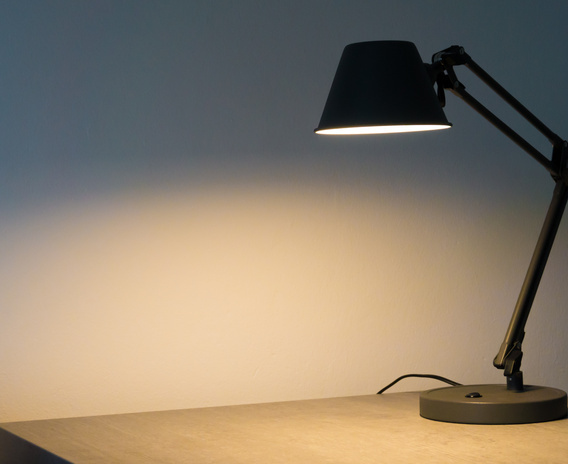
A desk lamp is directional. A fixed cone over a desk lights a circle 40 cm across and leaves the rest of the page in shadow; the period's answer was a hinged or counterbalanced arm, which is a different product entirely.
Light source
- E27 in a full-size base, E14 in a small one, on 230 V. Both keep the lamp replaceable, which matters more here than anywhere else in the house because a table lamp sits at eye level and you will notice a colour temperature you dislike every evening.
- 2700 K against teak, brass and warm ceramic glazes. A cooler source turns oiled wood grey and makes an olive glaze look muddy.
- A linen or parchment shade transmits a good deal of light through the fabric as well as out of the ends, so it needs less lumen output than a metal shade to light the same area. 400 to 600 lumens is usually plenty; 800 in a fabric shade is glaring.
- Check the maximum wattage on the lampholder before fitting a large retrofit lamp in a small enclosed base. Heat has nowhere to go inside a closed glass or ceramic body.
- An inline dimmer on the flex costs very little and turns a decorative lamp into an evening one. The period lit rooms low and from several points, and a table lamp at half output is most of that effect.
Where to put them
Two or three low light sources beat one bright ceiling fitting, and that is the single habit worth copying from these interiors. A pair flanking a sofa on matching side tables, one on a sideboard behind it, and the ceiling fitting off — that is what a 1960s living room looked like in the evening. Keep the lamps roughly the same height as each other if they are in a pair, and let them differ if they are across the room from one another.
Questions people ask
Can I put a period shade on a modern base, or the reverse?
Yes, and it is often the cheapest way to a lamp you actually like, because shades wear out faster than bases. Check the fitting type: European shades attach either by resting on a wire carrier that clips over the lamp, or by a threaded ring at the socket. The two are not interchangeable without an adapter.
What colour should the shade be?
A pale linen or parchment shade gives warm light through the fabric and a soft edge to the pool below. A dark or opaque shade gives you two hard cones of light and nothing sideways, which is dramatic on a sideboard and useless for reading. The period used both, deliberately, for those two different results.
Is a matching pair a good idea?
Beside a bed or flanking a sofa, yes — symmetry is doing a job there. Across a whole room, no. Repeat a material rather than a model: the same brass, or the same glazed ceramic, in two different silhouettes.
What else lights the same room?
A table lamp is one point of a scheme, not the scheme. Retro lamps sets out how the whole period fits together room by room, and retro wall lights covers the case where there is no surface to stand a lamp on.
How does this differ from a vintage table lamp?
Mid-century is a period geometry — cone shade, tapered base, thin brass. Vintage is a surface condition: aged metal, smoked glass, visible wear, from any decade at all. Vintage table lamps is the page for the second of those.