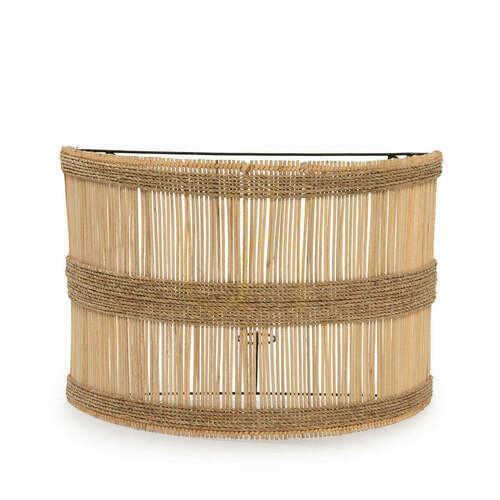
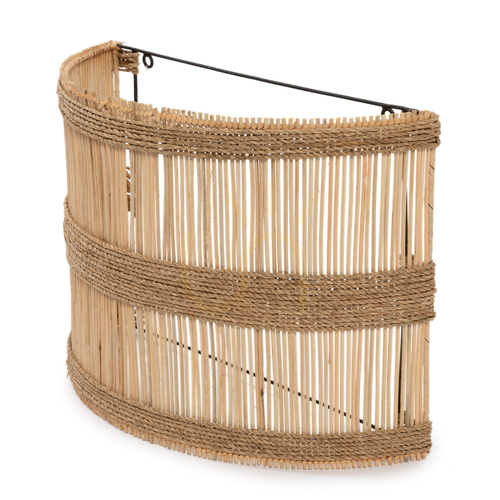
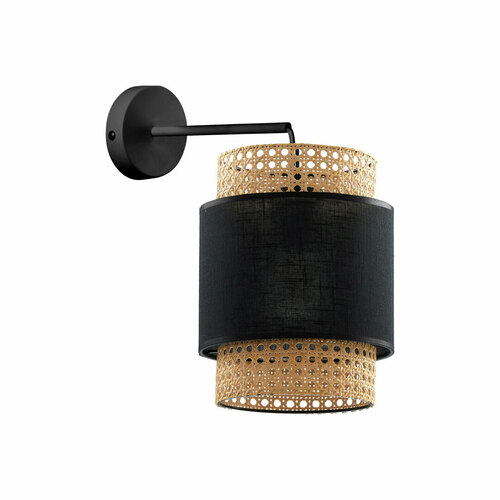
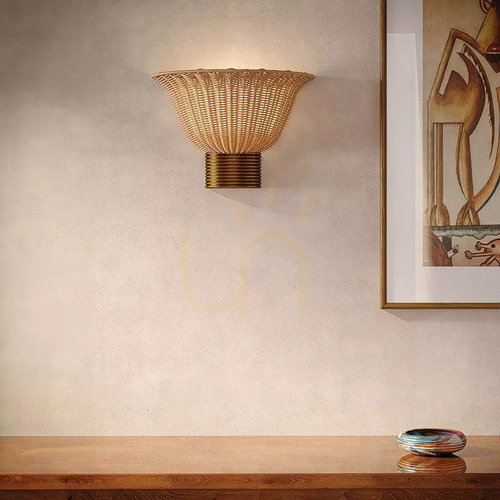
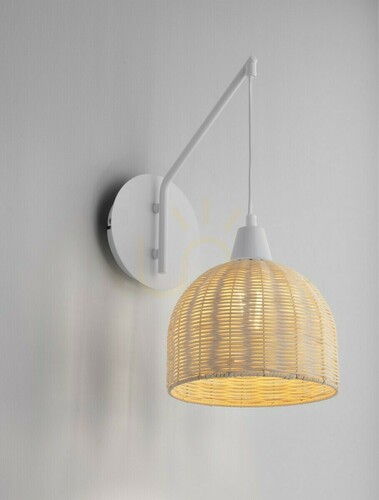
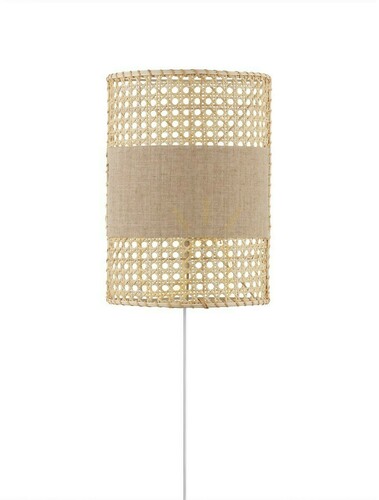
A rattan wall light sends its light through a hand-woven cane shade, so you get a warm glow and a pattern of light and shadow on the wall rather than a flat pool of brightness. On a wall fitting the weave matters more than it does on a pendant: it decides how much usable light reaches the room, which bulb you can safely fit, and whether the light is good for reading or mainly there for atmosphere.
Is rattan actually good for lighting?
For soft, ambient and accent light, yes. Rattan is the solid, flexible stem of a climbing palm, which bends easily into domes, discs and baskets, and the gaps in the weave break the light up into dappled shapes. On a wall, those shapes land on the plaster right behind the shade, which is where the effect is strongest. An open weave lets plenty of light through and throws crisp patterns; a tight weave gives a gentle, even glow but less light to see by. If you want to read under it, look for a shade that is open at the bottom or an arm that tilts.
The main designs you will come across:
-
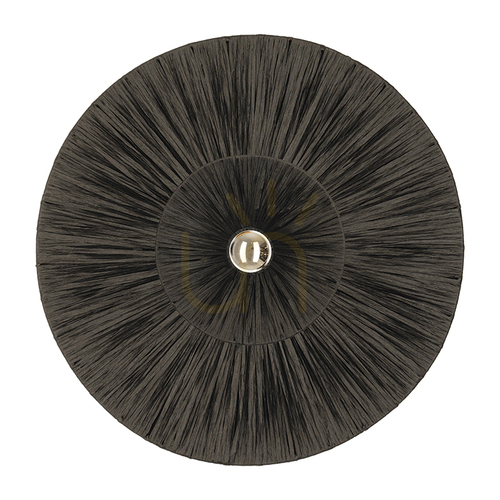
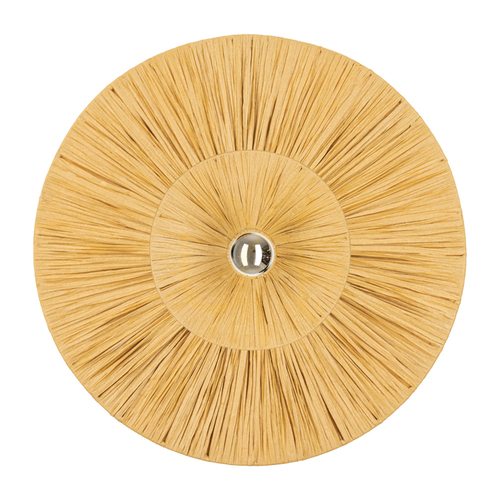
Flat disc or sunburst – shallow, often 7–15 cm deep, with the bulb behind or in the centre of the weave. Good for narrow hallways and above a headboard.
-
Half-basket or cone on a bracket – washes light upwards, downwards or both.
-
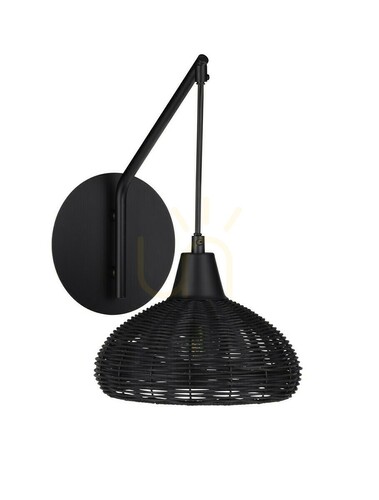
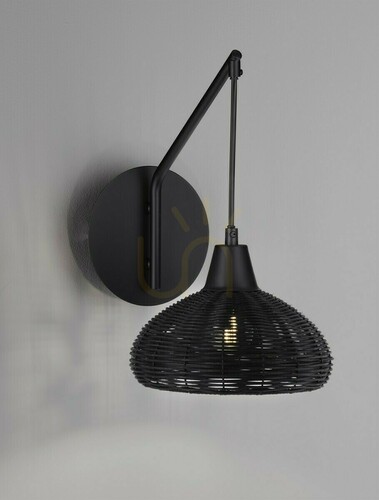
Swing-arm – pulls out over a bed or armchair, then folds back flat against the wall.
-
Hanging wall light – the shade hangs from a hook on its own flex, rather like a small pendant at the side of the bed.
-
Rechargeable – integrated LED charged via USB, with no wiring at all.
Choosing one: sizes, fittings and wiring
| What to check |
Typical range |
Why it matters |
| Shade or disc diameter |
about 20–60 cm |
beyond roughly 45 cm it reads as wall art |
| Projection from the wall |
7–15 cm flat, 30–50 cm on an arm |
keep it slim where people pass |
| Lampholder |
E27, B22 bayonet, E14 on smaller designs |
bulbs are often sold separately |
| Maximum wattage |
15–60 W depending on design |
the closer the cane, the lower the limit |
| Colour temperature |
2700–3000 K |
cool white makes natural cane look grey |
| IP rating |
usually IP20 |
dry rooms only |
| Electrical class |
Class I (earthed) or Class II (double insulated) |
a metal arm on a Class I fitting needs an earth |
Plug-in versions come with a flex, an inline switch and a fused UK plug, so they suit rentals and rooms without a wall light point. Run the cable down a slim trunking channel painted to match the wall, or let a fabric flex hang as a feature. A hard-wired rattan wall light connects to a wall box and is switched from the door. That job belongs to a qualified electrician working to BS 7671.
Bulbs that suit cane
Use LED. It runs far cooler than halogen or old filament incandescents, and in a wall light the weave can sit just a few centimetres from the bulb. Never exceed the maximum wattage printed on the fitting; shallow discs often have a surprisingly low limit. A frosted or opal bulb cuts glare through the gaps, while a clear filament bulb looks lovely behind a loose weave. Globe bulbs light a round disc more evenly. Dimming needs a dimmable bulb and a compatible dimmer; stepped bulbs that change brightness with each flick of the switch are an easy alternative.
Placement and care
Next to a bed, the centre of the light usually sits 120–150 cm off the floor; in a living room 150–180 cm; on a landing or stairs 170–190 cm, high enough not to catch a shoulder. A disc above a headboard looks balanced 30–40 cm above its top edge. Pairs either side of a mirror or sideboard look calm only when the heights match exactly.
Dust with a soft paintbrush or the brush attachment of a vacuum on low suction. Wipe marks with a barely damp cloth and dry straight away; never soak the cane. Switch off and let the bulb cool first. Avoid fitting a rattan light directly above a radiator, as dry heat makes cane brittle, and expect strong sun to shift its colour. Natural rattan mellows to a honey tone over the years anyway. Small irregularities in the weave are normal on a hand-made shade.
Frequently asked questions
What is a good height for a rattan wall light?
Around 150–180 cm to the centre in a living room, a little lower beside a bed so the light falls on a book, and higher in hallways.
Can a rattan wall light go outdoors?
Natural cane does not cope with rain or damp. For a porch or covered terrace, look for synthetic rattan with at least IP44.
Are rechargeable rattan wall lights any good?
They are handy where there is no socket or wiring, but they are usually dimmer than a mains light and need charging every so often. Think of them as mood light.
Can I put a rattan shade on an existing wall light?
Often, yes, if the shade has the right fitting ring for your lampholder and the bulb sits well clear of the weave. Check the fitting's maximum wattage too.
Where does a large rattan wall light work best?
On a broad, empty wall: above a sofa, a bed or a console table, where a 50–60 cm disc can act as both light and decoration.
Can I use one in a bathroom?
Not a standard IP20 cane fitting. Bathrooms need a suitably IP-rated light for the zone it sits in, usually at least IP44.
If there is no wall light point where you need one, plug-in wall lights are the simpler route. For metal, glass and fabric designs and other shapes, see wall lights in general.