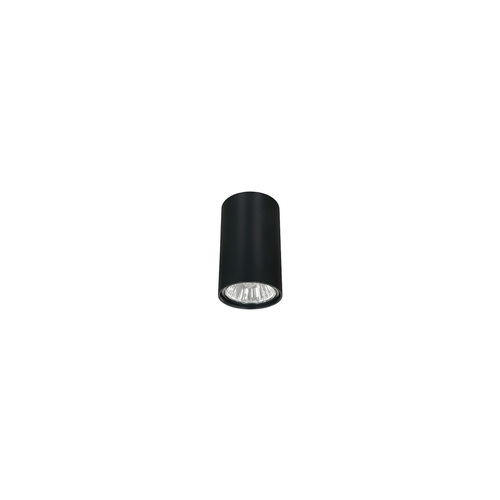
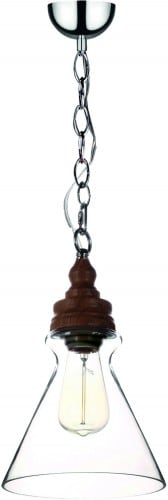
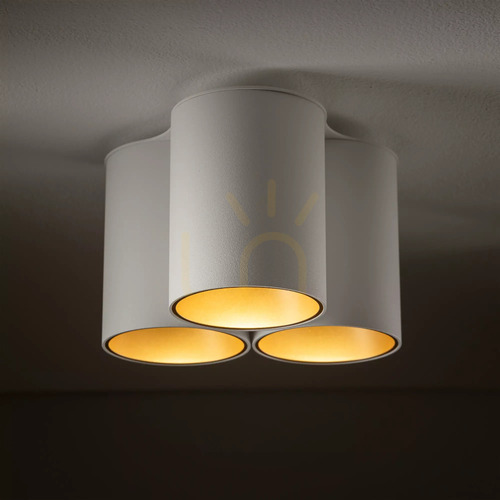
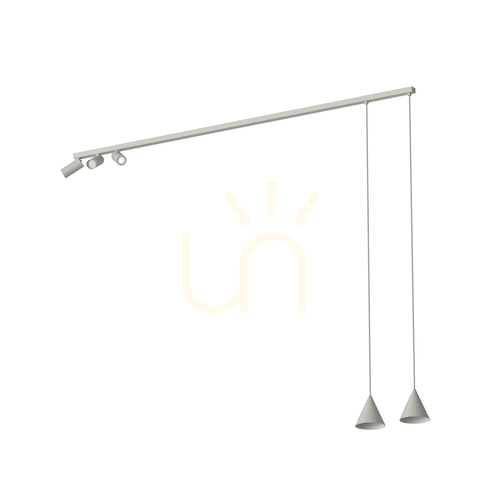
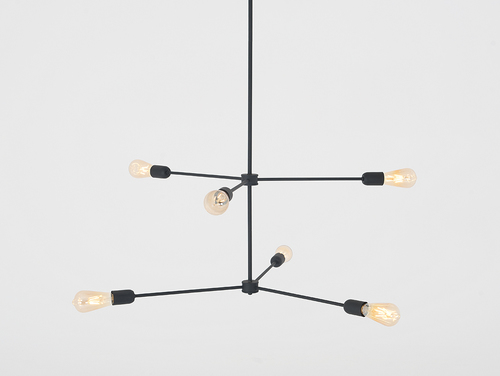
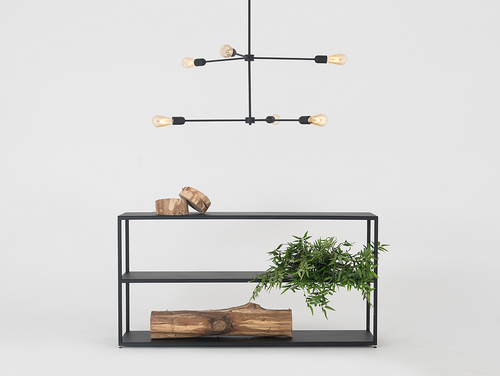
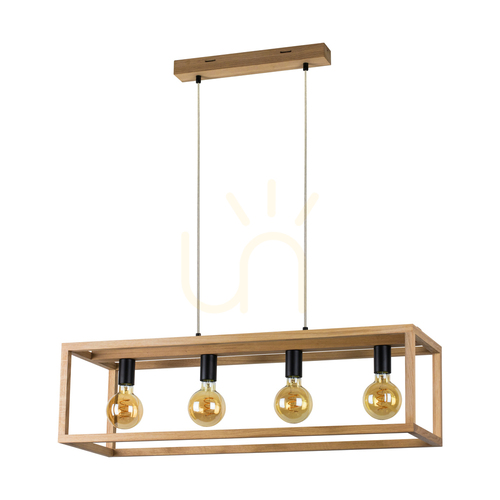
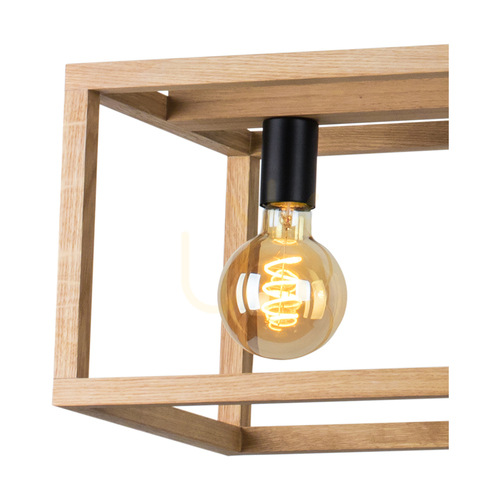
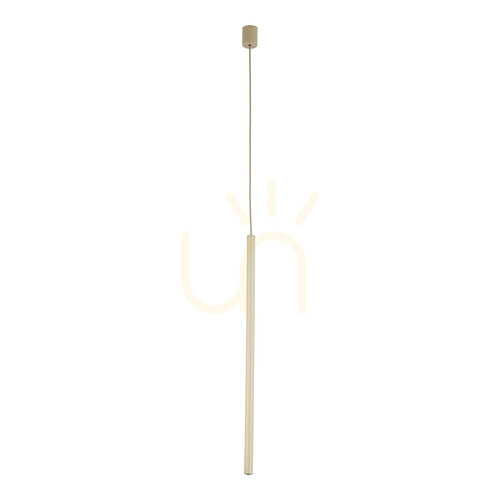
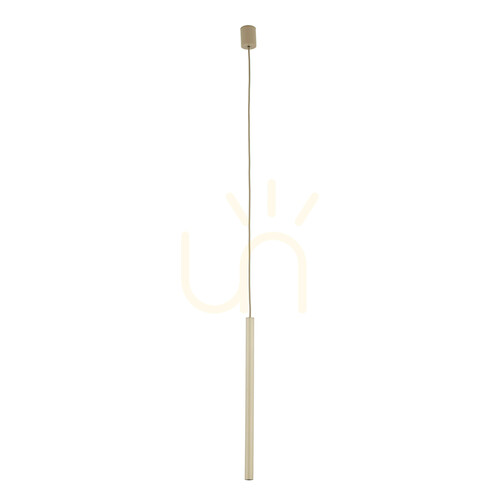
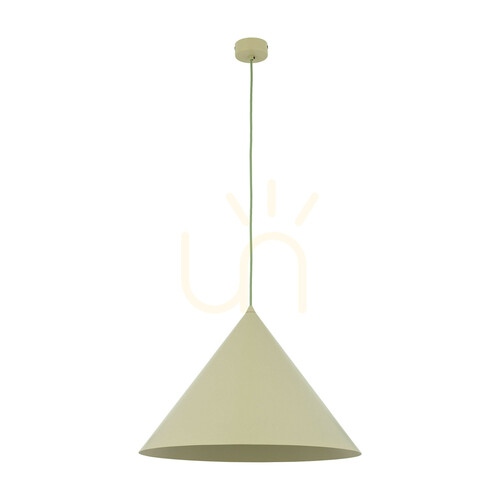
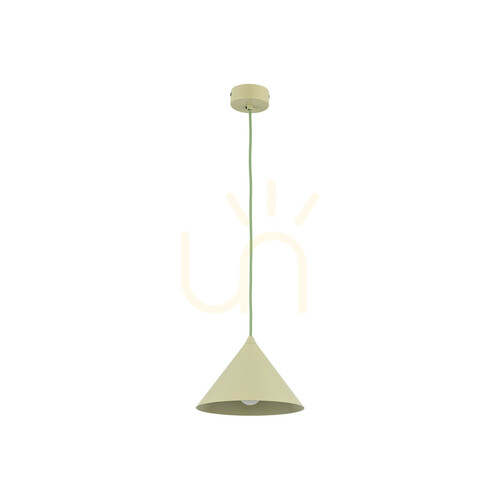
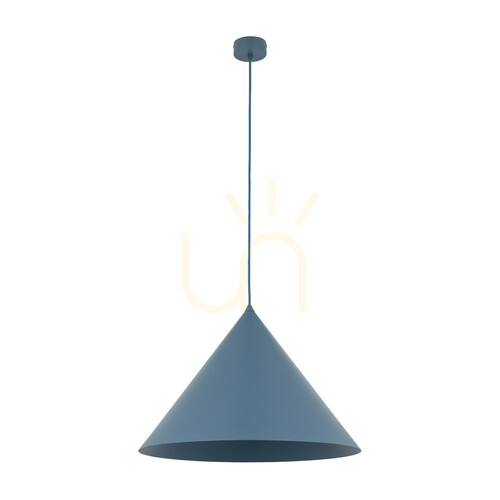
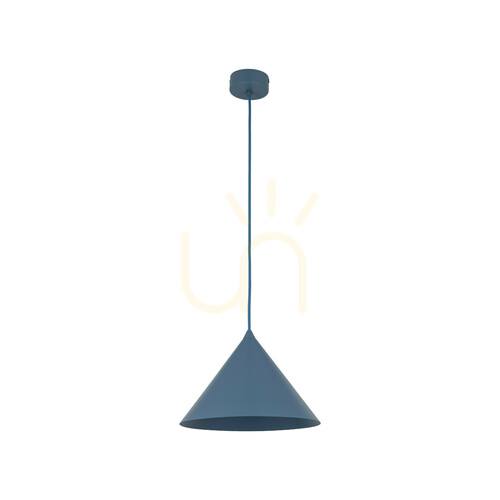
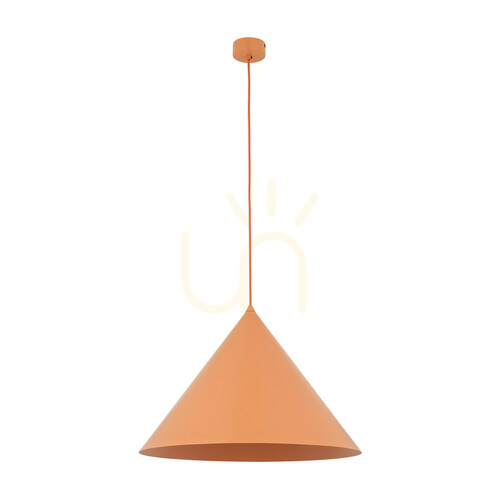
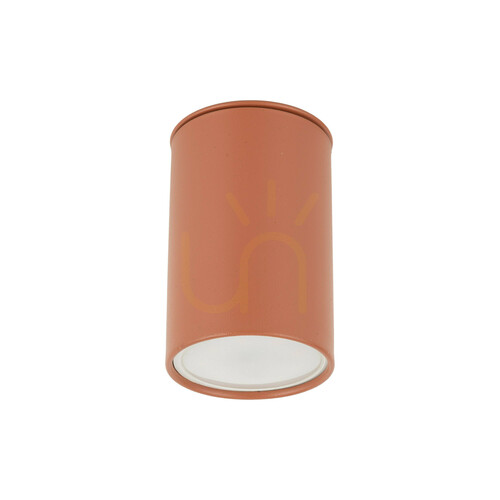
Industrial ceiling lights in a home are not the factory originals. The loft look is the domestic conversion of that language — the same black steel, the same exposed fixings and open shades, but softened for a room people live in: brass instead of bare galvanising, mesh instead of a heavy cage, warm glass where the original had none. It became the default look for converted buildings because it survives a hard ceiling. Where there is no plaster to hide a cable, a fitting that admits to being a fitting is the only honest answer.
Five forms on one page, and they are not interchangeable
This is the broad ceiling category filtered to one style, so it holds several mounting types at once. Choosing the form comes before choosing the finish.
The ceiling forms this range holds
| Form |
What it does |
Typical socket |
Where it belongs |
| Single pendant on rod or chain |
A defined pool of light under an open shade |
E27 |
Over a table, an island, or a stairwell |
| Flush and semi-flush |
Even light across a whole room, no drop |
E27, GX53 |
Corridors, low ceilings, anywhere with headroom to protect |
| Multi-lamp frame or bar |
Several sources in a line or a cluster from one point |
E27, G9 |
A long table, a kitchen run, an open-plan zone |
| Directional spots on a plate |
Light aimed at a wall, a worktop or a picture |
GU10 |
Kitchens, hard ceilings, rooms where nothing can hang |
| Track and rail systems |
Several movable heads on one supply, repositioned later |
GU10 or low-voltage modules |
Open-plan spaces and any layout still being worked out |
956 products carry this style on ceiling lights, which makes it the deepest style range on the site. Of those whose form is recorded, 204 are hanging pendants and 49 are flush or semi-flush mounts. The attributes behind every figure on this page are filled in sparsely, so read the counts as floors rather than as percentages.
The socket mix tells you what this range really is
474 fittings take an E27 cap, which is the classic open-shade pendant. But 175 take GU10 and 86 take G9, and another 55 use GX53 — those are directional spots, compact flush fittings and small multi-head bars, not shaded pendants. There are also 45 with an integrated LED module and five built around the AR111 reflector lamp, which is a wide-bodied spot used where a single head has to cover a large area.
The voltage figures make the same point from another direction. 890 products run on ordinary 230 V mains, but 38 run on 48 V and five on 24 V. Those are low-voltage track systems: a slim rail carrying the supply, with magnetic heads that clip on anywhere along it and move later. In a converted space with an exposed ceiling, that is often the more sensible answer than committing to a fixed position, and it is worth knowing this page holds those systems before settling on a fixed pendant.
What the range is made of
-
Steel first. 379 products are recorded as steel and 286 as metal generally, with 119 in aluminium. Glass appears on 114 and wood on 35, with brass on 23. Plastic and acrylic together account for 161, which is mostly diffusers on flush fittings rather than visible bodywork.
-
Black, then white. 351 are listed as black and 136 as white, followed by brown on 35, grey on 32, gold on 29, beige on 28 and brass on 27. Black with a brass or gold detail is the loft register; raw galvanised steel is the factory one, and this range leans firmly towards the first.
-
Mostly single-lamp fittings. 502 take one lamp. After that come 106 three-lamp fittings, 74 with four, 64 with six and 62 with two, with smaller numbers running up to ten. The multi-lamp frames are what a long kitchen or a wide island needs.
-
Dry rooms unless stated. 859 are IP20. Ten carry IP54, six IP44 and three IP65, so a bathroom, a covered terrace or a workshop needs the rating checked on the individual product rather than assumed from the style.
Ceiling height still decides
-
Under 2.4 m: flush fittings and ceiling spots only, unless the pendant hangs over a table nobody walks on. Open metal shades are heavy and unforgiving at head height.
-
2.4 to 2.7 m: a single pendant over a table at 70 to 80 cm above the top, or a spot bar for the rest of the room.
-
2.7 to 3.5 m: the range this style was drawn for. Long rod suspensions, multi-lamp frames and track all work, and a large open shade finally reads at the right scale.
-
Above 3.5 m or an exposed structure: track along a beam, or a pendant on a long chain hung deliberately low over a defined zone. A fitting tight to a very high ceiling lights nothing useful.
- 2.05 m of clear headroom under anything people walk beneath, in every case.
Bulbs, and the glare problem
732 of these products arrive without a light source; 75 include one. 317 are recorded as taking a replaceable LED lamp and 89 have an integrated module, which is the split worth checking before buying — an integrated fitting cannot have its colour temperature changed later.
- An open metal shade shows the lamp from below. Where the fitting hangs over a table or a seating area, that means a frosted lamp rather than a clear filament one, however good the filament looks in photographs.
- 2700 K for living spaces, 3000 K over a kitchen worktop. Of the products that record a light colour, 30 are warm and 20 are colour-changing, so the choice is usually yours to make with the lamp.
- GU10 spots come in beam angles from about 24 to 60 degrees. A narrow beam is for a picture or a splashback; a wide one is for general light. Fitting the wrong angle is the most common reason a spot arrangement looks patchy.
- Where a fitting takes several lamps, buy them together. On an open frame with no diffusion, a single lamp from a different batch is visible from across the room.
- Check the maximum wattage on any small enclosed metal shade. Steel conducts heat into the body and an undersized shade around a large lamp runs hot.
Who supplies it
TK-Lighting carries 324 of the products here, with Nowodvorski on 138, Antigo on 119, Italux on 68, UMMO on 67, and Ideallux and Rendl light studio on around 30 and 24. That spread matters because the suppliers occupy different ends of the style: the volume producers cover black steel shades and spot bars, while the smaller names carry the plaster, concrete and brass pieces that push the look towards the domestic end.
Questions people ask
Is loft the same as industrial?
They share a vocabulary and differ in intention. The industrial original is factory equipment: raw steel, deep enamel reflectors, heavy cages, no concession to the room. The loft version is that language made habitable — black rather than galvanised, brass details, mesh instead of cage, warmer glass. Industrial chandeliers covers the heavier reading if that is what you actually want.
Should I use track or fixed fittings?
Track wins wherever the furniture layout is not settled or the ceiling is exposed and hard to drill twice. Fixed fittings win over a dining table, where the position is known and a rail overhead is one object too many. There is no reason not to use both in an open-plan space.
Do these come with bulbs?
Usually not — the large majority ship without a light source, which is normal for European lighting. That is why the cap type matters: E27 on the shaded pendants, GU10 on the spots, G9 and GX53 on the compact fittings, and a fixed module on the integrated ones.
Can I use one in a bathroom or on a covered porch?
Only where the individual product says so. The overwhelming majority of this range is IP20, which means dry rooms, and only a couple of dozen products carry any splash or dust rating at all.
What lights the rest of the space?
The same vocabulary runs down the walls and along the table. Industrial wall lights covers brackets, projection and mounting heights, and tube pendant lights takes the linear forms that suit a long island or a bar. If you want the aged rather than the engineered version of the same metals, vintage ceiling lights is the neighbouring page.