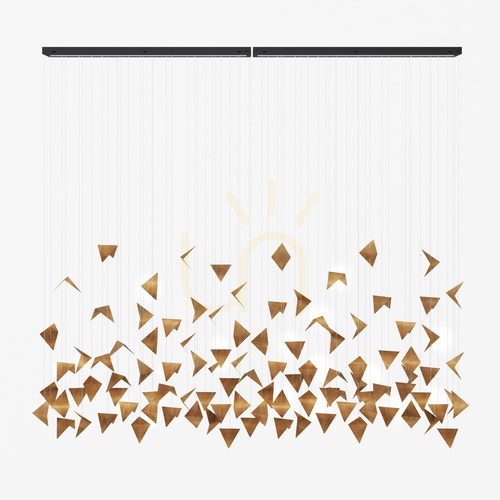
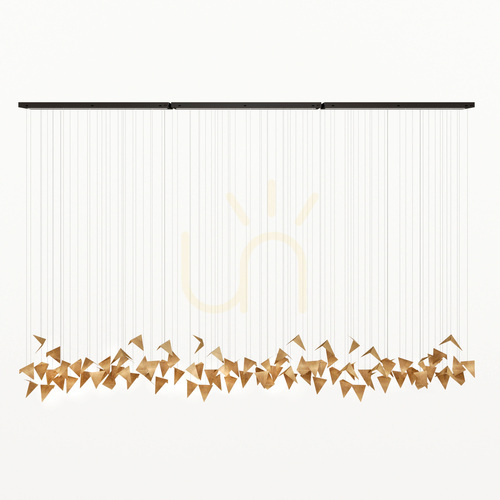
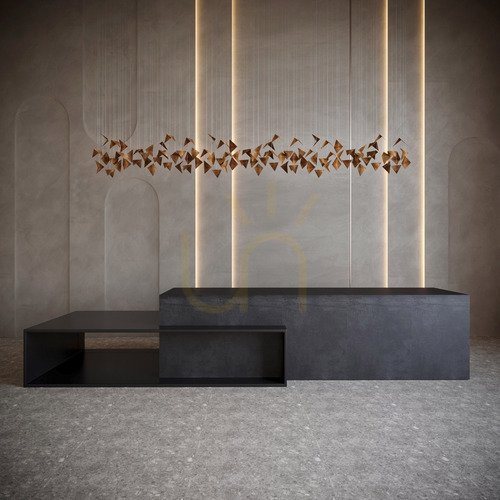
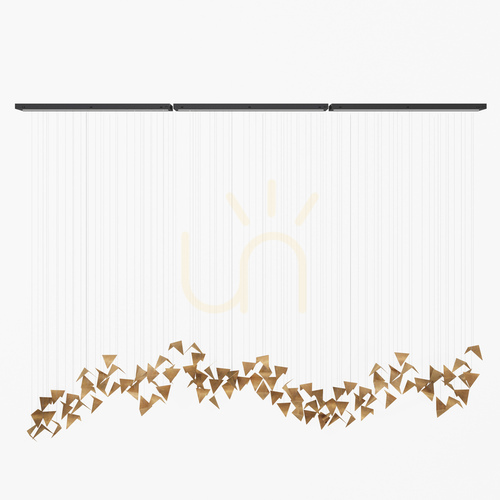
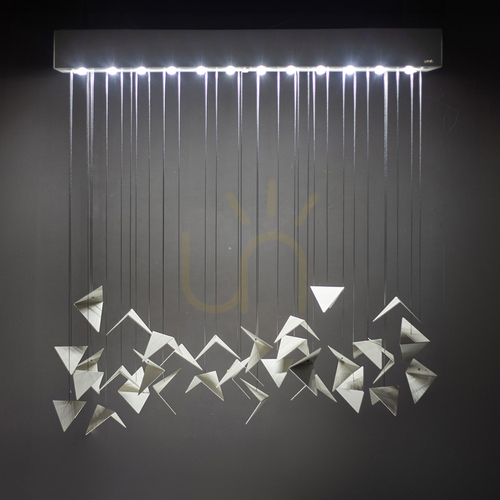
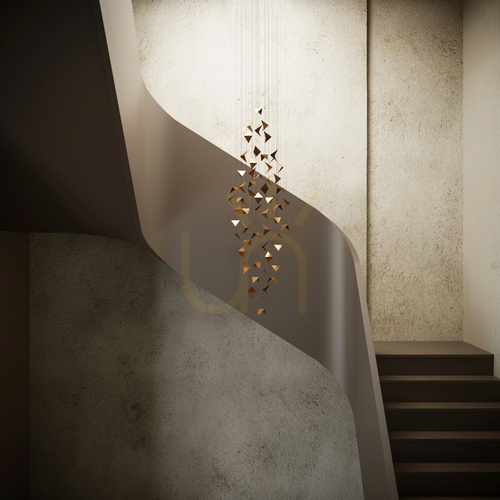
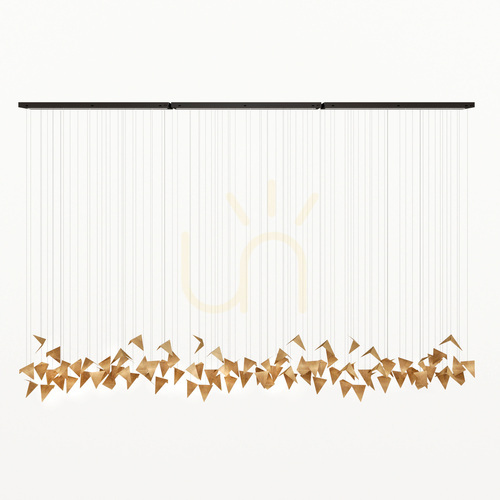
An industrial chandelier takes the vocabulary of the factory floor — raw and blackened steel, cage guards, enamel shades, exposed conduit, visible bolts — and arranges it into a multi-lamp fitting for a ceiling. It is worth separating this from the loft look, which is the residential conversion of the same language and is generally softer, warmer and more decorative. The genuine industrial original was never designed to be attractive: it was designed to survive a workshop, to be repaired with a spanner, and to put light where a machine was. What we buy now keeps that logic and puts it in a dining room.
Where the forms come from
Workshop originals and how each translates to a domestic ceiling
OriginalWhat it was forRecognisable byAt home
Cage-guarded pendantProtecting a bulb from a swinging tool or a ladderA steel basket over a bare lamp, hinged or bolted at the neckThe single most characteristic form; needs a filament-look lamp to make sense
Enamel coolie shadePushing all the light onto a bench belowA wide, shallow steel cone, white inside and dark outsideExcellent over a table; the white interior returns light that a raw steel shade eats
Gantry or barLighting a long line of machinery from one supplyA steel spine carrying several heads at fixed intervalsThe most useful form over an island or a long table
Conduit clusterRunning power along a wall or ceiling with no plaster to hide itRigid tube instead of cable, with junction boxes as visible elbowsTurns a badly placed ceiling outlet into a design decision
Articulated armBringing a lamp to the work rather than the work to the lampSprung or clamped joints, counterweights, wing nutsMore common as a wall or desk fitting than as a ceiling one
What this filter holds
11 models sit behind this page, all of them from Gie El, and their shape is consistent enough to describe precisely. Read each figure as a floor rather than a share, since catalogue attributes are filled in unevenly.
-
Metal, and only metal. All 11 models are recorded as metal-bodied, with no glass or fabric shade elements recorded at all.
-
Large lamp counts. 3 models carry fifteen light points and one carries twelve, alongside single-lamp and three-lamp designs. These are wide multi-head frames rather than compact fittings.
-
Suspended. All 11 are recorded as hanging ceiling fittings.
-
Dry rooms, mains voltage. All 11 are IP20 on 230 V.
-
Lamps supplied. 6 models are recorded as including the light source, and 9 take a replaceable LED lamp, with 5 taking a G9 capsule.
Fifteen lamps is a scale problem before it is a light problem
A frame carrying twelve or fifteen heads is a large object. Two numbers should be settled before anything else: the span, and the total output.
On span, the usual room arithmetic applies — length plus width in metres, read as centimetres, so a 5 by 6 metre room supports a fitting around 110 cm across. Over a table, the frame should be half to two thirds of the table width with at least 30 cm of clear table on each side. A fifteen-head frame in a 4 by 4 metre room is not a bold choice, it is a fitting that touches the walls with its shadow.
On output, fifteen lamps at 470 lumens each is over 7000 lumens from a single point — roughly three times what a 25 m2 dining room wants in the evening. The right answer on a large multi-head frame is a low-output lamp in every socket, typically 200 to 300 lumens, plus a dimmer. The frame is doing the visual work; the light it delivers should be modest.
The lamp is part of the design, so choose it deliberately
-
Filament appearance. On a cage or bare-socket fitting, a clear lamp with a visible LED filament reads correctly. A frosted lamp looks like a stopgap.
-
2200 K to 2700 K. Blackened and raw steel is a cool grey material, and warm light is what stops it looking like a stairwell in a car park. At 4000 K an industrial frame turns institutional immediately.
-
Glare control. A bare lamp at eye level across a room is uncomfortable however good it looks. Either hang the fitting high enough that the lamps sit above a standing sightline, or dim it, or choose a form where a shade hides the source.
-
G9 capsules appear on several of these designs and give a small, near-point source, which suits an open frame where the lamp is meant to be a spark rather than a globe.
Weight, and the ceiling that has to hold it
A steel frame with a dozen heads is heavy, and every kilogram of it hangs from one point. Fix into a joist, into a timber noggin set between joists, or into a concrete slab with an expansion anchor that reaches the concrete rather than the plaster skim. Two further points are specific to large frames:
First, level the frame along the length of the room rather than by eye from the doorway. A long bar shows a millimetre of slope against a ceiling line and nothing else in the room will let you forget it. Second, plan the lifting. A wide multi-head frame is awkward for one person and impossible to hold overhead while making connections, so it is a two-person installation and the wiring should be terminated at the canopy before the frame goes up.
Common questions
What is the difference between industrial and loft?
Industrial is the factory original — raw steel, cages, enamel, conduit, no ornament. Loft is that vocabulary adapted for living in, usually with warmer finishes, more glass and softer forms. The two share a shelf in most shops. The broader loft-style comparison is on industrial ceiling lights, and the wall equivalents on industrial wall lights.
Does an industrial frame suit a low ceiling?
Only over a table. These are suspended fittings with real depth, and in a walking route under a 240 cm ceiling there is not enough height to hang one without ducking. Below that, surface-mounted forms are the sensible route.
Can I fit fewer lamps than the sockets allow?
You can, but on an open frame the empty sockets are visible and the composition breaks. Better to fill every socket with a lower-output lamp, which gives the same total light and keeps the object intact.
Will raw steel rust indoors?
Lacquered and powder-coated steel will not. Genuinely raw or wax-finished steel can spot in a humid kitchen or bathroom, and the fix is a light wax rather than a cleaning product — detergent strips the wax and makes it worse.
How does it compare with a vintage frame?
Vintage leans on aged brass, smoked glass and patina; industrial leans on bare structure. In a room with warm timber the vintage version usually sits more easily, which is what vintage chandeliers covers.