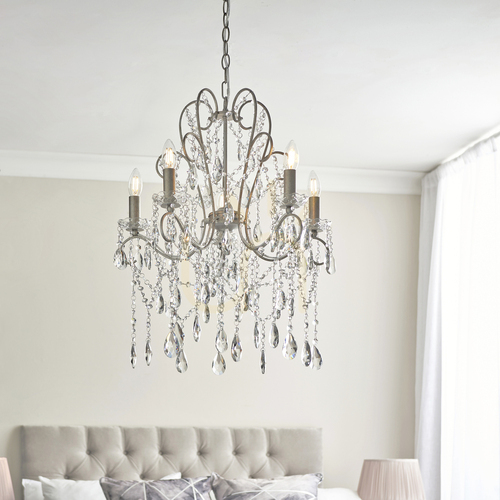
Vintage chandeliers are multi-arm ceiling fittings built to look as though they have been in the building for decades: a frame in aged brass, blackened iron or oxidised bronze, arms that curve rather than radiate, and lamps left visible on candle tubes with the drip marks moulded in. Vintage describes a condition rather than a century, so the category holds several quite different objects — a candle-arm frame, a glazed lantern on a chain, a cage of metal strapwork, a tiered fitting in smoked glass. What unites them is that none of them is trying to look new.
Four families, and what each is actually for
The recurring vintage chandelier forms
| Form |
What it looks like |
Where it belongs |
Light it gives |
| Candle-arm frame |
Curved arms from a central column, lamps upright on candle tubes, aged brass or blackened iron |
Dining room, hall, over a stairwell |
Upward and outward. Lights the ceiling and the walls, not the table |
| Glazed lantern |
A four- or six-sided metal frame with clear or seeded glass, hung on a chain |
Entrance halls, porches under cover, above a staircase |
Contained and directional; the glass keeps the glare in |
| Cage and strapwork |
An open metal frame, often spherical or barrel-shaped, with the lamps inside and no glass at all |
Kitchens, open-plan spaces, rooms with a hard finish |
Undiffused. A decorative object first and a light second |
| Tiered glass |
Two or more rings of smoked, amber or ribbed glass shades on a metal frame |
Rooms with height, over a large table |
The softest of the four, because every source sits behind glass |
Size, and the rule that gets misapplied
The old catalogue rule is to add the room's length and width in metres and read the answer in centimetres — a 4 by 5 m room takes a fitting around 90 cm across. It works for solid, closed shapes. Apply it to an open cage or a splayed candle-arm frame and you will buy something a third too large, because an airy frame reads much bigger than its diameter suggests. For open forms, take the number and reduce it by 25 to 30 per cent.
-
Over a dining table, the fitting should be roughly half to two thirds the width of the table, and never wider than the table itself. The height of the fitting matters as much as the diameter: a tall candle frame eats the space a low-ceilinged room does not have.
-
In a hall, size against the floor area rather than the table, and check the sightline from the front door. A chandelier seen at eye level from a landing needs to look right from above as well as below.
-
In a stairwell, the fitting can be much larger than the plan area suggests, because it is read from several floors at once. This is the one place a genuinely big chandelier makes sense in an ordinary house.
Hanging height
- Over a dining table: the lowest point 75 to 85 cm above the tabletop. A candle-arm frame is measured to the bottom of the arms, not to the finial, and the difference is often 20 cm or more.
- Over any floor people walk on: 2.05 m of clear headroom, minimum. A chandelier in a hall is the classic thing to walk into with a suitcase.
- In a stairwell: measure from the highest tread the fitting hangs over, never from the hall floor. Sized to the hall, it becomes a hazard three steps up.
- In a double-height space: hang it so the body sits roughly level with the upper floor. Higher and it belongs to nobody; lower and it blocks the void it was bought to fill.
Weight, fixing and the ceiling above the plaster
This is the part that gets left to the day of installation and should not be. A metal chandelier of 60 to 80 cm can weigh several kilograms before the lamps go in, and all of that load hangs from a single point. It needs a fixing into a joist or a cavity anchor rated for the weight, not the plasterboard plug that came in the box. Two further things to check before ordering: the canopy diameter, which on a period-style fitting is often small and will not cover a large modern ceiling box; and the chain, which usually comes over-long so links can be removed on site, meaning the electrician needs the finished drop written down before starting rather than guessed at the top of a ladder.
Bulbs, because they are on display
On a candle-arm or cage fitting there is no shade at all, so every lamp is visible from every point in the room. That makes the choice of light source part of the design rather than an afterthought.
- Small candle or golfball lamps on E14, or E27 on the heavier frames, on 230 V. Count the lamp positions before buying: eight to twelve small lamps is a real replacement cost and a real load on the circuit.
- 2200 to 2400 K with a visible filament, 2700 K behind glass. Anything at 4000 K makes aged brass look green and smoked glass look grey, and it undoes the entire finish.
- Where the lamps are exposed and the fitting is at eye level from a staircase, choose frosted lamps rather than clear ones. A dozen bare points of light seen from the side is glare, not atmosphere.
- Use the same lamp from the same batch throughout. On a fitting where every source is visible at once, a single lamp half a step cooler is instantly obvious.
- A dimmer is close to essential on any undiffused multi-lamp fitting. At full output it is uncomfortable in a domestic room; at a third it becomes the object it was drawn as.
What it sits beside
A vintage chandelier is a strong object and it does not want competition. One in a room, with the rest of the lighting kept plain and low — table lamps, a wall bracket beside a mirror — is how these fittings were used when they were new. Where it fails is against a busy ceiling: a chandelier plus spotlights plus a pendant in the same sightline reads as three decisions rather than one. It is unusually good against plain modern surfaces, and unusually bad against other decorative fittings.
Questions people ask
Will a chandelier light the room on its own?
A candle-arm frame will not. Lamps pointing upward on tubes light the ceiling and the top of the walls, and leave the table underneath dim — which is what a dining room actually wants, but not what a kitchen does. A tiered glass fitting or a lantern manages far better because the sources sit lower and behind diffusion. Either way, plan for a second layer at low level.
Is it too formal for an ordinary house?
The candle-arm frame in polished brass with crystal drops is; that is a different style altogether. A blackened iron cage or a glazed lantern reads as utilitarian rather than grand, and sits comfortably in a kitchen or a hallway in a modern flat. The finish decides the formality far more than the arm count does.
Can I hang one in a room with a 2.4 m ceiling?
Over a table, yes, if the fitting is shallow — under about 35 cm tall — and hangs no lower than 75 cm above the top. Over open floor in a 2.4 m room, no chandelier works, and the honest answer is a flush or semi-flush fitting instead. Vintage ceiling lights sets out which forms each ceiling height can take.
How is this different from a mid-century chandelier?
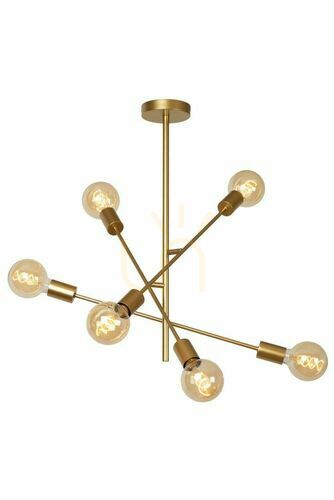
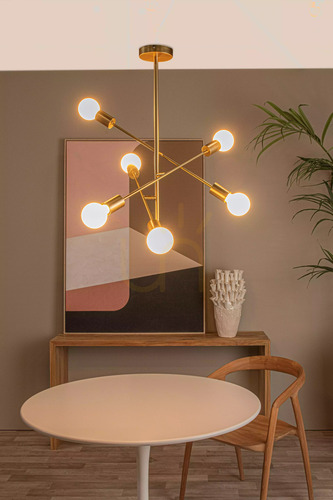
Almost completely. The mid-century form is a sputnik — straight rigid arms radiating from a ball, in bright new brass, symmetrical in every direction. This one curves, ages and hangs. Mid century chandeliers covers that opposite instinct.
What if I want coloured or leaded glass instead of metal?
That is a separate tradition with its own rules about how the glass is made and lit. Tiffany chandeliers covers the leaded-glass branch, and art nouveau chandeliers the organic period frames that go with it.