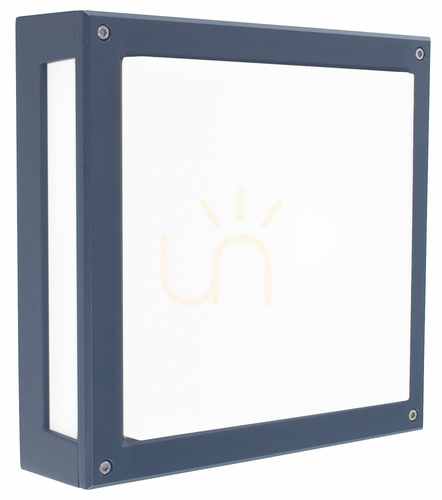
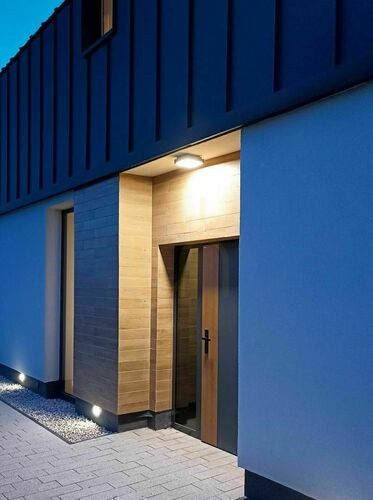
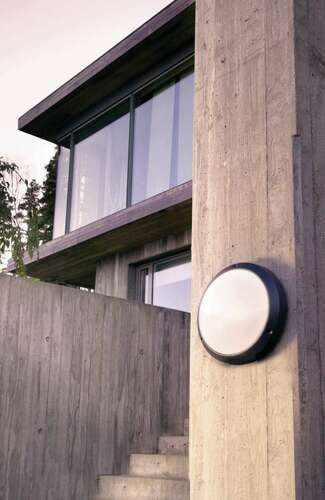
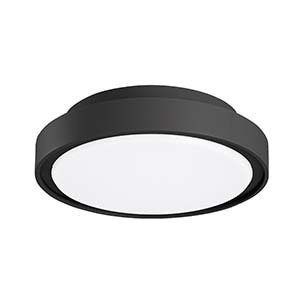
An outdoor ceiling light with motion sensor and a dusk sensor comes on only when two things happen together: it is dark enough outside and someone walks into the area beneath it. In daylight it ignores movement; at night it stays on for the time you set, then switches itself off. Mounted in a porch roof, canopy or soffit, the sensor looks straight down and covers a circle around the door – exactly where you stand fumbling for keys.
Motion and dusk together, not dusk-to-dawn
It is easy to confuse the two. A dusk-to-dawn light has only a photocell: it switches on at nightfall and burns until morning. That suits a lantern marking a path, but over a front door it lights an empty porch for ten hours and shines into the neighbours’ windows. Add a motion sensor and the photocell simply arms it: below the set lux level, any movement brings the light on, and each new movement restarts the timer.
Ceiling fittings use one of two sensor types:
-
PIR (passive infrared) reacts to the heat of a moving body and is most reliable when someone crosses the field. It cannot see through glass or dense planting.
-
Microwave (HF) sends out low-power radio waves and also catches people walking straight towards it. It works through diffusers, thin walls and timber doors, which is why it is often hidden inside the fitting. Metal blocks it.
What to check before you buy
| Spec |
Typical range |
What it means at home |
| Mounting height |
2.2–4 m |
Most porch ceilings and canopies sit around 2.4–2.7 m. |
| Detection angle |
360° |
The whole doorstep is covered, with no blind corners. |
| Detection diameter |
roughly 4–10 m |
On a porch right by the pavement, turn it down. |
| Dusk threshold |
a few to a few hundred lux |
Around 10–30 lx is the point where daylight turns grey. |
| Time delay |
a few seconds to several minutes |
1–2 minutes at the front door, longer on steps. |
| IP rating |
IP44–IP65 |
IP44 under a closed porch, IP54 or IP65 where rain blows in. |
| Colour temperature |
3000–4000 K |
Warm white is kinder to visitors; neutral white shows more detail. |
A front door needs only a few hundred lumens; a carport or a wide covered drive looks better at 1000–1500 lm. Integrated LED fittings typically last tens of thousands of hours, while models with an E27 lamp holder let you change the bulb. On a coastal property or an exposed gable, a higher IP rating and a corrosion-resistant body earn their keep in the damp British winter.
Some microwave fittings add a standby or corridor mode: when the time runs out they drop to a fraction of full output for a while instead of cutting straight to black. On a communal landing or a long side passage that softer fade is safer than a sudden switch-off.
Where they work best
Porches and storm porches, canopies over the back door, soffits above steps, carports, covered patios, side passages and communal landings in flats. In shared hallways a ceiling sensor light does the job of a timed switch without anyone hunting for a button. If you need to watch a long drive, a wall-mounted sensor light that looks outwards is usually the better tool; the ceiling version covers a smaller, even circle directly below.
Downsides worth knowing
-
Stays off in the evening: a street lamp or another light falling on the photocell convinces it that it is still day.
-
Switches on for no reason: boiler flues, sun-warmed brickwork, branches, foxes and cats. A microwave sensor can also see through a thin fence onto the pavement – reduce its sensitivity.
-
Slower on hot days: PIR needs a temperature difference between you and your surroundings, so its reach shrinks in a heatwave and grows in winter.
-
Cobwebs and insects on the lens cause flickering triggers. Wipe the lens and diffuser with a damp cloth, never with solvents.
Frequently asked questions
What are the downsides of using motion sensor lights?
Nuisance triggering, a light that goes off while you are standing still, and the odd evening when a nearby light fools the dusk sensor. All three are usually cured by adjusting sensitivity, time delay and the lux threshold, or by masking part of a PIR lens.
Which outdoor light has the best motion sensor?
There is no single best type. PIR suits an open porch where people walk across; microwave suits a fitting with a hidden sensor or a doorway people approach head-on. More useful questions are whether the sensor is adjustable and whether its detection circle matches your ceiling height.
Do I need a waterproof outdoor ceiling light?
Under a fully enclosed porch, IP44 is generally enough. On an open canopy, carport or anywhere wind drives rain sideways, choose IP54 or IP65.
How do I set the sensor?
Look for dials marked LUX (sun and moon), TIME (clock) and sometimes SENS. Set LUX at dusk, turning it until the light responds to movement, then trim the time and sensitivity by trial. Some fittings are factory-set with no dials at all.
Can I keep the light on permanently?
Many models switch to permanent light if you flick the wall switch off and on quickly. The exact sequence varies, so check the instructions.
Can I fit one myself?
The light needs a permanent 230 V supply with live, neutral and earth, and the wall switch stays on. Work on fixed wiring should be done by a qualified electrician to BS 7671.
If you only need motion detection, have a look at outdoor ceiling lights with motion sensor; for porch and canopy fittings in general, see outdoor ceiling lights.