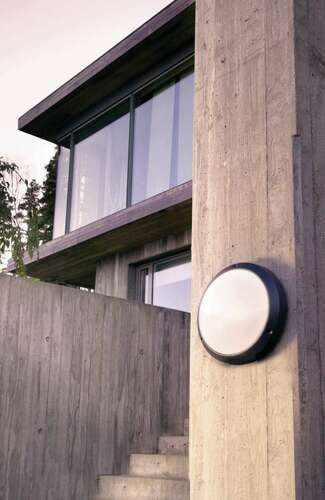
An outdoor motion sensor ceiling light fixes to the underside of a porch canopy, a carport roof or a covered passage and switches itself on when someone walks beneath it, then off again once the area has been quiet for a set time. Because the sensor faces the ground rather than the garden, it watches a full circle around the fitting instead of a wedge in front of a wall.
That circle is the reason to choose a ceiling fitting over a wall light with a PIR. Under a carport you might arrive from the car, the side gate or the back door; a wall light only sees what is in front of it, while a fitting in the middle of the roof catches all three routes.
Where a sensor ceiling light earns its place
-
Porch and front-door canopy: lights the step and the lock before you reach for your keys, and greets visitors without anyone touching a switch.
-
Carport and open garage: comes on as you get out of the car, whichever side you open. A brighter output and a longer run-on time help when you are unloading shopping.
-
Covered walkway, side return or loggia: several fittings can be wired so that one sensor switches the whole run.
-
Bin store, log store, garden room canopy: short trips in the dark where a switch would be forgotten or out of reach.
If there is only a wall above the door, an outdoor wall light with a sensor is the more natural fit.
PIR or microwave sensor?
Most fittings use a passive infrared (PIR) sensor: two elements behind a faceted lens compare heat, and a person crossing the field changes the picture. It works best on movement across its view and is a touch slower with someone walking straight towards it. Warm summer evenings, when the surroundings are close to body temperature, also blunt it slightly.
The alternative is a microwave sensor, sometimes sold as HF or radar. It sends out a weak signal and reads the reflections, so it is not bothered by temperature and notices smaller movements. It is hidden inside the housing, which keeps the fitting looking like an ordinary ceiling light. The catch: it sees through glass, plastic, thin timber and even thin walls (though not metal), so in a small carport it may react to someone walking past on the other side of the fence. Turn its range down and test.
Choosing the right specification
Typical values for outdoor ceiling fittings with a sensor. Always check the figures for the individual light.
| What to check |
Typical value |
What it means at home |
| Mounting height |
about 2.2–4 m |
most porch soffits sit at 2.3–2.6 m, carport roofs a little higher |
| Detection angle |
360° |
a full circle beneath the light; masking clips can block part of the lens |
| Detection range |
usually 4–10 m, adjustable |
set it short on a front path next to the pavement |
| Run-on time |
a few seconds to several minutes |
1–2 minutes at the door, 3–5 minutes in a carport |
| IP rating |
IP44–IP65 |
IP44 under a solid porch, IP54 or IP65 where rain blows in sideways |
| Light output |
roughly 400–2000 lm |
400–800 lm at the door, 1000–2000 lm for a double carport |
| Colour temperature |
3000–4000 K |
warm white by the front door, neutral white for working areas |
Integrated LED or a lamp holder? An integrated LED fitting is slimmer and needs no bulbs, but when it eventually fails the whole fitting is replaced. An E27 holder lets you choose brightness and colour; use an LED lamp in it, because compact fluorescents warm up slowly and do not like being switched on and off dozens of times a night.
Installation and upkeep
Mains sensor lights run on 230 V. In England, adding a new outdoor circuit is notifiable under Part P, so use a registered electrician, and BS 7671 expects outdoor circuits to have 30 mA RCD protection. Any existing switch normally stays on, since the sensor needs constant power. Mount the light slightly to one side of the path rather than directly over it, so visitors cross the sensor field rather than walking into it.
Wipe the diffuser and sensor lens with a soft, damp cloth once or twice a year, without solvents. A single cobweb across the lens can switch the light on all night. Check the seal against the ceiling while you are up the ladder; British winters are mild but wet, and condensation is the usual enemy.
Frequently asked questions
Can I turn off the motion sensor on outdoor lights?
On many fittings, yes: flick the wall switch off and on twice quickly to hold the light on, and switch off for around ten seconds to go back to sensor mode. The exact sequence differs between models, so check the instructions.
Is there a wireless motion sensor light for a porch ceiling?
Battery and solar sensor lights exist, but under a roof a solar panel gets little sun and batteries need regular changing. A wired fitting is brighter and does not depend on the weather.
Are sensor ceiling lights good security lights?
They make an entrance or carport feel occupied and show who is approaching. For lighting a whole drive or the back garden, a floodlight with a sensor covers far more ground.
What is the best LED light for outdoor use under a canopy?
One with the right IP rating for its exposure, a warm or neutral colour that suits the house, and output matched to the space. A bright cool-white light in a small porch tends to glare.
Do I need a waterproof light under a porch?
Even under cover, rain, mist and condensation reach the fitting, so choose at least IP44. Open-sided carports and exposed canopies call for IP54 or IP65.
Why does my sensor light keep coming on at night?
Usually an animal, swaying plants, a car on the road or insects on the lens. Reduce the range, mask the problem direction and clean the sensor.
For styles, materials and fixing details beyond the sensor, see outdoor ceiling lights. If you want the motion sensor paired with a separate daylight control, read on about outdoor ceiling lights with motion and dusk sensor.