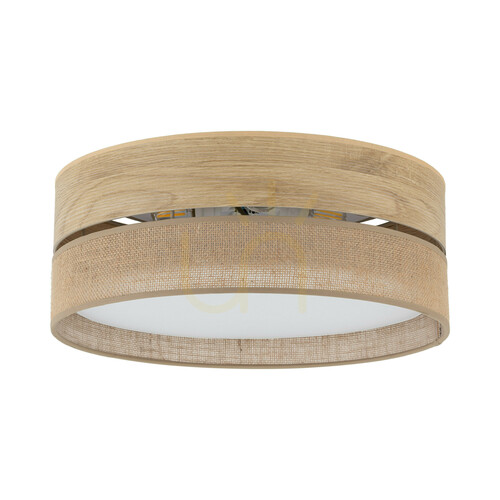
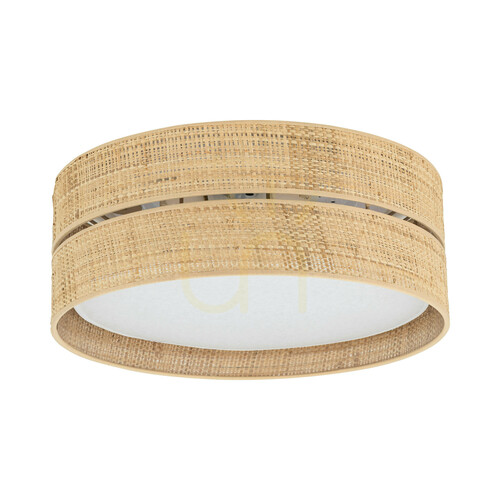
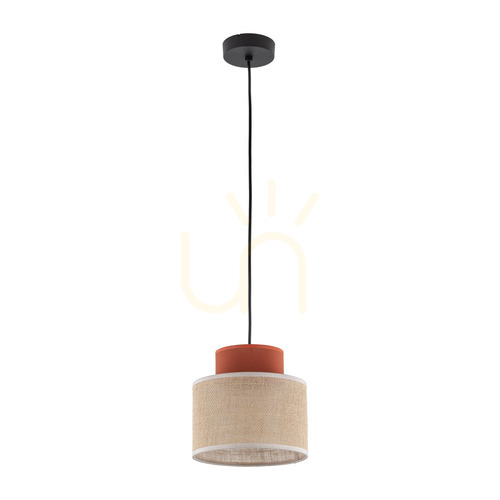
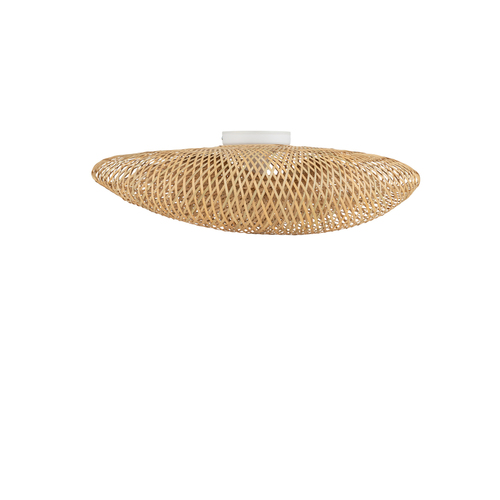
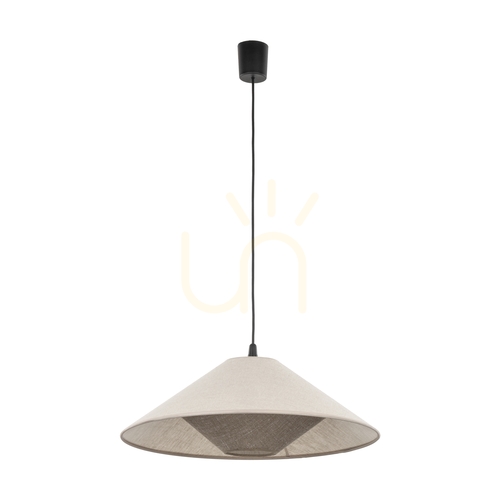
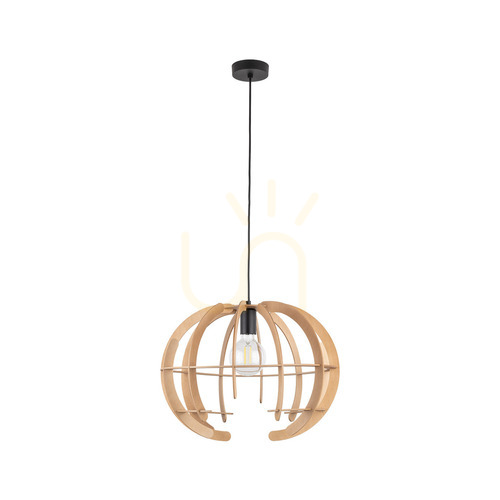
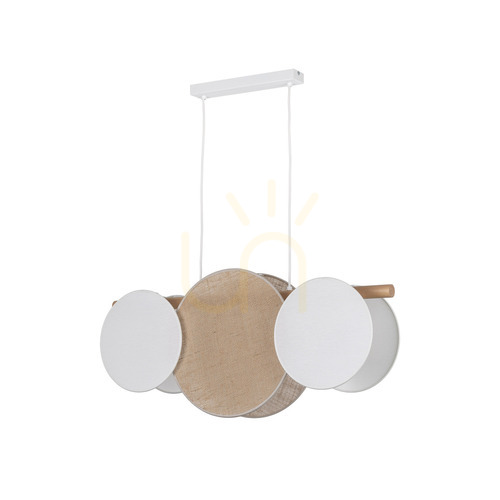
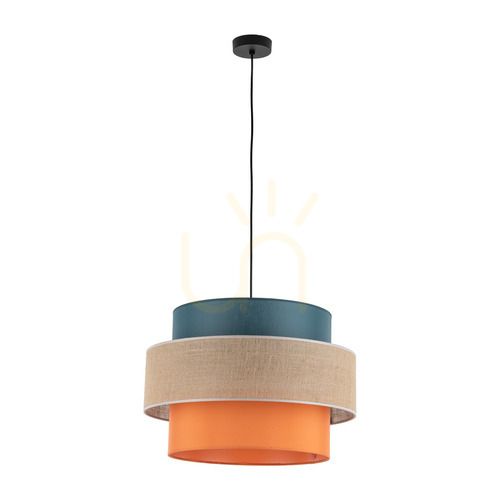
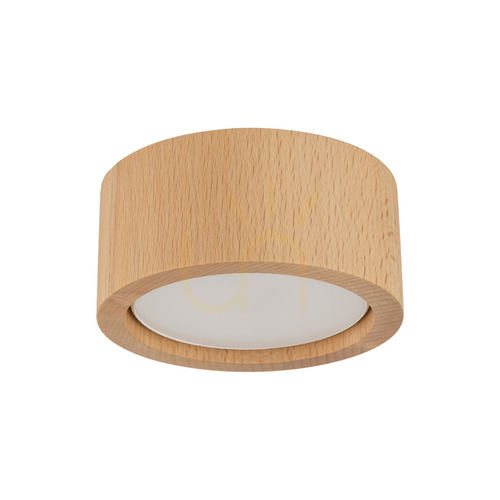
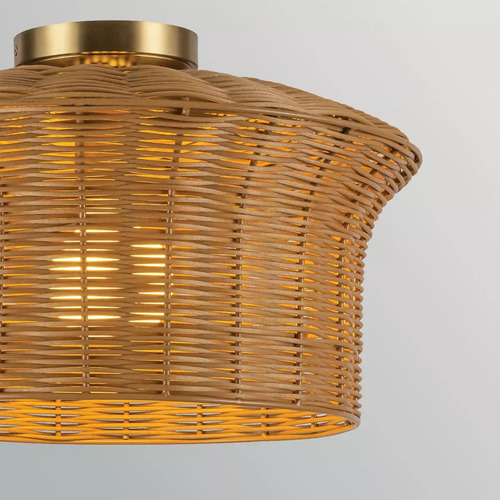
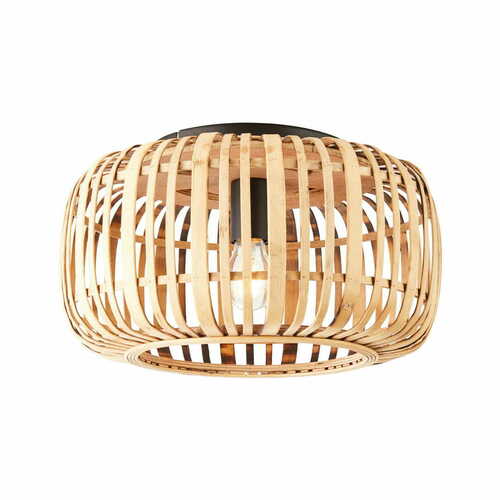
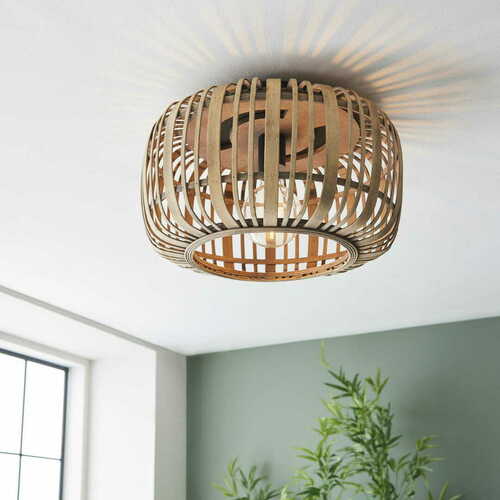
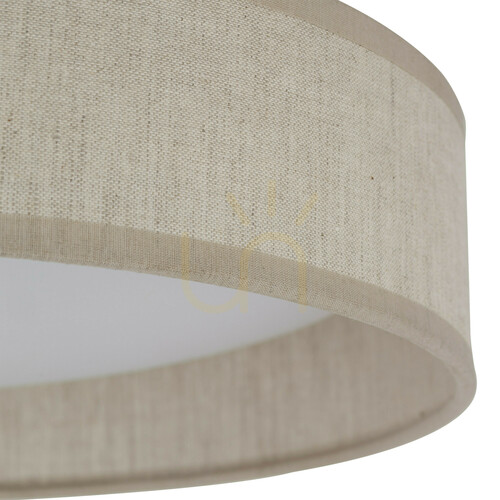
Boho ceiling lights are flush and semi-flush fittings whose shade is made of natural fibre — rattan, wicker, bamboo, jute, seagrass or knotted cotton macramé — over a simple metal frame. The appeal is not the shape, which is usually a plain dome or drum, but the material: a woven surface is full of small irregular gaps, and light passing through it lands on the ceiling and walls as a soft, textured pattern that no moulded diffuser can imitate. It is worth being clear about the consequence up front. A woven shade absorbs a great deal of light. This is a decorative fitting, not a task light, and a room lit only by one will feel dim.
Which fibre, and what each one does
Natural fibres compared
| Fibre |
How it is worked |
Effect when lit |
Practical notes |
| Rattan |
Solid palm stem, steamed and bent into an open lattice |
Wide gaps and strong shadow lines; the most graphic of the fibres |
Stiff and durable; a knock dents rather than breaks it |
| Wicker |
A weaving method rather than a plant — willow, rattan core or cane woven over a frame |
Fine, dense pattern with a warm honey cast |
Dries out and can crack in a very dry room; the odd strand works loose |
| Bamboo |
Split canes laid parallel or crossed |
Straight-line shadows, closer to a slatted screen than a weave |
The hardest of the group and the least likely to sag |
| Jute and seagrass |
Twisted rope wound round a frame |
Almost no light passes through; the glow comes from the open ends |
The lowest output of any boho shade, and the strongest texture |
| Macramé cotton |
Hand-knotted cord, often with a fringe |
Soft, irregular pattern with no repeat |
Holds dust; cotton yellows near a hot lamp, so keep the wattage low |
Flush or semi-flush changes the shadow
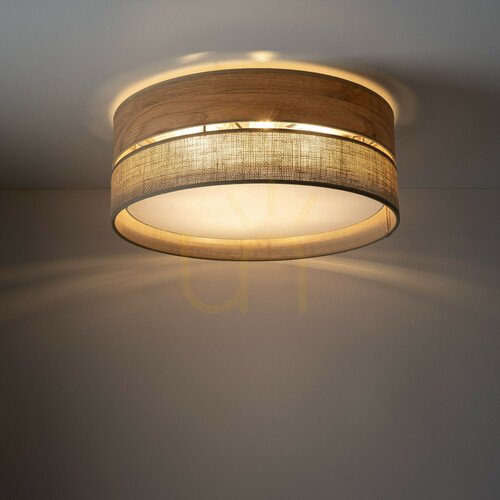
This is the decision specific to a ceiling-mounted boho fitting, and it is easy to get wrong from a photograph. A shade pressed tight against the ceiling has nowhere to throw its pattern — the light escapes sideways and downward, the ceiling above stays dark, and you get the texture of the shade without the shadow play. A semi-flush fitting on a 15 to 25 cm stem lets light out of the top of the weave and lands the pattern on the ceiling in a halo around the fitting, which is the effect most people are actually buying.
So: if the ceiling is 230 to 240 cm and nothing may hang, accept the flush form and treat the fitting as a textured object rather than a projector. If there is 250 cm or more, choose the semi-flush and the fitting does what the photographs show. Either way, keep the shade at least 210 cm above the floor in a walking route.
How much light you actually get
A tight weave passes a small fraction of what the lamp emits. That is not a fault, but it has to be planned for. Three consequences follow.
-
Specify the lamp generously, and dim it. An 800 lm E27 lamp behind a rattan dome delivers what a bare 300 lm lamp would. A dimmer lets you have the texture in the evening and the output when you need it.
-
Do not use it alone in a working room. In a kitchen or a study, pair it with something directional. In a bedroom or a hall it can be the only fitting, because those rooms want atmosphere more than illuminance.
-
Give the pattern a plain surface. Woven shadow against textured wallpaper cancels itself out. A flat white or pale ceiling is the best screen you will ever get.
The light source itself matters less here than on a pierced-metal fitting, because a weave is deep — light passes through several strands and comes out scattered whatever the lamp. That is the difference between the two mechanisms: pierced brass projects sharp geometry from a point source, and a weave produces a soft, irregular texture. The pierced-metal version of the same idea is on oriental lamps.
What this filter holds
45 models sit behind this page. The figures below are floors rather than shares, since catalogue attributes are filled in unevenly.
-
Standard sockets. 38 models take E27, with a handful on integrated LED, GU10 and GX53. E27 is the right socket for this style, because it lets you choose output and colour temperature to suit the density of the weave.
-
Single-lamp designs. 31 models carry one light point, 5 carry three, and small groups carry four and six.
-
Dry rooms. 41 models are recorded IP20 and 3 at IP54.
-
The palette is the material. 18 models are recorded beige and 8 in a wood tone, with smaller groups in brick, brown, black, white and green — natural fibre colours, with painted frames providing the darker tones.
-
No lamp supplied. 41 models ship without one, and 44 run on 230 V mains.
TK-Lighting supplies most of the range, with Nowodvorski and CustomForm contributing the rest.
Heat, dust and the things that shorten a woven shade's life
Natural fibre and heat do not mix well. A hot filament lamp inside a closed rattan dome scorches the strands nearest it over a couple of years, and cotton macramé yellows faster still. LED lamps solve this almost entirely, since the heat goes into the base rather than radiating into the shade — but check that the lamp sits centrally with clearance all round, and avoid the largest lamp the fitting will physically accept.
Dust is the other issue. A woven shade collects it in the weave, where a cloth cannot reach. A vacuum with a soft brush head, used gently and every few months, keeps the pattern crisp; a damp cloth pushes dust into the fibre and can stain jute permanently. Never wet a macramé shade — cotton cord shrinks unevenly as it dries and the knots pull out of shape.
Common questions
Will a boho ceiling light work in a kitchen?
Over a table or a breakfast area, yes. Directly over a hob or a worktop, no — the output is too low for the task, and airborne grease sticks to natural fibre and cannot be washed out.
Can I put one in a bathroom?
Only a rated model in a dry zone, and 41 of the 45 models here are IP20. Steam is bad for natural fibre in any case; it swells, dries out and loosens the weave over time.
Does the shade sag?
Rattan and bamboo hold their shape indefinitely. Loosely woven jute and long macramé fringes will relax slightly over a year or two, which most people read as the material settling rather than as a fault.
Is boho the same as japandi?
They share natural materials and neither uses ornament, but the discipline is different: boho is layered, warm and slightly irregular, while japandi is spare, pale and precisely composed. If the restraint appeals more than the texture, japandi ceiling lights and japandi wall lights are the pages to compare.
What colour temperature suits natural fibre?
2700 K, or 2200 K if the room is used mainly in the evening. Rattan and jute are warm, yellow-brown materials, and cool light drains them to grey — the same failure that spoils timber and brass under the wrong lamp.