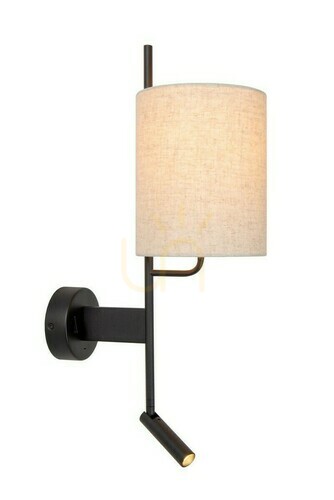
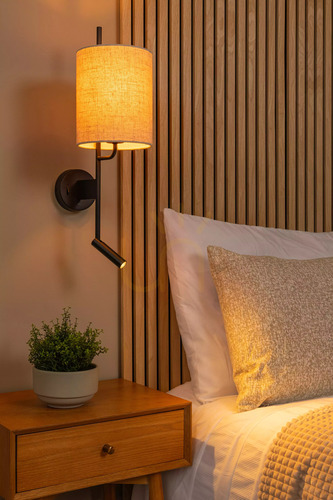
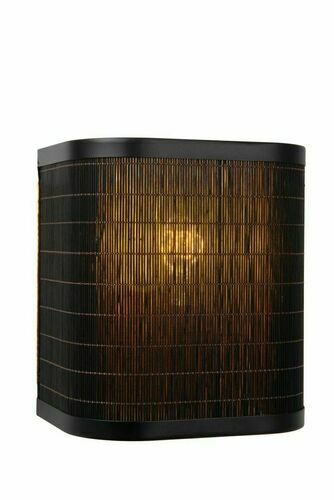
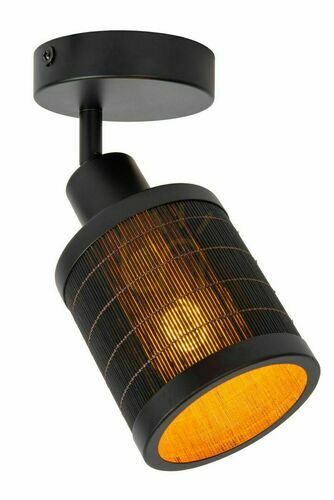
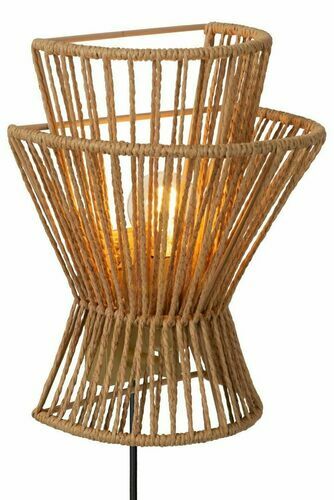
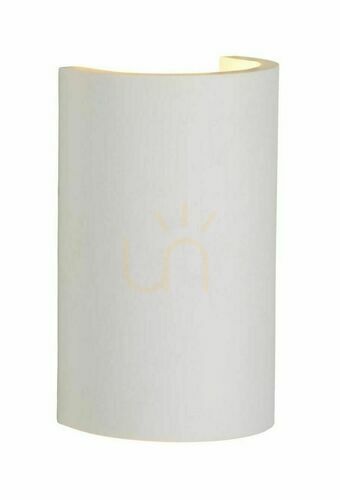
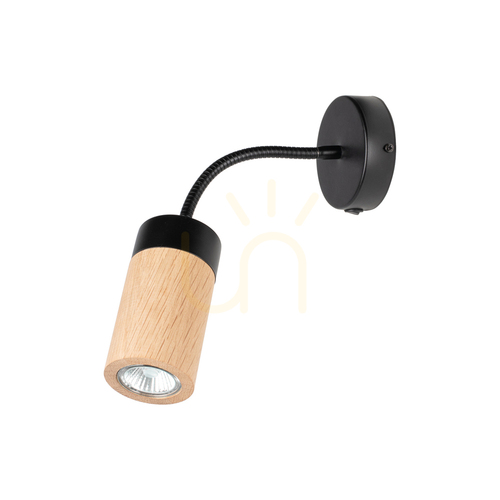
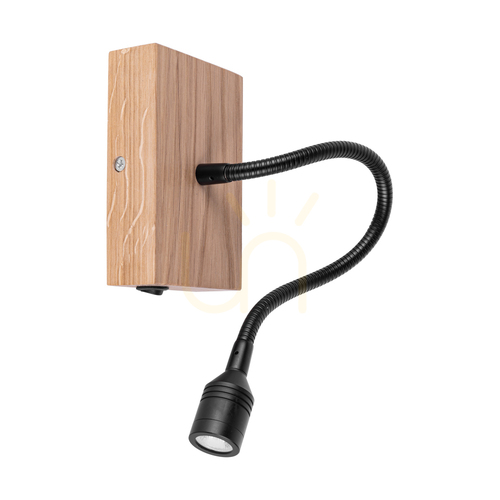
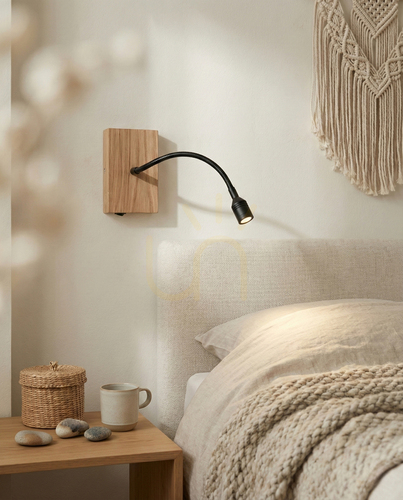
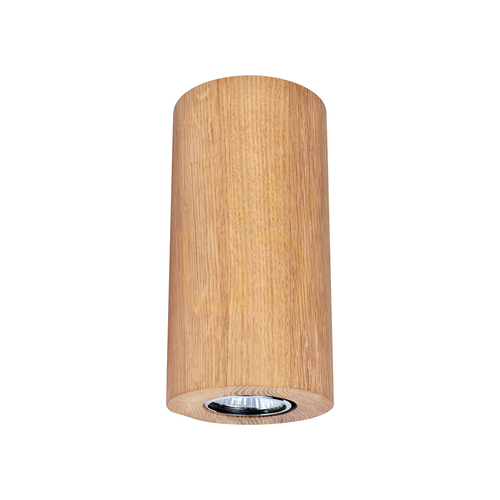
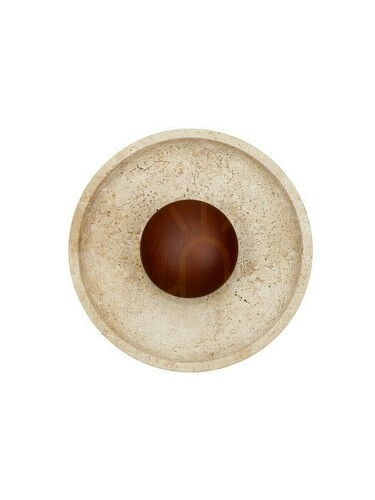
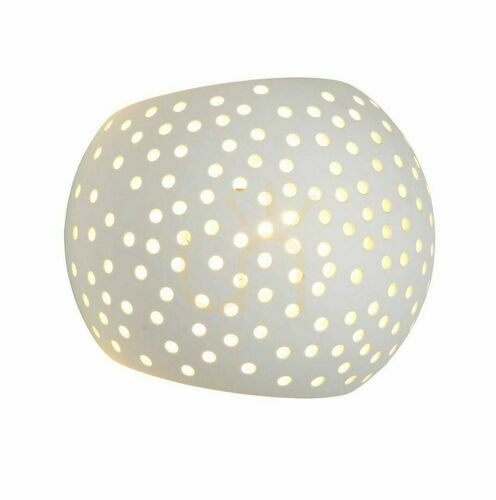
Japandi wall lights answer a problem both parent traditions cared about: how to light a room without putting a bright object in anyone's field of view. Japanese interiors do it by filtering the source through paper; Nordic interiors do it with low, warm, functional fittings that stay out of the way. A wall bracket in this style is therefore usually matt rather than glossy, pale ash or oak, unbleached fabric, raw plaster or slim black steel — and it is nearly always the only fitting on that wall.
What the fitting is doing with the light
The shape of a wall bracket determines its light distribution completely, and in a style that puts one fitting on a wall rather than three, getting that distribution right is most of the decision.
Four distributions, four jobs
| Fitting |
Where the light goes |
Good for |
Not for |
| Plaster half-cylinder or wedge, flush to the wall |
A soft column up and down the plaster; nothing into the room |
Corridors and stairs; it can be painted the wall colour and disappears entirely |
Reading, or lighting a room |
| Fabric or paper shade on a short bracket |
Diffuse in every direction, including through the shade itself |
Bedsides, living room walls; the softest light in the style |
Anywhere it can be knocked, or any room with steam |
| Wood or metal arm with a small tilting head |
A directed pool wherever it is aimed |
Reading in bed, a chair, a work surface |
General room light; the pool is small and hard-edged |
| Small opal or ceramic dome, wall-hugging |
Even and undirected, close to the surface |
Passages and small rooms; comfortable from any angle |
Task light of any kind |
Mounting heights
Measured to the centre of the backplate, from the finished floor.
-
Beside a bed: 1.1 to 1.25 m, or 50 to 60 cm above the mattress top. This is the position where the style earns its keep, because a wall bracket frees the whole bedside surface — and an empty surface is the point of the whole tradition.
-
General light on a living room wall: 1.5 to 1.7 m. One fitting, not a run of them. Above 1.7 m an open-topped shade shows you its inside from standing height.
-
Corridor: 1.6 to 1.8 m, with nothing projecting more than about 10 cm below shoulder height. A flush plaster wedge is the natural answer here and it takes paint, so it can be made to vanish.
-
Stairs: 1.6 to 1.8 m above the tread directly beneath the fitting, never above the landing floor, or the spacing steps unevenly up the wall.
-
Reading: whatever the height, the head needs at least 30 cm of reach or a tilt to get the light onto a page rather than onto the wall behind your shoulder.
What is in this range
Twelve products carry the Japandi style on wall lights, so this is a small and deliberate selection rather than a broad one — Lucide supplies most of it, with single entries from Nowodvorski and Candellux. The material spread is the interesting part: metal on six, wood on four, plaster on three, and then fabric, steel, concrete, rattan and paper on one or two each. Attributes are sparsely filled, so treat those as floors. Even so, the shape of the range is clear enough — natural and mineral surfaces alongside the metal, with rattan and paper appearing at all, which they do on almost no other wall light page.
-
Colours stay inside the palette: black on five, white on three, natural wood on three, grey on one. Nothing polished, nothing chromed.
-
Single-lamp fittings, with one two-lamp exception. That matches the style rather than limiting it: a Japandi wall is meant to hold one source.
-
Dry rooms. Everything here is IP20 and runs on 230 V, so a bathroom needs a rated fitting from elsewhere. Inside the zone around a bath or shower, and for 60 cm beyond it, at least IPX4 is required, and a fitting beside a basin mirror is normally specified at IP44.
Light source
None of these products includes a bulb, which is normal for European lighting. Six take an E27 cap, four take G9 capsules, and there is one each on E14 and GU10; eleven are recorded as taking a replaceable LED lamp, so colour temperature stays a reversible decision.
- 2700 K, or 2400 K behind unbleached linen, paper or rattan. Warm sources are what make pale wood and natural fibre look like themselves; at 4000 K oak turns grey and linen turns blue.
- Frosted or opal lamps throughout. A wall light sits at eye level, and a paper or thin fabric shade will show the outline of a clear filament lamp as a dark shape inside it.
- G9 fittings are compact and usually sealed into a small body — that means low output by design, which suits a corridor and does not suit a reading position.
- A pair beside a bed should be on the same dimmer, from the same batch, at the same colour temperature. Mismatch is more visible in a symmetrical pair than anywhere else in the house.
- Keep the output modest. This is a style built around low, even, evening light, and a bright wall bracket undoes it faster than a bright ceiling fitting does.
Hard-wired or plugged in
A hard-wired bracket sits over a recessed box on a switched circuit; it is the tidy answer and it commits you to the position, so mark the height on the wall with tape and live with it for an evening before drilling. A cord-and-plug version runs a visible flex to a socket. In most styles that is a compromise; here it is close to neutral, because a plain textile cable running down a pale wall is consistent with the whole material language rather than at odds with it.
Questions people ask
Can a wall light replace a bedside lamp?
That is the strongest argument for one in this style. It clears the whole bedside table, which is the surface the tradition most wants empty, and it cannot be knocked over. The requirement is reach or tilt — at least 30 cm of projection if you actually read in bed.
How many should a room have?
One per wall, at most. Japandi is a subtractive style and a run of matching brackets down a living room wall reads as a hotel corridor. A pair either side of a bed is the exception, because the symmetry is doing a job there.
Is a plaster fitting practical?
Yes, with one caveat: unsealed plaster marks permanently if it is handled with oily hands, and it cannot be wiped clean. It can be painted the exact colour of the wall, which is the reason to choose it — a fitting that disappears completely when the light is off is a very Japandi outcome.
What separates this from Scandinavian or minimalist?
Scandinavian design will happily use colour, pattern and several fittings in one room. Minimalism is about geometry and hard edges, and will accept a polished white cylinder. Japandi keeps the surfaces matt, natural and slightly irregular, and removes fittings rather than adding them. Minimalist ceiling lights shows where the harder-edged version goes.
What lights the rest of the room?
Wall brackets in this style are a supporting layer, never the main one. Japandi ceiling lights covers the single overhead object the room is built around and which forms a given ceiling height can take, and japandi pendant lights goes into shade materials and drop heights over a table.