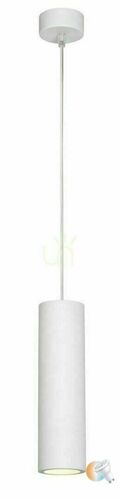
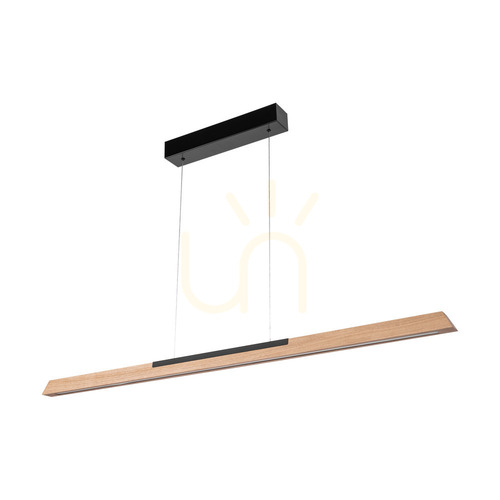
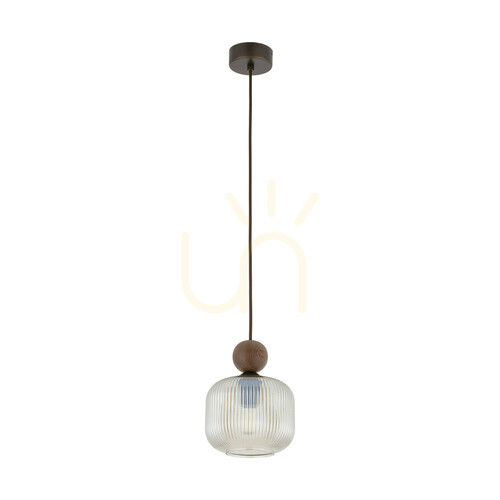
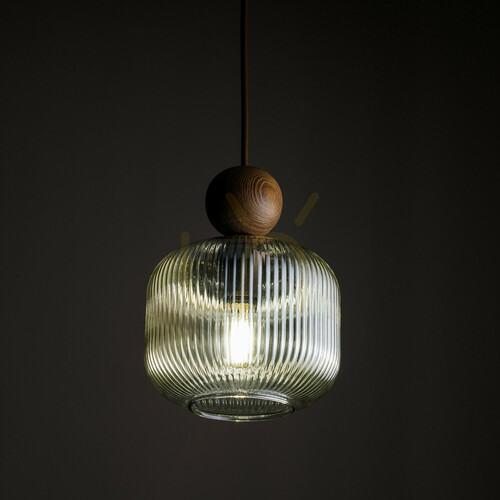
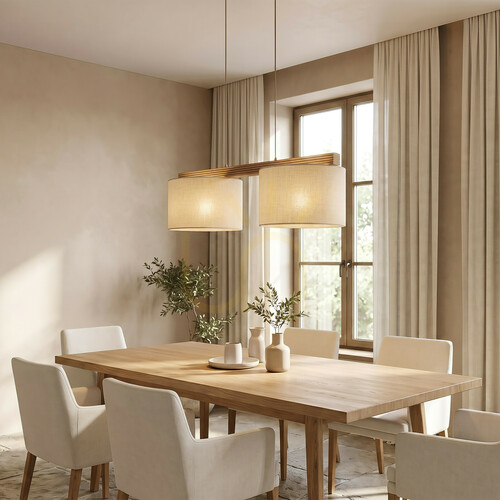
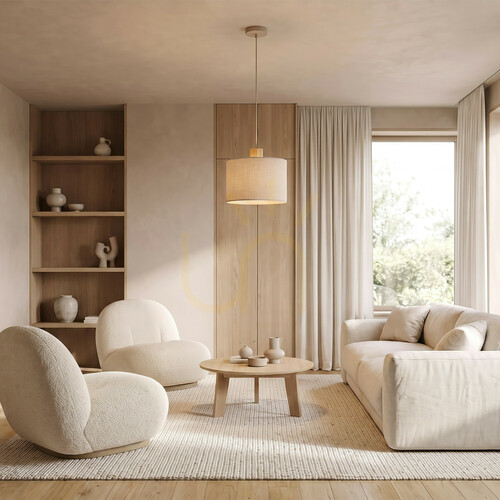
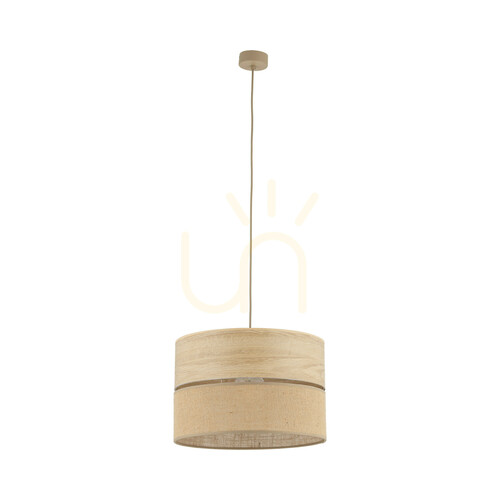
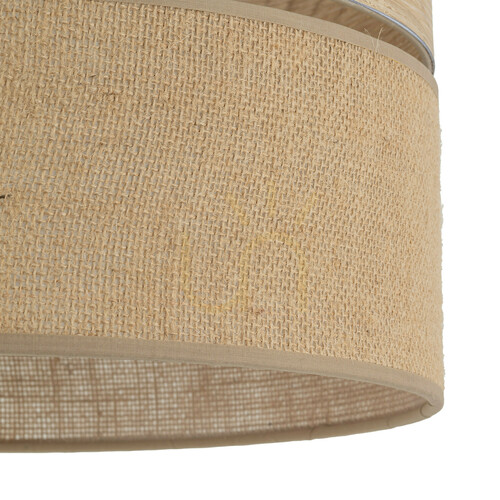
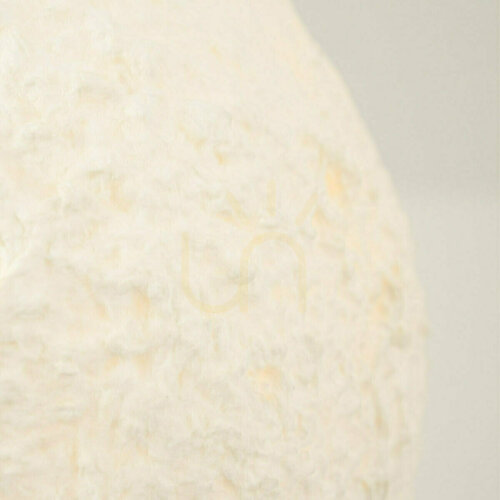
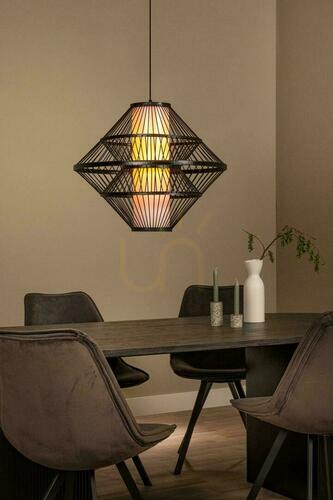
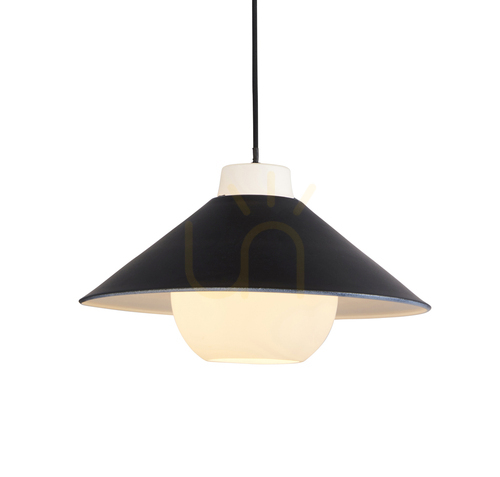
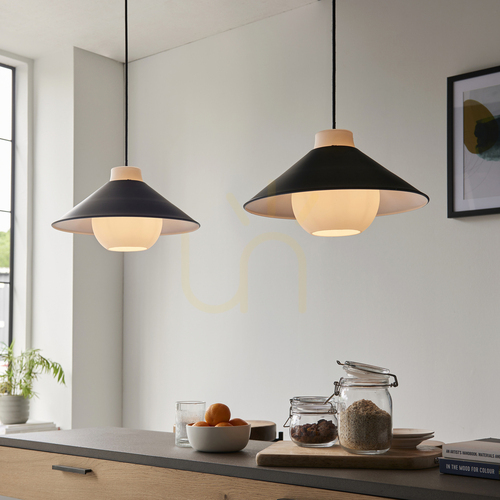
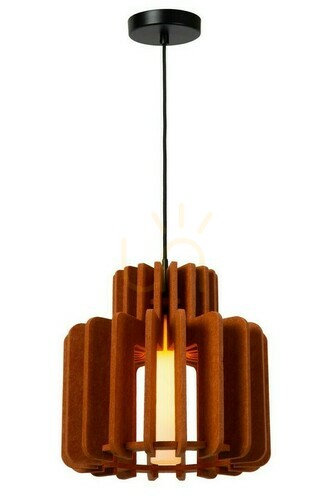
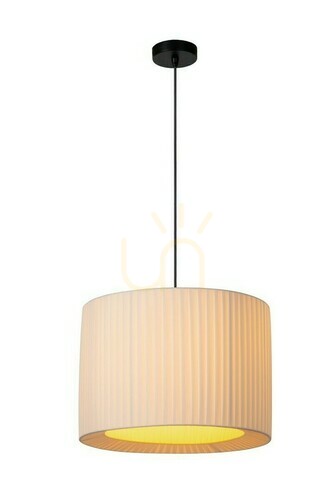
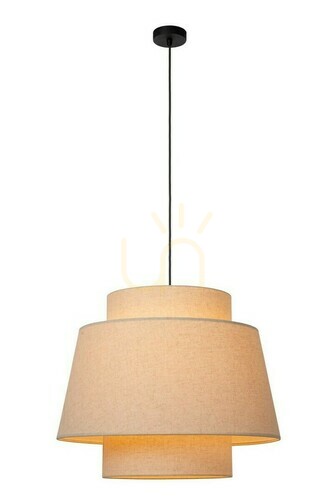
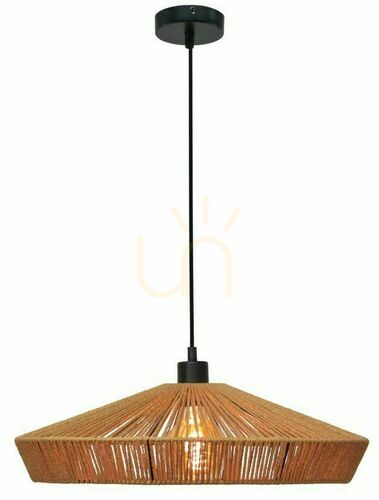
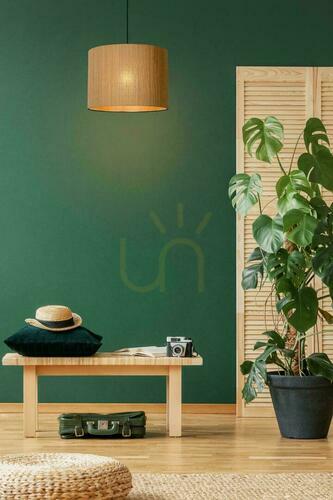
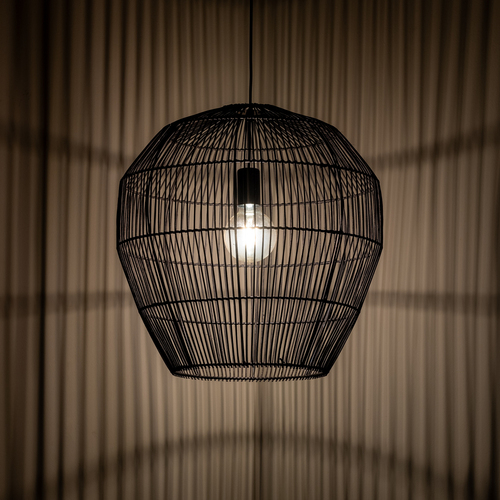
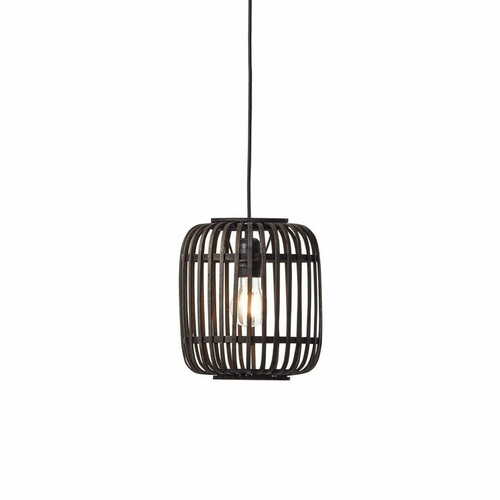
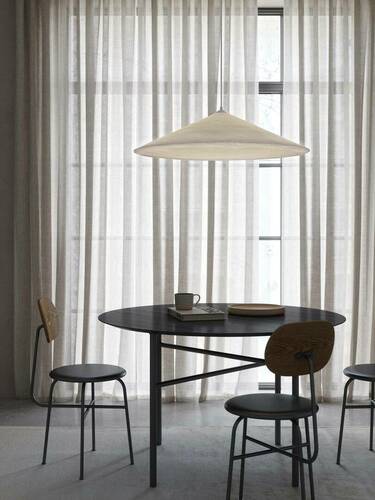
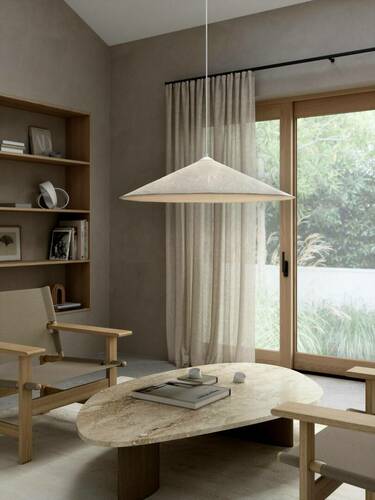
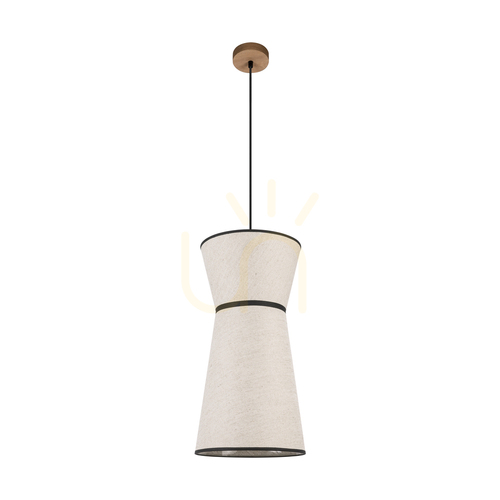
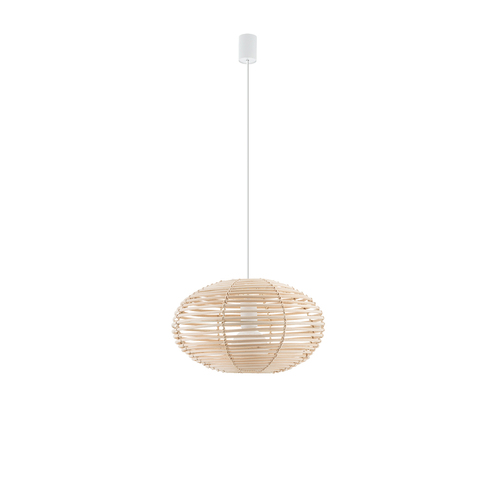
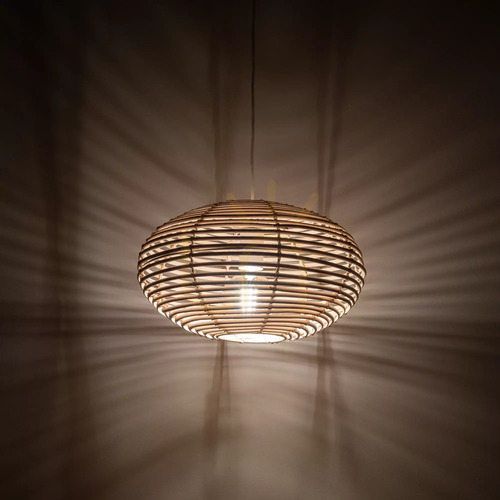
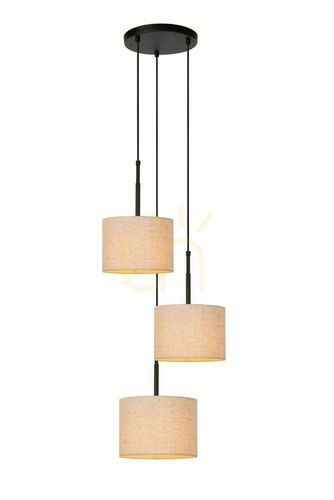
A japandi pendant light is defined by its shade material more than by its shape. The style comes from two traditions that both hide the light source — Japanese interiors filter it through paper and screens, Nordic interiors soften it against dark winters — so what hangs over the table is usually a drum of unbleached linen, a paper globe, a turned wooden dome or a matt plaster shade on a slim black cable. Nothing is polished, nothing reflects, and the fitting is meant to disappear when the light is off.
The shade material is the specification
These materials behave differently enough that choosing between them is a practical decision, not an aesthetic one. This range carries all of them.
Shade materials and how each one behaves
| Material |
Light |
In a kitchen |
Cleaning |
| Linen and cotton |
Glows across the whole surface as well as at the openings; the softest light in the style |
Fine over the eating end, poor near a hob |
Vacuum with a brush head. Marks do not come out |
| Paper and rice paper |
Even and sourceless, with the frame ribs faintly visible |
Keep it well away from steam |
Dry brush only. Treat it as consumable over five to ten years |
| Wood, turned or veneered |
Opaque body, light directed straight down, warm reflected colour at the rim |
Good, provided it is finished rather than raw |
Damp cloth. Watch for drying and cracking above a radiator |
| Plaster and concrete |
Fully opaque, hard-edged pool below, no side light at all |
The most durable choice near cooking |
Dusts easily; unsealed plaster marks permanently if handled with oily hands |
| Ceramic |
Opaque with a matt glaze; a defined pool and a visible object |
Good and easy to wipe |
Washes. Heavier than it looks — check the fixing |
The range bears this out. Of 69 products, 27 are recorded as metal and 27 as fabric — an even split that no other style on the site produces — with glass on eight, wood on eight, ceramic on five, concrete on five and paper on five. These attributes are filled in sparsely, so each figure is a floor rather than a share.
Drop, diameter and how many
-
Over a dining table: the bottom of the shade 70 to 80 cm above the tabletop. A fabric or paper shade can sit at the lower end of that, because it does not glare from the side the way an open metal shade does.
-
Over a kitchen island: 75 to 85 cm above the worktop. People stand here, so the sightline across the island decides the height rather than the seated eye level.
-
Diameter: roughly a third of the table width for a single shade. A large paper globe is the exception — it reads as a volume rather than a shade and can go considerably bigger without dominating.
-
A row of three: 40 products here take one lamp and 19 take three, so the linear group is a real part of the range. The table needs to be at least 160 cm long, with the outer two set in about 30 cm from the ends.
-
Over open floor: 2.05 m of clear headroom, minimum, and one fitting rather than a cluster. Clustering is the fastest way to lose the calm this style depends on.
Colour and finish
The palette in this range is narrow on purpose: 18 products are recorded as black, 14 as white, 11 as natural wood, eight as grey and eight as beige, with a couple in pink and single entries in brown and rust. There is no chrome and no gloss in the leading colours. In practice the choice comes down to whether the fitting should be seen or not — a black stem with a black shade is a drawn line against a pale ceiling, while a white or unbleached shade on a white ceiling vanishes when the light is off, which is the more Japanese of the two instincts.
The cable, the canopy and the ceiling
- Slim matt black or textile cable is the style's default, and the canopy is usually small. Check its diameter against the ceiling box you already have, because a narrow rose will not cover a large modern box.
- Ask whether the drop is adjustable at the rose or fixed at manufacture. A fixed 150 cm cable in a 2.4 m room cannot be corrected afterwards.
- The ceiling point rarely sits over the table. A discreet hook with the cable run back to the existing rose is a legitimate solution, and a textile cable run deliberately reads better than a white PVC one pretending not to be there.
- Plaster, concrete and ceramic shades are heavy for their size. Anything over a couple of kilos wants a fixing into a joist or a rated cavity anchor rather than the plug in the box.
The light source
61 of these pendants take an E27 cap, two take GU10 and four are built around an integrated LED module. 60 of them ship without a bulb, and 50 are recorded as taking a replaceable LED lamp — so on almost everything here the light source is a separate decision that stays reversible.
- 2700 K generally, 2400 K behind unbleached linen or paper. A cool lamp through natural fibre turns it grey and takes away the warmth the material was chosen for.
- Frosted or opal lamps only. Paper and thin fabric show the shape of the lamp inside as a dark silhouette, and a filament lamp behind a paper shade reads as a fault rather than a feature.
- Keep the output lower than instinct suggests. Fabric and paper emit across the entire surface, so 600 to 800 lumens over a table feels brighter here than the same figure inside a metal shade.
- Where the shade is plaster or concrete and fully opaque, the opposite applies: all the light goes downward in a tight pool, so a wider beam or a second fitting elsewhere in the room is worth planning for.
- A dimmer suits the style particularly well. These interiors are lit low in the evening, and a fabric shade at half output is the effect the whole thing is built around.
Where the range comes from
Lucide supplies 55 of the 69 products, with Fabbian and Candellux on three each, Nowodvorski, Aldex and BAZAR BIZAR on two, and single entries from Nordlux and Thoro. One dominant supplier makes the range coherent, and the smaller names are where the genuinely tactile pieces sit — the natural fibre, the ceramic, the concrete. Those are the ones that stop a room reading as a single catalogue order.
Questions people ask
Is a paper shade practical over a dining table?
Over the table, yes, for years. Over a hob or a hot induction plate, no — paper and unlined linen absorb grease and steam and cannot be cleaned. In an open kitchen, keep the soft materials over the eating end and use wood, plaster or ceramic where the cooking happens.
One pendant or three?
One, unless the table is genuinely long. This is a style built on subtraction, and a single well-sized shade with quiet ceiling around it does more for a room than a row. The three-lamp arrangement earns its place over a 180 cm table or a long island, where a single shade cannot cover the length.
What is the difference from Scandinavian?
Scandinavian design accepts colour, pattern and several fittings in one room. The Japanese half of Japandi removes all three and adds negative space. The quickest test is quantity: one object over the table, nothing else on the ceiling.
Do these come with a bulb?
Almost none of them do, which is normal for European lighting. Nearly all take an ordinary E27 cap on 230 V, so the lamp is easy to source — but with fabric and paper shades the choice of lamp changes the object, so it is worth a moment rather than a default.
What else goes in the room?
Japandi ceiling lights compares the pendant against the flush and semi-flush forms if the ceiling cannot take a drop, and japandi wall lights covers the bedside and the corridor, where a single low source is exactly what the style wants.