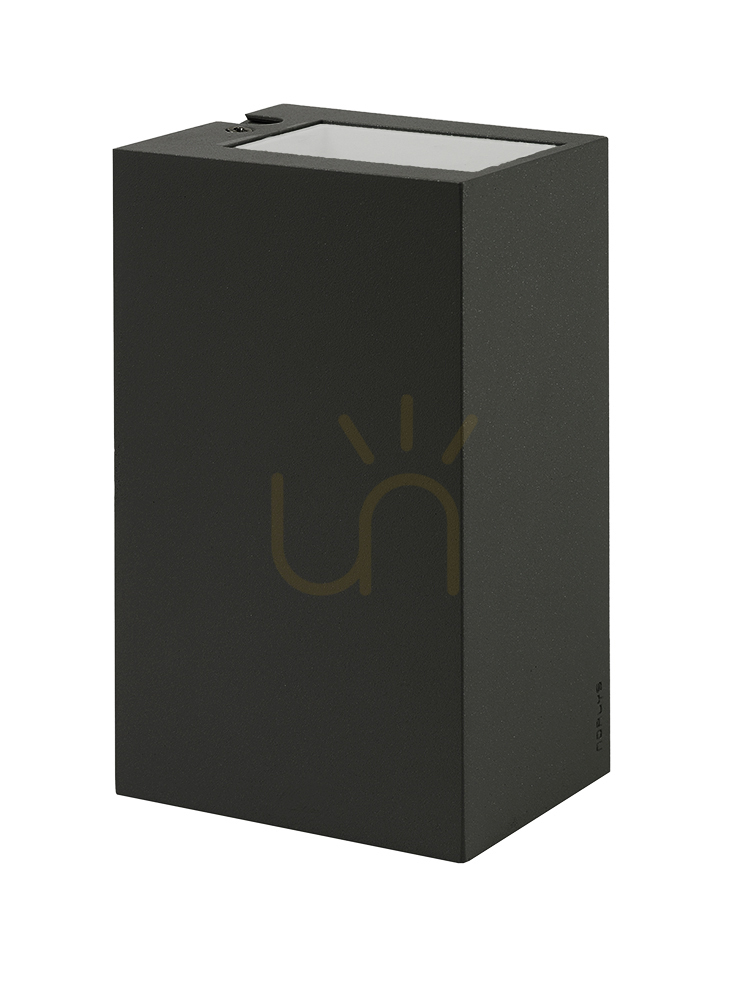
Lillehammer 2270BL is an outdoor wall light shaped as a compact rectangular block of cast aluminium, powder-coated black (RAL 9005). Light leaves through panes of clear safety glass in the top and bottom faces, so the front of the fitting stays plain. The LED module and the electronic DALI driver are inside the housing, so there is no light source or driver to buy separately.
Size and wall mounting
According to the manufacturer's drawing, the fitting is 18.5 cm high and 8 cm wide and projects 11 cm from the wall. It is fixed through two ø5 mm holes spaced 45 × 130 mm apart, so it needs a strip of wall at least 8 cm wide, for example beside a door frame.
The housing is rated IP65 — dust-tight and protected against water jets from any direction — and IK08 for impact resistance. The fitting is protection class I, so it must be connected to a protective earth (PE) conductor.
What light it gives
The fitting lights in two directions: a narrow 4° beam one way and a wide 60° beam the other. The manufacturer allows mounting either way up, so the narrow beam can run up the wall and the wide one down — or the reverse. On a façade this produces a thin line of light on one side of the fitting and a broader pool on the other.
The LED module gives 3000 K, a warm white, with a colour rendering index of CRI 80. The fitting puts out 127 lm at 7.3 W — accent-light level that draws a pattern on the wall rather than lighting a whole driveway or path.
Control and connection
The driver works on a DALI2 system, so dimming and programming the fitting needs a DALI2 controller in the installation. The terminals take conductors up to 5 × 1.5 mm² and allow the supply to be looped on to the next fitting, and the cable gland takes a round cable of 7–10.5 mm diameter — so a row of wall lights along a façade can run from a single supply line.
The manufacturer also states how many of these fittings one circuit breaker can carry given the 6.7 A inrush current: 46 on a B10 breaker, 74 on B16, 74 on C10 and 119 on C16. These figures are useful when planning a longer run of fittings on one circuit.