
Garden and park lanterns – classic lighting for paths and driveways
Garden lanterns can mark a safe route, frame a formal entrance and give a property character after dark. Height and the number of arms alone do not guarantee a good result. Beam distribution, weather resistance, a suitable foundation and spacing that guides the eye without creating a row of glaring points all matter. This guide explains when to choose a classic park lantern, when a low bollard works better and how to plan fittings from 1 to 2.5 metres high.

Contents
- Lantern or bollard: start with the function
- How high should a garden lantern be?
- Spacing along a path or driveway
- Beam, lumens and glare
- Colour temperature and surroundings
- IP, IK and outdoor materials
- E27 lamp or integrated LED?
- Foundation, cables and installation
- Controls after dark
- Matching the style to the property
- Common mistakes
- Summary
Lantern or bollard: start with the function
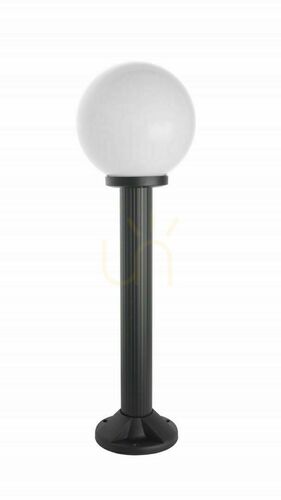
A park lantern is normally a taller, prominent fitting fixed to a plinth or foundation; a bollard is lower and guides light close to the path. Tall lanterns suit a gate, broad driveway, courtyard or a long garden axis. One lantern head looks restrained, while several arms can cover a wider area but need visual space.
A low bollard marks bends, steps and path edges without competing with planting. On a small plot, a series of bollards is usually better proportioned than a 2.5 m lamp post. Both types can work together: tall focal points at the entrance and low guidance deeper in the garden.
Compare Garden Lanterns and Bollard Lights.




How high should a garden lantern be?
Standing garden lights around 1–1.5 m remain close to human scale and suit short paths or terraces. Models of 1.8–2.2 m stay visible above a hedge or parked car. A 2.5 m post fits a broad driveway or large plot, but can dominate a narrow path and shine into windows.
Judge the finished height including the plinth. Account for slopes, mature planting and the lantern head’s position relative to eye level. On a steep drive, successive points may need stepped mounting so their heads form a calm rhythm.
Spacing along a path or driveway
There is no universal spacing. It depends on mounting height, optics, beam angle, output, lamp type, path width and surface reflectance. Start with the manufacturer’s photometric data. Testing one fitting after dark helps assess comfort, but does not replace proper data or a lighting design.
On a broad driveway, alternate fittings from side to side to create a natural rhythm and avoid a runway effect. One side can be enough for a narrow path if the beam reaches the full width. Light gates, steps and changes of direction separately; safety matters more than perfectly equal gaps.
Beam, lumens and glare
More lumens do not automatically make a better garden. A clear globe with a visible lamp sends light in every direction and can glare. An opal diffuser softens the point, while a shielded top directs more light to the surface. Near a boundary, choose optics that do not spill into a neighbour’s property or the sky.
Outdoor light should have a purpose, be aimed where needed, remain no brighter than necessary and operate only when useful. Limit emission above the line of sight and beyond the target surface. This reduces glare, energy use and light pollution. Check the view from bedroom windows and from a driver’s position at the gate.
Colour temperature and surroundings
Warm 2700–3000 K light complements brick, timber, greenery and traditional details. It is also gentler in an evening garden than cool light rich in short blue wavelengths. Neutral 4000 K may be justified in a technical or parking zone, but need not cover the whole property.
Keep one colour temperature within a visible composition. A 2700 K lantern beside a 4000 K façade light can look accidental. Direction and consistency matter more than maximum power.
IP, IK and outdoor materials
A standing fitting faces rain, dust, frost and UV. Check the IP rating of the complete product and its permitted mounting position. IP44 occurs in sheltered locations but is not a universal minimum; exposure to spray, dust and weather determines the required protection. Cable entries, glands and the base must retain the rated sealing.
IK describes impact resistance, important near gates, mowers and public paths. Aluminium needs a durable coating, steel suitable corrosion protection and plastics UV stability. In coastal areas or near road salt, verify resistance to aggressive environments. Periodically inspect fixings, seals, drains and finishes.
E27 lamp or integrated LED?
An E27 holder makes it easy to replace the lamp and change output or colour. Check maximum wattage, diameter and length: a large globe or long filament may not fit. The lamp must be approved for an enclosed fitting and elevated temperature. In a clear globe, consider real output as well as appearance because a bright filament can glare.
Integrated LED may provide purpose-designed optics and higher efficacy. Check service life, warranty and whether the module or driver can be replaced. Dimming in either system requires compatibility between the lamp or driver and the control.
Foundation, cables and installation
A tall lantern acts as a lever in the wind. A 2.5 m model generally needs a stronger base than a 1–1.5 m bollard. Size the foundation for the fitting’s mass and wind area, the manufacturer’s instructions, soil and local frost conditions. Do not anchor it only to loose paving. Keep fixings accessible and route water away from cable joints.
A qualified electrician should design, install and test a buried 230 V circuit. This includes cable suitable for direct burial, mechanical protection, overcurrent protection and an RCD. Metal parts must be connected according to the fitting’s protection class and instructions. Outdoor or underground connectors and glands must retain the IP rating; an ordinary box or twisted wires are not acceptable. Protective tests are required after installation.
Controls after dark
A photocell switches regularly, but without a timer the lanterns may run all night. An astronomical timer or schedule is better: full light in the evening, dimming or switch-off later, and operation before dawn only if needed.
Motion sensing suits a side route, although a tall lantern switching abruptly can disturb neighbours. Limit detection range and duration; where possible, use a gentle transition from a low background level to working light.
Matching the style to the property
A traditional park lantern is not restricted to period houses. It can form a deliberate contrast against a simple façade if its finish repeats in the gate, handles or wall lights. There is no need to copy every ornament; shared geometry, finish and light colour are enough.
A modern bollard is quieter beside minimalist architecture and grasses. Black creates a firm outline, graphite blends with paving, and aged metal strengthens a classic scheme. Judge the fitting in daylight too, when it is part of the landscape rather than a light source.
Common mistakes
- choosing height without considering the scale of the plot;
- equal spacing despite steps, bends and gates;
- a bright, unshielded lamp at eye level;
- cool light throughout the garden without a functional reason;
- spill into windows, the sky or beyond the boundary;
- choosing IP from the word “outdoor” alone;
- no foundation sized for wind and frost;
- unsuitable boxes, joints or switches exposed to water;
- no service access to lamps, drivers and fixings;
- operating at full output all night.
Summary
Garden lanterns should first solve a clear task: guide visitors, illuminate a gate or organise a large courtyard. Choose a height in proportion to the setting, set spacing from the beam rather than decoration, and limit upward spill. Warm light, suitable IP and IK ratings, a stable foundation and timed control create a safe, efficient installation that respects its surroundings.
Compare classic Garden Lanterns with more discreet Bollard Lights and build the layout outwards from the property’s key points.
Maciej Hudaszek


Maybe you will be interested in products from these categories?
Garden Lanterns, Bollard Lights
Tags & Blog Categories