
Light Bulb Sockets Explained: E27, E14, GU10, G9, and Others – How to Choose the Right One
E27, E14, GU10, GU5.3, G9, G4, GX53… these base codes look like a code, and a mistake means another trip to the store—or a light bulb that stays in the drawer forever. In fact, the system is logical and can be figured out once and for all. In this guide, we explain what the letters and numbers in bulb base names mean, how to identify the base in your light bulb, the differences between common threads and plugs, and what to watch out for when replacing halogen bulbs with LEDs.

Table of Contents
- How to read socket markings?
- E27 and E14 – Edison threads
- GU10 and GU5.3 – spotlights
- G9 and G4 – small specialty bases
- Less common sockets: GX53, G13, R7s, E40
- Cheat sheet: bulb base chart
- Replacing halogen bulbs with LEDs – pitfalls
- Not just the base: bulb size and shape
- Most common purchasing questions (R7s, T8, enclosed fixtures)
- Summary
How to read base markings?
Each marking consists of letters and a number—and has a specific meaning:
- First letter = mounting type. E for Edison – screw-in thread, G – pin-type base, B – bayonet (push and turn, common in the UK), R – base with recesses at the ends (halogen tubes).
- Number = dimension in millimeters. For E threads, this is the socket diameter (E27 = 27 mm), for G plugs, it is the pin spacing (G9 = 9 mm between pins).
- The letters following G specify the design: U denotes thicker pins with a twist-lock mechanism (GU10 is inserted and twisted), X denotes a disc-type mount, and 5.3 in GU5.3 refers to the spacing of the thin pins in millimeters.
With this knowledge, “GU10” is no longer a mystery: a plug with pins spaced 10 mm apart, secured by twisting. The rest comes with practice—and the cheat sheet below.
E27 and E14 – Edison screw bases
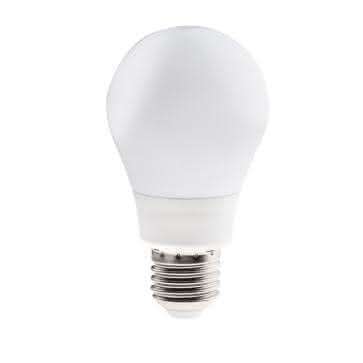
E27, or “thick thread,” is the most common socket in Polish homes—the same one used since the days of the classic Edison light bulb. You'll find it in pendant lights, floor lamps, wall sconces, and garden lights. Its strength lies in the unlimited variety of light sources available: from milk-white globes to large decorative filament bulbs in amber glass, in every color and dimmability class. If the lamp has an E27 base, you have complete freedom.
E14, or “thin thread” (14 mm), is its slimmer counterpart for smaller fixtures: chandeliers with arms, wall sconces, and bedside lamps. The candle shape (C35) and the small ball (G45) are the most popular here. Practical note: In a multi-arm chandelier, all E14 bulbs should be from the same batch—differences in color and shape between manufacturers are visible to the naked eye when the bulbs are exposed.
Two shopping tips for both socket types:
- Maximum wattage of the fixture (e.g. “max 40 W”) should be treated as a heat limit—an 8 W LED bulb can easily replace a 60 W incandescent bulb and will stay well within the limit.
- The bulb’s diameter is often more important than the base: you can screw any E27 bulb into an E27 socket, but a large decorative bulb may not fit inside the lampshade. Check the diameter and length, especially for ceiling lights.
GU10 and GU5.3 – spotlights
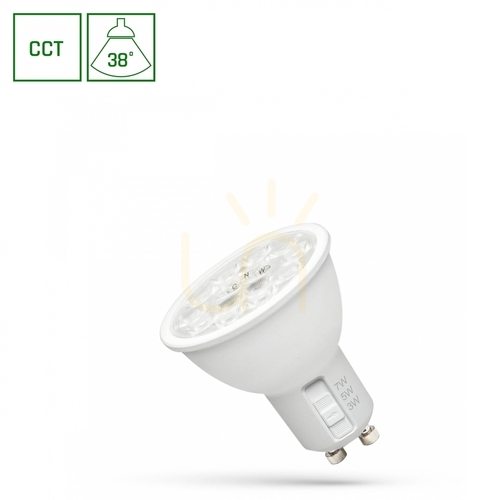
GU10 is the standard for ceiling sockets, spotlights, and 230 V track systems: two thick pins—you insert them, turn them a quarter turn, and you’re done. GU10 bulbs are shaped like spotlights (PAR16) and emit a focused beam—when purchasing, in addition to wattage and color temperature, you choose the beam angle: 36° is the universal standard, 15–24° creates accent lighting, and 60°+ provides flood lighting. Dimmable and CCT (color temperature control) versions are widely available.
The GU5.3 (MR16) looks similar but has thin pins and a 12 V power supply—it requires a transformer. This is standard for older halogen and low-voltage lighting systems (e.g. garden). When upgrading to LED, the old electronic transformer can sometimes be a source of problems—more on that below.
How can you tell them apart in practice? GU10: thick pins with “feet”, GU5.3: thin, sharp pins. Physically, they don’t fit together, but in a store it’s easy to confuse the shape of the MR16 (spotlight) with the base—always check the base, not just the appearance of the bulb.
G9 and G4 – the little specialists
G9 is a miniature plug with two flattened loops, powered directly from 230 V. Designers love it for its size—it fits into slender wall sconces, ceiling lights, and decorative lamps where no “normal” light bulb would fit. Thumb-sized G9 LEDs now produce 250–500 lumens, when replacing them, pay attention to the dimensions (some LEDs are longer than halogen bulbs and stick out of the socket) and to dimmability, which isn’t a given in this category.
G4 is an even smaller pin-type connector, powered by 12 V —the world of furniture lights, range hoods, and boat and RV lighting fixtures. Here, too, LEDs have replaced halogen bulbs, but the transformer must be compatible (see the section on pitfalls).
Less common bases: GX53, G13, R7s, E40
- GX53 – a flat “disc” mounted by rotation, found in furniture fixtures and low ceiling lights. Replacement is a breeze: just snap it in and twist.
- G13 – the base of classic T8 linear fluorescent tubes (two pins at the ends of the tube). LED "tubes" replace fluorescent bulbs, but the wiring method depends on the ballast—be sure to read the replacement instructions.
- R7s – a double-ended base for short halogen "bulbs" used in spotlights and uplighter floor lamps. There are LED replacements available, but they can be thicker—check the space in the fixture.
- E40 – industrial “large Edison” (40 mm) for streetlights and industrial halls. You’re not likely to find it at home, unless it’s in a repurposed, vintage-style factory lamp.
Cheat sheet: table of handles
| Shaft | Mounting | Voltage | Typical application |
|---|---|---|---|
| E27 | 27 mm thread | 230 V | pendant lamps, floor lamps, garden lamps |
| E14 | 14 mm thread | 230 V | chandeliers, wall sconces, bedside lamps |
| GU10 | pins, quarter-turn | 230 V | spotlights, track lighting |
| GU5.3 (MR16) | thin pins | 12 V | older halogen spotlights, 12 V installations |
| G9 | push-in loops | 230 V | small decorative fixtures |
| G4 | pins | 12 V | furniture, range hoods, RVs |
| GX53 | turntable | 230 V | furniture fixtures, flat ceiling lights |
| R7s | double-sided | 230 V | spotlights, uplighters |
Tip: Remove the old bulb and take a photo of it next to a ruler —in a store (including ours), identifying the base from such a photo takes just a few seconds.
Replacing halogen bulbs with LEDs – pitfalls
A “one-to-one” replacement usually works, but four pitfalls can ruin the result:
- 12 V transformer: old electronic transformers have a minimum load (e.g. 20–60 W). The 4-watt LED set can sometimes be "invisible"—the light flickers or doesn't turn on at all. Solution: a 12 V constant-voltage LED power supply or converting the fixture to a 230 V GU10 socket.
- Dimmer: The bulb must be labeled as dimmable, and the dimmer itself must be compatible with LEDs (for loads starting at a few watts). Old halogen dimmer + LED = flickering.
- Color temperature: the halogen was always ~2700–3000 K. If you buy LEDs on a whim, you might easily end up with 6500 K lighting in your bedroom. Check the Kelvin rating on the packaging—we’ve written a separate guide on this topic.
- Dimensions and cooling: LED replacements can be longer (G9, R7s) or have a heat sink (GU10)—in tight fixtures, check that the bulb doesn’t stick out and that it has room to breathe, An LED enclosed in a sealed, hot shade has a shorter lifespan.
Not just the base: bulb size and shape
On the packaging, next to the base, you’ll find a second code—the bulb shape: A60 (classic pear, 60 mm), G45 (small globe), C35 (candle), G95/G125 (large decorative spheres), ST64 (vintage “Edison”), PAR16 (GU10 spotlight), R50/R63 (mushroom-shaped bulbs for older spotlights). The letter indicates the shape, the number indicates the diameter in millimeters. This code determines whether the bulb will fit in the shade and how it will look in an open fixture: choose G45 or ST64 for a string light, C35 for a nightlight, and for a large pendant light over the table—a decorative G125 filament bulb.


Frequently Asked Questions (R7s, T8, enclosed fixtures)
A few questions that most often make shoppers hesitate at the checkout:
- R7s – what length? The base is the same, but the “bulbs” come in different lengths: most commonly 78 mm (small spotlights) and 118 mm (floor lamps, outdoor halogen lamps), less commonly 189 mm. Measure your old light bulb—the length must match to the millimeter.
- T8 (G13) fluorescent bulbs to LED. LED “tubes” replace linear fluorescent lamps, but the connection method depends on the ballast: with an electronic ballast, you often need to bypass it and replace the starter with an LED jumper, and the tube may be powered from one end or both ends. Always read the instructions for the specific replacement.
- GX53 vs G53, MR16 vs GU5.3 – it’s easy to confuse them in a search engine. GX53 is a flat disc for furniture fixtures, MR16 describes the shape of the reflector, and GU5.3 refers to its base (12 V) – when shopping online, filter by base type, not by bulb shape.
- Enclosed fixtures. For sealed, airtight ceiling fixtures and garden lights, you need bulbs labeled “enclosed fixture rated” – a standard LED enclosed in a hot, non-ventilated housing will overheat and have a shorter lifespan.
- Socket adapters (e.g. E14→E27). They operate mechanically and can be convenient, but they change the dimensions and push the bulb away—make sure the larger bulb fits inside the shade and doesn’t touch it, and don’t exceed the fixture’s rated wattage.
Summary
The letter indicates how the bulb attaches to the fixture (E – screw, G – pins), the number specifies the diameter in millimeters (of the screw socket or pin spacing), and the voltage divides the world into hassle-free 230 V (E27, E14, GU10, G9) and 12 V (requiring a transformer) (GU5.3, G4). Add the right bulb shape, color temperature, and dimmability—and no light will ever catch you off guard again. You can find all the blanks and shapes in the category Light Sources, and frames for DIY projects at Electricccessories.
Victoria


Maybe you will be interested in products from these categories?
Light Bulbs, Electricccessories
Tags & Blog Categories