
Outdoor LED Floodlights and Spotlights – Power, IP and Beam Angle
The LED floodlight is the most pragmatic lamp around the house: its job is to light the driveway, the gate, the yard or the façade – brightly, cheaply and reliably, for years and in any weather. The trouble is that you buy one about once a decade, while manufacturers speak the language of watts, lumens, beam angles and IP codes. This guide translates it all, step by step: how a floodlight differs from a spotlight and the old “halogen”, how much power a driveway needs versus the pitch behind the barn, how a motion sensor works and where not to point it, which colour temperature keeps the yard from looking like a supermarket car park – and how many floodlights a typical plot really needs.

Table of contents
- Floodlight, spotlight, “halogen” – which is which
- Power and lumens: how much light for which area
- Beam angle and mounting height
- An LED floodlight with a motion sensor
- Light colour outdoors
- IP, mounting and wiring
- How many floodlights per plot?
- Summary
Floodlight, spotlight, “halogen” – which is which
Three names circulate in shops and conversations, so let’s sort them out at the start:
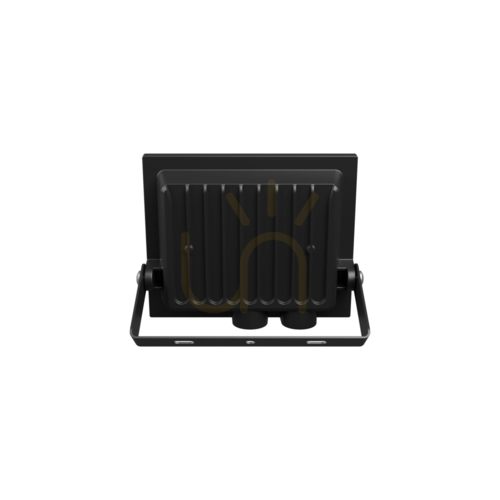
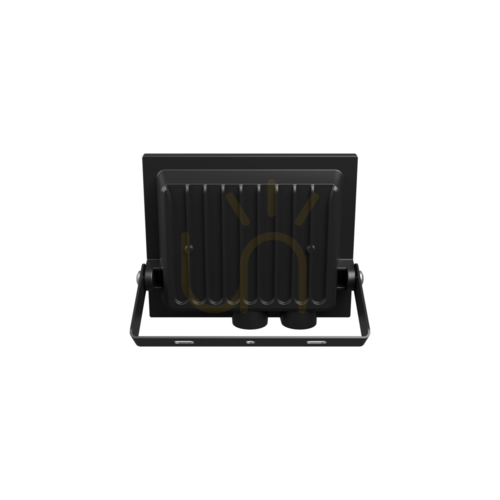
- An LED floodlight – a flat, rectangular fitting with a wide beam (usually 100–120°), designed to flood a larger surface with light: a driveway, a yard, a façade. It mounts on a wall, post or mast, on an adjustable bracket.
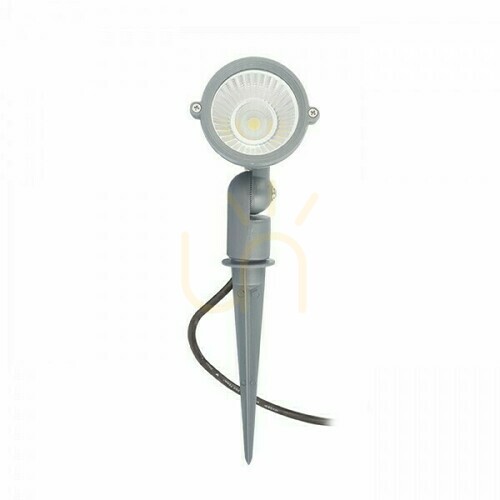
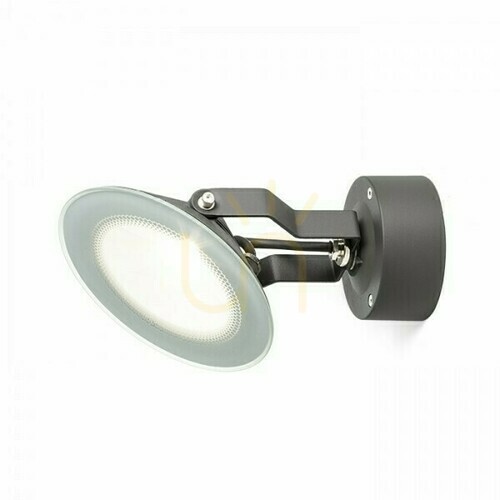
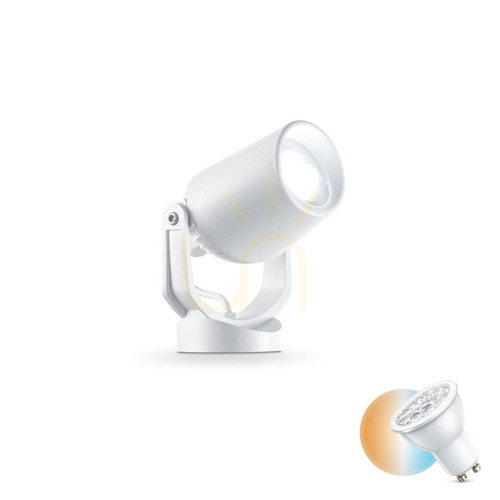
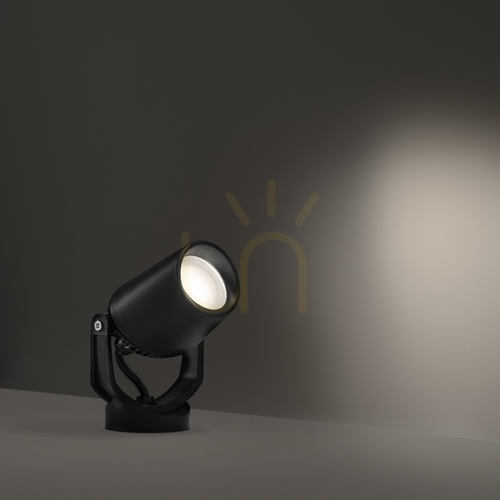
- An outdoor LED spotlight – a directional fitting with a narrower beam (from a dozen or so up to ~60°) that “picks out” a specific target from the dark: a tree, a sculpture, a section of façade, a gate. Garden versions often come with a spike to push into the lawn.
- A “halogen” – the colloquial name inherited from the filament halogen floodlights of the pre-LED era. Today’s LED floodlight delivers the same light at ~80–90% lower power draw and runs far cooler than a halogen (though the housing of a working fitting can still get hot) – if a real 300 or 500 W halogen still hangs on a wall somewhere, replacing it pays for itself remarkably fast with regular use.
The line between a floodlight and a spotlight can blur – the key is the beam angle, coming up in a moment.
Power and lumens: how much light for which area
The first shopping rule: compare lumens, not watts. Watts say how much power the fitting draws; lumens – how much light it gives. Modern LED floodlights typically achieve 90–120 lm per watt, so as a rough ladder:
- 10 W (approx. 1000 lm) – a gate, an entrance, a utility door; point tasks over 10–20 m²,
- 20 W (approx. 2000 lm) – a single-car driveway, a patio, the bin store and bike shelter,
- 30 W (approx. 3000 lm) – a wider driveway, a smaller yard, a house façade,
- 50 W (approx. 5000 lm) – a working yard, a manoeuvring area, the back garden,
- 100 W (approx. 10 000 lm) – a large manoeuvring area or car park.
How does that translate into area? For circulation and orientation (the path to the gate, the driveway) an average of 20–30 lx suffices; for outdoor work (a workshop under a shelter, chopping wood) aim at 50–100 lx. A simplified formula that accounts for scatter and reflection losses: lumens needed ≈ area × required lux ÷ 0.5. Example: a 50 m² driveway × 30 lx = 1500 lm on the surface, i.e. a fitting of 2500–3000 lm – a 20–30 W floodlight. Dark paving and façades absorb more – take the upper end then.
Two practical notes: two smaller floodlights beat one big one – light from two directions shortens shadows and glares less; and a small flux reserve is useful, but don’t oversize the fitting by several classes – it costs energy, your neighbours’ goodwill, and turns the garden into a stadium.





Beam angle and mounting height
The beam angle decides whether a fitting “floods” or “aims”:
- 100–120° (floodlight) – a wide carpet of light; the pool on the ground has a diameter of roughly two to three times the mounting height, with a marked fall-off in brightness at the edges. The higher you hang the fitting, the larger the area it covers – and the fewer lux land on each metre.
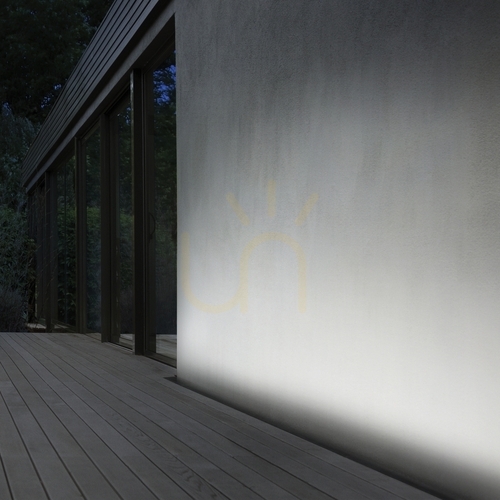
- 25–60° (spotlight) – a focused beam for accent tasks: uplighting a tree, drawing out the texture of a façade, lighting a gate from a distance. An outdoor LED spotlight on a ground spike can move around with the garden – the most flexible accent light there is.
- Mounting height: 2.2–2.8 m for entrances, gates and sensor-equipped fittings, 3–4 m for the driveway and yard, 5–6 m on a mast over a larger area – though there you need more power or several fittings.
- Rule of thumb: mount wide beams high and aim them steeply down; narrow beams – low, so the beam ends its journey on the target (a wall, a tree crown) rather than in windows or over the fence. The opposite combinations generate glare and light spilling into the sky.





An LED floodlight with a motion sensor
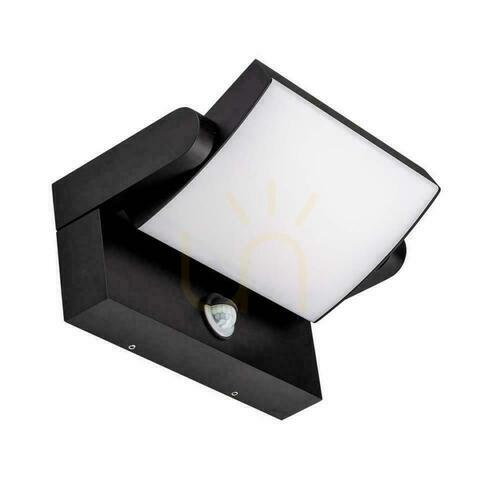
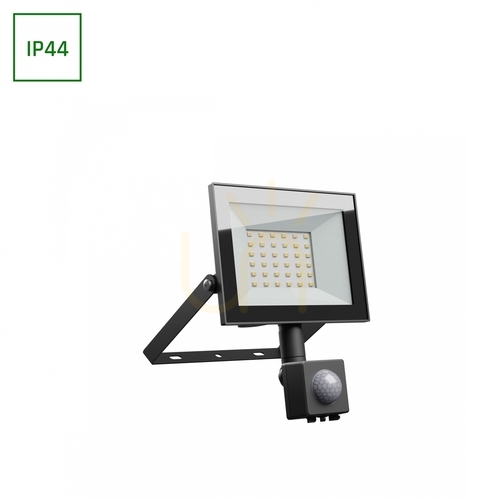
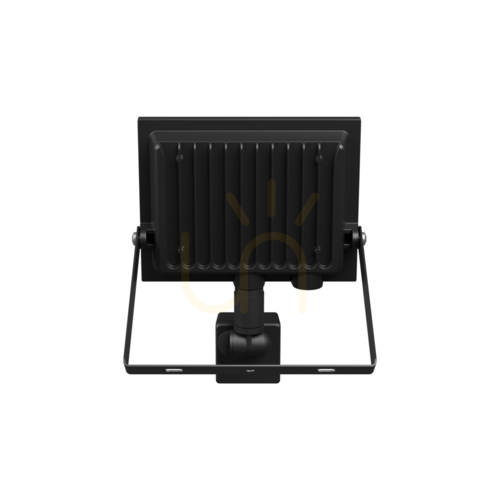
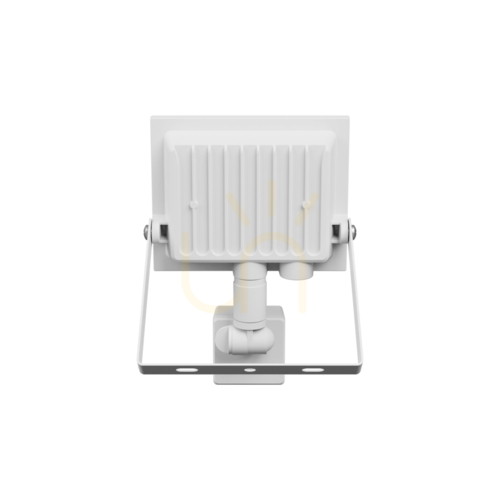
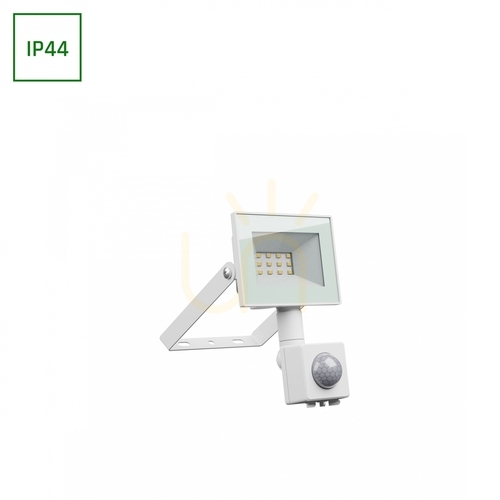
An LED floodlight with a motion sensor is the most sensible version wherever the light works on demand: by the gate, the door, the bin store, the passage behind the house. A PIR sensor reacts to a moving heat source typically within 8–12 m and an angle of 120–180°, and the three dials you’ll find on the underside of the housing set everything that matters:
- LUX – the dusk threshold: set it so the fitting doesn’t fire in daylight,
- TIME – how long the light stays on after detecting motion (usually from a few seconds to several minutes) – 1–3 minutes covers a walk to the door,
- SENS – sensitivity: turn it down if cats and hedgehogs keep waking the lamp.
The most common mounting mistakes that make a sensor “go mad”: pointing the detection field at the street or pavement (every passer-by and car switches the light on), at shrubs and branches (sun-warmed leaves moving in the wind can impersonate an intruder), and at heat sources – a heat pump outlet, a chimney, a ventilation grille. The sensor sees best across the expected direction of movement, not “head-on” at whoever approaches – that’s when detection is most reliable.
Two scenarios where you’re better off without a sensor: a showpiece façade (the light should play there all evening – a dusk sensor or timer serves better) and places where you actually sit – nobody enjoys waving an arm every two minutes.






Light colour outdoors
Floodlights come in three colours and each has its place:
- 3000 K (warm white) – the zones you look at from the house and relax beside: the patio, the garden, the façade, the path to the door. Warm light doesn’t turn greenery into a hospital corridor and treats the night landscape more gently.
- 4000 K (neutral white) – the universal working choice: driveway, yard, shelter, bin store. Good visibility and natural colours without a “frosty” tone.
- 6500 K (cold white) – strictly technical tasks: a building site, a loading ramp, a workshop. By a house it looks harsh and glares the most after dark.
Whatever the colour, for the house and garden choose fittings with CRI ≥ 80 – below that, greenery and the façade lose their colours.
And remember the good-neighbour side of the subject: a floodlight aimed too flat shines into windows – yours and other people’s – and lighting up the sky is a waste of energy and light. Aim the beam downwards, at your own plot, and match the power to the task, not “just in case”. Less sky glow also means more visible stars – a bonus you won’t find in the product card.
IP, mounting and wiring
- Sealing: the standard for fittings under the open sky is IP65 – dust-tight and resistant to water jets, meaning rain from any direction and a rinse with a hose (but not a pressure washer). IP44 versions suffice under a roof sheltered from driving rain. Ground-spike spotlights, working closest to water and mud, often carry IP66 – and where occasional flooding is possible, look for IP67.
- Mechanical resistance: near the ground and in “busy” spots (garage, gate) check the IK index – in exposed places you want to see IK08–IK10.
- Bracket and aiming: the adjustable yoke is half the battle – after dark you’ll correct the angle so the light lands on the target, not above it. Tighten the joint only after an evening trial.
- Leave the wiring to an electrician: outdoor circuits require a 30 mA residual current device, junction boxes and glands with an adequate IP rating, and cables running across the plot – a buried-grade type laid in the ground. Class I fittings must have the earth wire connected, route the cable with a drip loop before it enters the fitting, and tighten the cable gland onto the wire – it’s what keeps the whole thing sealed.
- Mast and post: bolt mast-mounted fittings to the brackets the manufacturer intended and check them after the first gale – vibration can loosen screws.
How many floodlights per plot?
The question of how many floodlights a plot needs has the same answer as most lighting questions: less power, more points. A typical detached-house property needs three to four fittings, each with its own job:
- gate and entrance – 10 W with a motion sensor; greets the household and guests, discourages the uninvited,
- driveway/gate – 20–30 W, with a sensor or on a dusk switch, mounted on the wall or the gate post,
- working yard / back of the house – 30–50 W with a motion sensor where you walk with your hands full of shopping or firewood,
- accent (optional) – a 10 W spotlight on a spike under a tree or by the façade, on a dusk sensor, for beauty rather than function.
On a large property (1500 m²+), an extra 50 W floodlight on a mast or the barn wall will light one specific zone – the area behind the house or the utility yard – and when a yard is meant for working after dark, plan two fittings from two directions rather than one strong one: deep shadows disappear and glare halves.
You’ll find the full offer in two categories: wide beams in LED Floodlights, and directional accent and garden fittings in Outdoor floodlights.
Summary
A good LED floodlight is chosen in five steps: lumens matched to the task (roughly area × lux ÷ 0.5, with 20–30 lx for circulation and more for work), beam angle (wide floods, narrow aims), a motion sensor where the light works on demand, colour (3000 K by the relaxation zones, 4000 K for tasks), and IP65 plus sensible mounting – beam aimed down, wiring done by an electrician. A typical plot is served by three or four well-thought-out points instead of one “stadium floodlight”. Start browsing in the LED Floodlights category, and you’ll find the accent spotlights for the garden in the Outdoor floodlights section.
Przemysław Doliński


Maybe you will be interested in products from these categories?
LED Floodlights, Outdoor Spot Lights
Tags & Blog Categories