
Patio and Balcony Lighting in Summer – Cosy Evenings After Dark
A summer evening has one flaw: it ends. When dusk falls after nine, the patio turns into a dark stage with no actors, and the balcony into a concrete niche nobody steps out onto any more. Yet it is precisely after dark, when the heat lets go, that sitting outside is at its loveliest. The difference between a terrace you flee back indoors from and one where conversations run past midnight usually comes down to two or three points of warm light. In this post we show how to build patio and balcony lighting out of ready-made blocks – string lights, rechargeable lamps, glowing spheres and solar lanterns – with no renovation or chiselling, and quite often without a socket.

Table of contents
- The patio as an extra room: three layers of light
- String lights: a ceiling of little lamps over the table
- Rechargeable lamps: light you carry in one hand
- Glowing garden spheres: moons on the terrace
- Wall lights, floodlights and solar lanterns
- Balcony lighting in an apartment block: small space, big mood
- Three ready-made evening scenarios
- The practical part: IP, light colour and insects
- Summary
The patio as an extra room: three layers of light
The best designers’ trick goes: treat the patio like a room that just happens to have no ceiling. In the living room nobody lights the evening with a single strong lamp under the ceiling – and exactly the same principle applies outdoors:
- the ambient layer – soft light that lets you see the table, the faces and the steps: a string of lights stretched over the patio, a wall light on the house wall,
- the task layer – focused light where something is being done: a lamp on the table at dinner, a sensor floodlight by the door and the steps,
- the mood layer – accents that take the lead after dark: glowing spheres among the planters, solar lanterns along the railing, candles on the table.
Rule number one: warm colour (2200–3000 K) and modest power. Outdoors the eye isn’t competing with a bright interior, so an atmospheric evening needs just a few hundred lumens – roughly 50–150 lm per mood point and 100–300 lm at the table. Strong, cold light turns a patio into a car park and kills the mood faster than a mosquito by your ear.
String lights: a ceiling of little lamps over the table
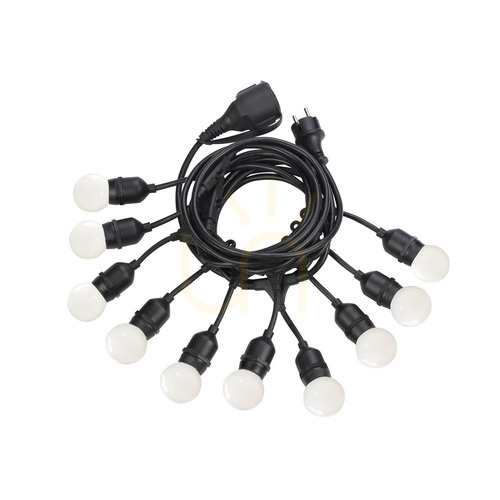
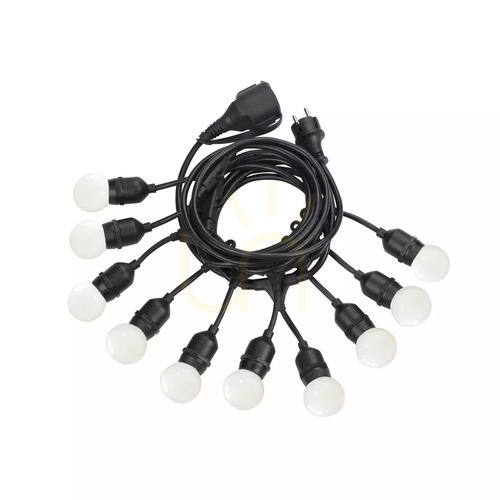
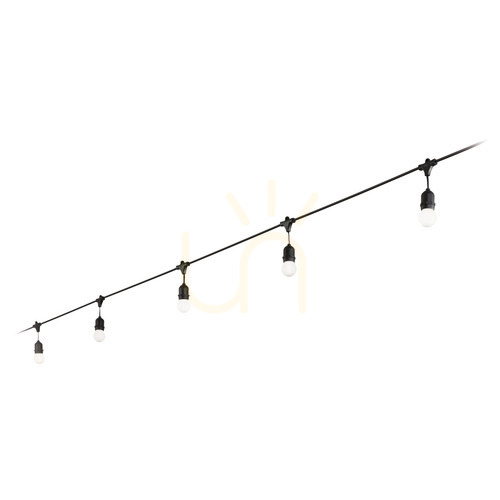
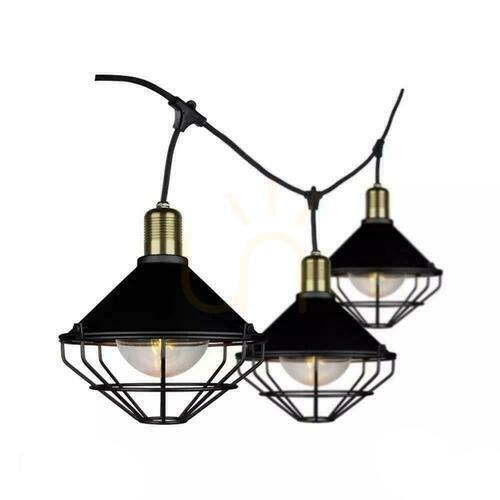
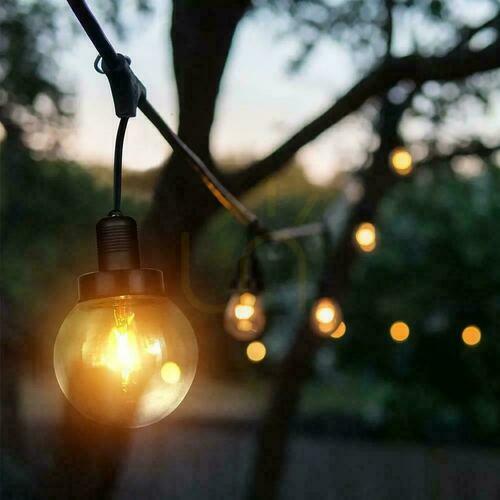
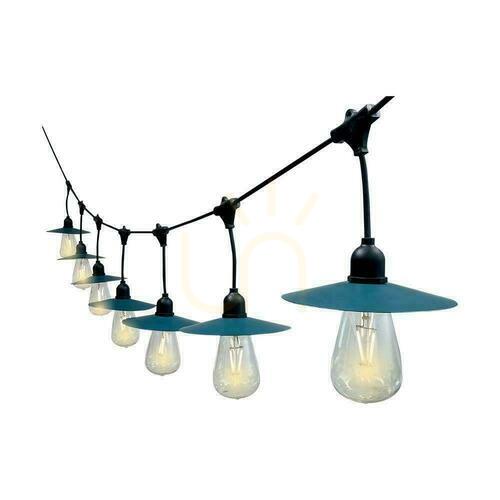
A string of lights is the fastest way to give the patio a “ceiling” – a chain of warm points overhead marks out the zone and delivers exactly that southern-European holiday mood we pine for after every trip. Stretched over the table it replaces a pendant lamp; run along a pergola or railing, it draws the patio’s borders in light. On a balcony, 3–5 metres are plenty: balcony string lights look their best hung in one or two relaxed arcs above the railing or along the wall, not pulled taut like a wire.
When choosing, mind three things: sealing of at least IP44 (for a permanent spot under the open sky, better IP54/IP65), E27 sockets if easy bulb replacement matters to you (filament LEDs at 2200–2700 K make the best mood), and the power source – solar versions free you from the socket, mains-powered ones shine reliably every evening. A detailed guide to choosing the length, mounting and bulbs for string lights is a separate post on this blog; the full collection lives in the Outdoor String Lights category.







Rechargeable lamps: light you carry in one hand
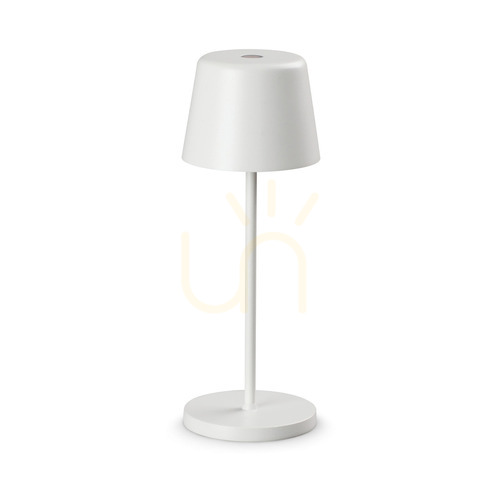
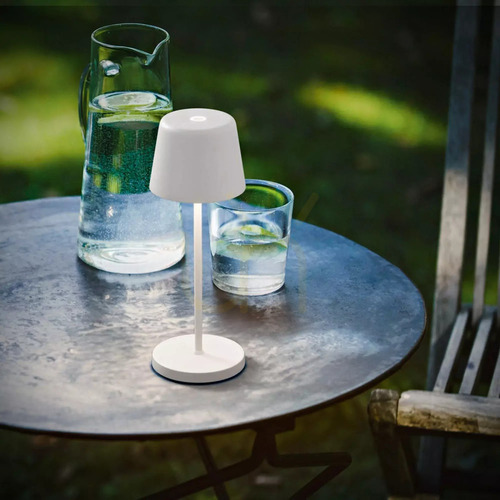
The biggest revolution of recent seasons in patio lighting is rechargeable lamps – small, cordless table lamps charged over USB that you place, each evening, exactly where life is happening. Dinner on the patio? The lamp stands on the table. Moving to the sun lounger? It comes along. Rain? It goes back inside and works on the chest of drawers. If you have ever typed “modern patio lights” into a search bar – this is precisely what it means today.
What else makes them easy to love:
- zero installation – no cables or sockets within reach of the table, no electrician; the lamp simply stands where it is needed,
- IP44–IP65 sealing – outdoor versions shrug off both the evening dew and a sudden summer shower,
- dimming and long battery life – most models run for many hours on the lowest setting, and a table needs only a few dozen lumens,
- a double life – in winter the same lamps work indoors as mood lighting on a windowsill.


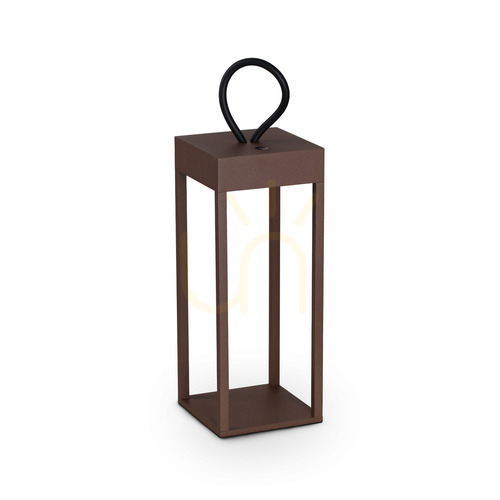
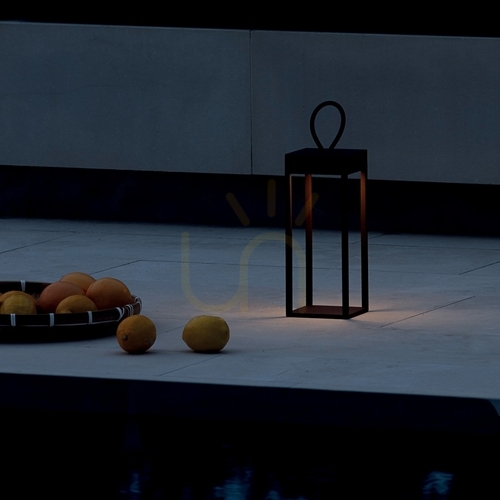
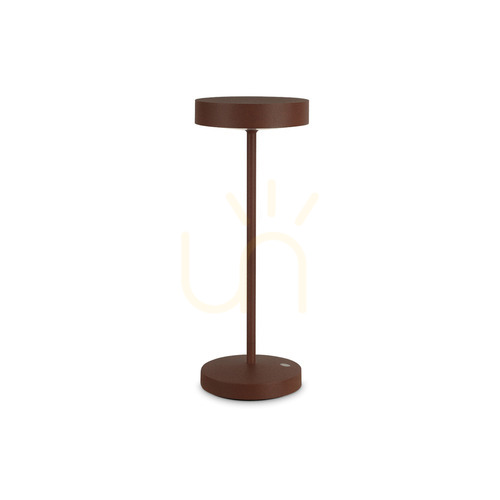


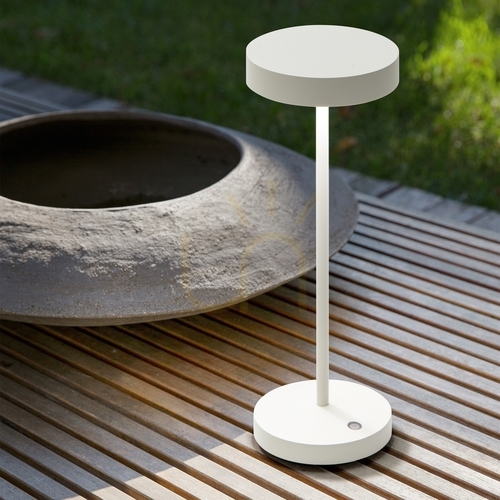


The whole growing collection of cord-free lamps is waiting in the Rechargeable Lamps category.
Glowing garden spheres: moons on the terrace
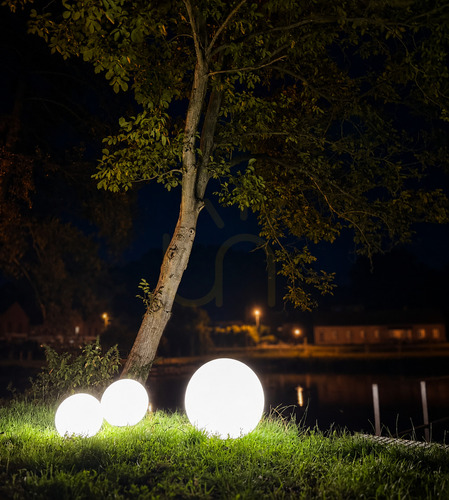
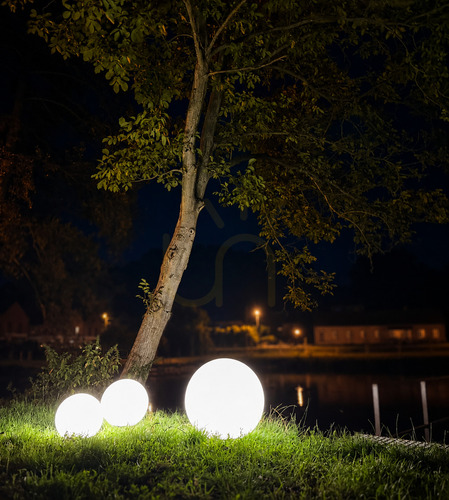
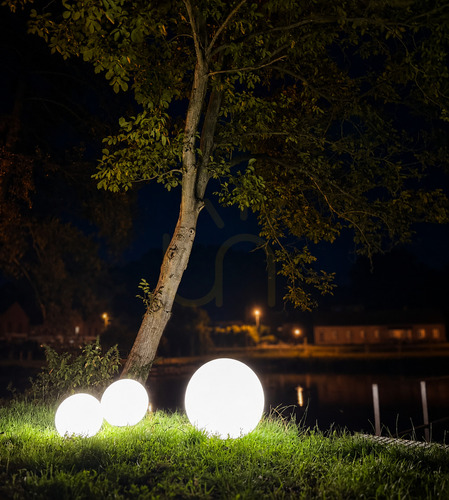
If one thing is to turn an ordinary patio into a stage set, let it be glowing garden spheres – at our store that means the LUNA BALL family, spheres designed and sold under Lunares’ own brand. Opal orbs placed among the planters look like moons fallen into the greenery – by day they are a minimalist sculpture, after dark they give soft, diffused light that blinds nothing and warms everything.
A few proven ways to arrange them:
- a group of three spheres of different sizes (say 30/40/50 cm) in a corner of the patio – a classic that orders the composition like good ikebana,
- a single sphere among the plants – light filtering through the leaves draws theatrical shadows on the walls,
- a rhythm of smaller spheres (20–25 cm) along steps or a path – functional wayfinding that looks like decoration,
- on a balcony – one 20–25 cm sphere in a planter creates more atmosphere than three gadgets at once.
Inside works an ordinary E27 bulb – pick a warm, low-power LED and the sphere will glow for pennies all season. The UV-resistant material doesn’t yellow in the sun, so the spheres stay outside from spring to autumn.





Wall lights, floodlights and solar lanterns
The third layer is permanently mounted light – plus the solar helpers:
- A wall light by the patio door gives base light for the entrance and the table; choose fittings that direct the beam downwards, sealed to at least IP44.
- A floodlight with a motion sensor watches over the steps and the gate: it comes on only when needed, so it doesn’t spoil the mood but does improve safety.
- Solar lanterns and lamps charge during the day and form a luminous guard of honour along the railing or flower bed by themselves in the evening. Their light tends to be delicate, and after a cloudy day they shine for less time – treat them as an accent, not working light, and give them a spot where the sun genuinely reaches for a few hours a day.
The full overview of outdoor fittings – from wall lights to floodlights – is in the Garden lamps and garden lighting category.
Balcony lighting in an apartment block: small space, big mood
Balcony lighting plays by its own rules: the space is small, there is often no socket, and drilling into the façade may be forbidden. The good news – on three square metres two points of light are enough, and every one of them can be done without a drill:
- a string of lights on the railing or wall – fixed with cable ties or self-adhesive hooks; a solar or battery version solves the power problem,
- a rechargeable lamp on the side table – one point of warm light beside two chairs turns the balcony into a café table in the open air,
- a 20–25 cm sphere in a planter among the plants – a mood accent that takes up exactly zero extra space,
- solar lanterns hung on the railing – a glowing rhythm that switches itself on.
Two rules of good neighbourliness: direct the light into the balcony, not at the neighbours’ windows or the street, and choose modest power – a balcony is a small room and needs less light than intuition suggests. After ten at night, a dimmed rechargeable lamp gives exactly as much glow as a conversation needs and not a lumen more.
Three ready-made evening scenarios
How do the blocks fit together? Three recipes to copy:
- Dinner for two on the balcony: a rechargeable lamp on the table (lowest setting), a string of lights in an arc above the railing, a candle in a lantern. Under 200 lumens altogether – and exactly the mood of your favourite trattoria.
- A summer party on the patio: a string of lights over the whole table zone, three spheres of 30/40/50 cm in the corner, a wall light by the door for the latecomers and a sensor floodlight on the steps. The light is everywhere the guests are – and glares nowhere.
- A quiet evening with a book: one rechargeable lamp by the lounger, a glowing sphere among the planters, the rest of the patio sunk in half-darkness. The less light, the more stars overhead.
The practical part: IP, light colour and insects
To finish, three things worth knowing before anything gets hung outside:
- Sealing: everything that stays outdoors permanently should carry at least IP44; fittings under the open sky, with no roof – better IP54/IP65. Rechargeable lamps brought in for the night can get by with less, but versions with an IP rating sleep soundly even when forgotten on the table.
- Colour: for the patio and balcony choose warm white, 2200–3000 K. It looks best against the night sky and doesn’t disturb the household’s evening rhythm – and there’s a surprisingly practical bonus: warm LED light usually attracts fewer insects than cold light rich in blue tones (though mosquitoes are more interested in us than in the lamp anyway).
- Power: plug mains string lights into outdoor sockets with a flap cover and an adequate IP rating, on a circuit with a residual current device; choose garden-grade extension leads and don’t treat them as a permanent installation. Leave the mounting of wall lights and other 230 V outdoor fittings to an electrician, and where there are no cables – let batteries and the sun do the work. A timer or dusk switch will have the patio greeting you with light before you even step outside.
Summary
Patio and balcony lighting is not an electrical project but a composition of ready-made elements: a string of lights as the luminous ceiling, a rechargeable lamp wherever the evening is happening, glowing spheres playing the moons among the plants, and solar helpers along the railings. All of it in a warm 2200–3000 K, sensibly sealed and at less power than intuition suggests – after dark, less means cosier. Start with the Outdoor String Lights and Rechargeable Lamps categories, and you will find the spheres, wall lights and the rest of the outdoor collection in the Garden lamps and garden lighting section.
Michał Smykowski


Maybe you will be interested in products from these categories?
Outdoor Lights, Outdoor String Lights, Rechargeable Lamps
Tags & Blog Categories