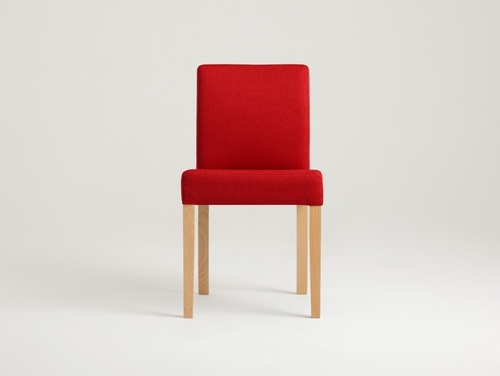
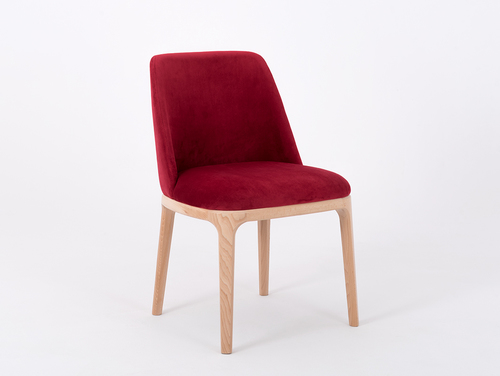
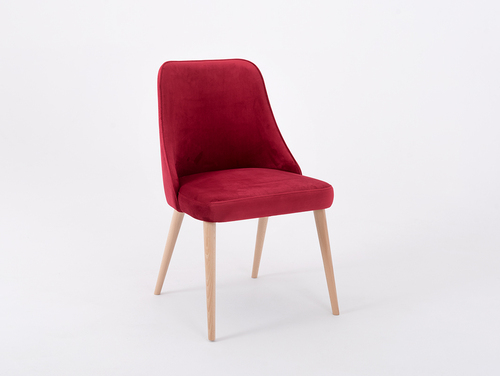
Red chairs are the piece people buy when the table, the floor and the walls are already decided and the room still reads as unfinished. Most of what carries this colour is a dining chair — a beech frame with an upholstered seat in cranberry or a deeper wine shade — with the occasional lacquered shell or bucket-style accent chair alongside. Because a chair is bought in multiples, the practical questions matter more here than they do for a single object.
Seat height against table height
This is the measurement that decides whether anyone stays at the table. European dining tables sit at 73 to 76 cm, and the seat height that works under them is 45 to 47 cm. What you are really aiming for is 27 to 30 cm of clear space between the seat and the underside of the top — less and thighs press up against the table, more and everyone eats with raised shoulders.
Check for an apron or a frame rail under the tabletop before you order, because it eats into that gap. If the chair has arms, measure to the top of the armrest as well: arms that will not slide under the table turn six chairs into six obstacles.
Counter and bar heights follow the same logic. A 90 cm counter wants a seat around 60 to 65 cm; a 105 to 110 cm bar wants 75 to 80 cm.
How much red a table can carry
Four matching red chairs make the colour the subject of the room. Two red and four neutral make it a detail, and the two usually go at the ends where they read as deliberate. Mixing works when the frames match and only the seats differ — same silhouette, different colour. It stops working when both the shape and the colour vary, at which point the set looks assembled rather than chosen.
On upholstery, red is one of the shades where you should look at the fabric class as well as the colour: a dining seat meets more spills than any other surface in the house. A removable seat pad, or a cover with a stain-resistant finish, is worth more at a dining table than a marginally better weave.
Frames, seats and what they are rated for
-
Beech is the standard European dining-chair timber. It is hard, tight-grained, holds a screwed joint and takes colour evenly. It also moves with humidity, so a chair that lives next to a radiator will loosen sooner.
-
Steel and aluminium frames go thinner for the same strength and stack better, at the cost of a colder feel and more noise on a hard floor.
-
Moulded shells in plastic or plywood carry a lacquered red well and wipe clean, but a shell with no upholstery is a thirty-minute chair rather than a three-hour one.
Where a manufacturer quotes a standard, EN 12520 covers domestic seating and EN 16139 covers contract use — the second is tested harder, which is a reasonable thing to look for if the chairs will take daily family duty. A stated maximum user weight, usually somewhere between 110 and 120 kg for domestic models, is the other number worth reading rather than assuming.
Stacking and floors
If the chairs get put away between uses, check the stated stack height rather than assuming they nest; many "stackable" chairs manage four, not eight. Chairs that stack also need a felt or plastic buffer between them, or the topmost one marks the seat below it.
Underneath, felt glides for timber and laminate, harder plastic for tile and stone. Replace them once a year on chairs that get dragged rather than lifted — a worn glide is what actually scores a wooden floor, not the chair.
Questions
Do red chairs work with a wooden table?
Very well with warm oak, beech and walnut, less well with cool grey-stained timber, which drains the red rather than answering it.
Should all the chairs match?
They should share a seat height and roughly a silhouette. Beyond that, a mixed set of two colours is a well-established look; three or more starts to need a reason.
Are upholstered red seats hard to keep clean?
No harder than any mid-tone, and easier than pale ones. Ask instead whether the seat pad lifts out — that is what makes a spill a five-minute problem instead of a permanent one.
Other colours and shapes are listed under chairs.