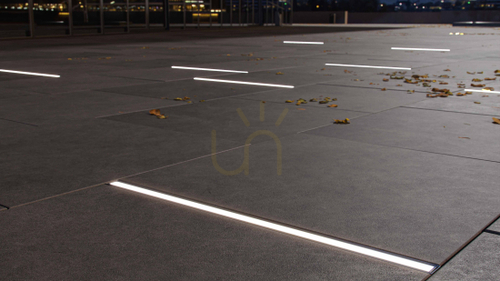
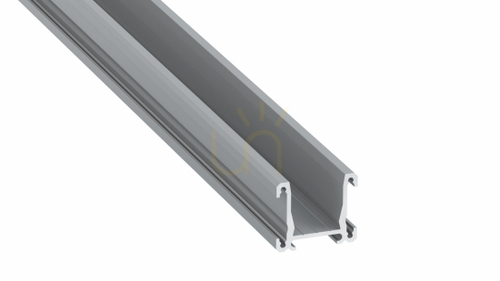
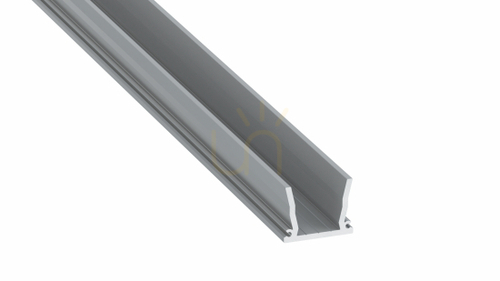
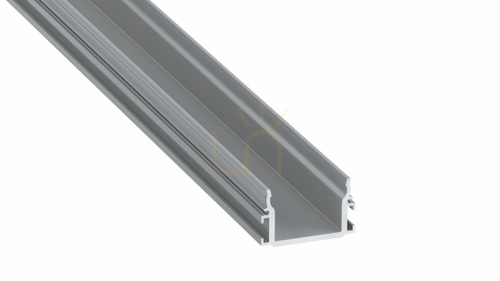
An outdoor LED profile is the aluminium channel that carries a strip through weather it was never designed to survive on its own. Indoors a profile is mostly about looks and heat. Outdoors it also faces rain, UV, frost and the daily expansion of a metal bar bolted to a wall — so the extrusion, the diffuser and the end caps matter more here than in any indoor run.
What the channel is actually doing
Three jobs, in order of how often they get overlooked. It pulls heat out of the tape, the biggest factor in how long the LEDs keep their brightness. It gives the strip a straight, rigid line, so the run does not sag along a fascia board. And it holds a diffuser that turns a row of diodes into a continuous line. Outdoors a fourth job appears: keeping water away from the electronics, or giving it somewhere to go.
IP rating is a property of the whole assembly
This is where most outdoor runs fail. An IP65 strip inside an open-ended channel is still exposed at the cut, at the solder joint and at the cable entry. The rating you end up with is the lowest rating in the chain — strip, channel, end caps, connectors, power supply. If the channel is open at the bottom and mounted vertically, water will find its way in and sit there. Sealed end caps with a gasket, a gland or grommet where the cable leaves, and a small drain path at the low point of a horizontal run all do more for longevity than moving up one IP class on the strip alone.
Aluminium, anodising and corrosion
Raw mill-finish aluminium is fine under cover and poor near the coast. Anodised surfaces hold up better because the oxide layer is part of the metal rather than a coating on top of it; powder coating looks neater and matches a facade, but a chip in it becomes a corrosion site. Check the fixings too: a stainless screw through an aluminium profile is standard, a plain steel one will stain the extrusion after a winter.
Diffusers outdoors
Diffuser choice is a trade between how much you hide the diodes and how much light you keep.
| Diffuser |
Light loss |
Outdoor behaviour |
| Clear |
lowest |
maximum output, individual diodes visible |
| Frosted / opal |
moderate |
the usual compromise; hides dots at short distance |
| Deep opal |
highest |
a genuinely continuous line, noticeably dimmer |
Material matters as much as opacity. Acrylic (PMMA) keeps its clarity in sunlight but is more brittle in frost; polycarbonate takes impact far better and can yellow over years of direct UV unless it is stabilised for outdoor use. If the run faces south and sits in full sun, ask about UV stabilisation before you buy on price.
Heat, expansion and how you fix it down
Aluminium moves. A long run fixed rigidly at both ends will bow in summer and pull on its screws in winter, so mounting clips that let the profile slide are better than continuous adhesive. Leave a small gap at joints. And keep the thermal path intact: the tape should sit flat on the base of the channel, not on trapped air or a second layer of foam tape, or the aluminium cannot do the job that keeps the strip alive.
Recessed or surface mounted
Surface profiles bolt to a soffit, fascia, wall or step riser and are the simplest to service. Recessed profiles are routed into decking, a step nosing or a plaster reveal and disappear completely, which looks better but makes water management your problem — a recess is also a gutter. Corner profiles at 45 degrees throw light down and outward from an eave or a step edge, and floor-rated versions with an impact rating exist for anything that will be walked on.
Common questions
Can I use an indoor profile outside if the strip is IP65?
You can, and it is a common shortcut, but you lose the sealing at the ends and the finish will suffer. If the location is exposed rather than merely outdoors-but-covered, a channel intended for the job is worth the difference.
Does the profile change how bright the light is?
Yes, through the diffuser. A deep opal cover can absorb a noticeable share of the output, so size the strip's lumens per metre with the diffuser in mind rather than choosing both independently.
Where should the power supply go?
Ideally indoors or inside a weatherproof enclosure, with only the low-voltage run going outside. A driver rated for damp locations still lasts longer somewhere dry.
Choose the channel and the tape together: the profile decides how long the strip lives and how the light finally looks. If you are still selecting the tape itself, start with the LED strips and profiles section and work back to the channel that fits it.