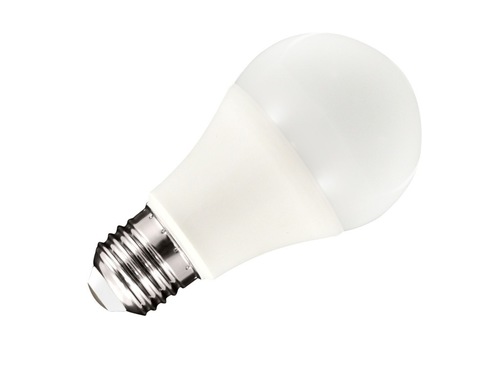
A light sensor bulb – usually sold as a dusk to dawn bulb – switches itself on as daylight fades and off again when morning comes. The sensor is built into the bulb, so you simply swap it for the one in your porch lantern or outside wall light and the fitting becomes automatic, with no photocell to wire in and no timer to set.
That convenience comes with one condition: the little sensor has to see daylight. Whether a dusk to dawn bulb works well depends far more on the fitting it goes into than on its wattage, so it pays to look at the lantern first and the bulb second.
How does a sensor light bulb work?
A photocell – a light-dependent resistor or photodiode – sits behind a small window, usually on the very top of the bulb or around the neck just above the cap. It keeps checking the ambient light level. When that drops below a set point, the driver switches the LEDs on; when it rises well above it the next morning, they go off.
Most bulbs switch on somewhere in the region of 10–20 lux and off at a noticeably higher level. That gap, plus a short delay, stops the light flickering every time a cloud passes or a car’s headlights sweep across the drive. Unlike a separate photocell switch, most bulbs have the threshold fixed at the factory, with no way to adjust it.
One thing to be clear about: a dusk to dawn bulb is not a motion sensor. It stays on all night. If you would rather the light only came on when someone walks up the path, you want a bulb that pairs a motion sensor with the daylight sensor.
Bayonet or screw, warm or cool: choosing the right bulb
In the UK the first question is the cap. Many porch and coach lights take a B22 bayonet, while newer and continental fittings use an E27 Edison screw; GU10 versions exist for spotlights and downlights, though they are less common.
| What to check |
Typical range |
What it means in practice |
| Cap |
B22 bayonet or E27 screw, occasionally GU10 or E14 |
check the lampholder before ordering |
| Brightness |
roughly 400–1100 lm |
400–600 lm for a front door, 800 lm or more for a driveway |
| Power |
usually 4–12 W |
replaces an old 40–100 W incandescent |
| Colour temperature |
2100–6500 K |
2700–3000 K looks welcoming and draws fewer insects |
| Switching level |
about 10–30 lux, usually fixed |
adjusted only by where the fitting is |
| Dimmable |
almost never |
do not use on a dimmer circuit |
| Rated life |
about 15,000–30,000 h |
several winters of all-night use |
For a single lantern by the front door, 5–7 W of warm white is plenty. A brighter, cooler bulb makes sense over a garage door or on a gatepost, where the light hangs higher and has more ground to cover.
Fittings that work – and the ones that don’t
Clear-glass lanterns, open-bottomed pendants on a porch and simple batten holders in a lean-to all suit a dusk to dawn bulb, especially if the glass sits slightly proud of the shade. Problems tend to come from a handful of situations:
-
Opal or heavily frosted enclosed globes let too little light through, so the bulb may think it is night all day.
-
A white wall, window or porch ceiling right next to the bulb bounces its own light back onto the sensor. It reads that as daylight, turns off, sees darkness and turns on again – the familiar on-off cycling.
-
A streetlight or a neighbour’s floodlight can keep the sensor from ever registering dusk.
-
Deep shade under a canopy makes the light come on early, sometimes on grey winter afternoons.
The bulb itself is not weatherproof – the fitting does that job. An outside wall light under the eaves should be at least IP44; anything fully exposed to rain needs a higher rating. Any new wiring on the 230 V circuit should be done by a qualified electrician to BS 7671.
Leave the switch on
The most common complaint is a bulb that never lights, and the usual reason is that the wall switch is off. The sensor needs a permanent supply, so the switch stays on and the bulb decides the rest. For the same reason it will not play nicely with dimmers, plug-in timers or smart switches that cut the power.
Running costs are modest. A 9 W bulb burning for 12 hours uses about 0.11 kWh a night; across a British year that is roughly 4,000 hours of darkness, or 35–40 kWh. December nights in southern England last about 16 hours, midsummer ones about seven and a half.
Frequently asked questions
Where is the sensor on a dusk to dawn light bulb?
Usually a small dark or clear window on the top of the dome, sometimes a sensor window on the neck near the cap. Whichever it is, keep it facing open sky rather than a wall or ceiling.
What causes a dusk to dawn light to go on and off?
Almost always reflected light: the bulb sees its own glow bouncing off a nearby wall, window or shade. Turn the fitting, move it a little or swap a reflective shade for a clear one.
Can you put a sensor bulb in any light?
It fits any lampholder with the right cap, but it only works properly where daylight reaches the sensor. Closed opal shades, uplighters facing the ceiling and windowless rooms are poor homes for one.
Do dusk to dawn lights require special bulbs?
A fitting with its own photocell takes an ordinary bulb. A dusk to dawn bulb is the alternative for fittings without a sensor – using both together is pointless.
Are dusk to dawn bulbs good for security?
A lit entrance makes a house look occupied and makes steps and keyholes easy to find. For lighting that reacts to visitors, a motion-and-daylight bulb or a separate PIR is the better tool.
Can I use one indoors?
Yes, near a window – a stairwell or hallway, for instance – but nearby room lights will also switch it off, and in a room without daylight it will simply stay on.
If you want light only when someone approaches, read about motion and dusk sensor light bulbs. Other caps, shapes and colour temperatures are covered under light bulbs.