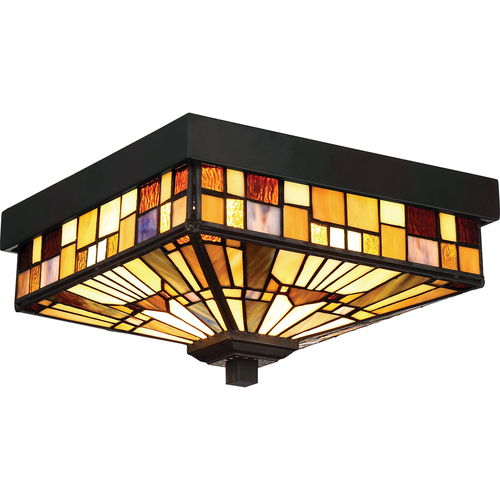
Tiffany outdoor lights are the one decorative style where the glass, not the metalwork, does all the work. Coloured glass pieces are cut, wrapped at the edges in copper foil and soldered together into a shade, so what you see lit at night is a mosaic rather than a single diffuser. That construction is beautiful and it is also the reason a Tiffany lantern has to be placed more carefully outdoors than almost anything else in a garden.
What makes a lantern Tiffany rather than just coloured glass
Three things separate the real thing from a printed or moulded imitation. The glass is cut into individual pieces, each with its own colour and texture — streaky, ripple, opalescent — rather than one pane with a pattern on it. Those pieces are joined by visible solder lines that follow the design, not by a moulded grid pressed into the surface. And the panels sit in a metal frame with a defined cap and base, because a foiled shade has no structural strength of its own.
Where Tiffany belongs outdoors — and where it does not
Under cover. A porch, a covered entrance, a deep eave, a carport, the sheltered side of a garden room. Those are the positions this style was designed for, and it is where it will still look right in ten years.
Avoid the exposed positions: a free-standing post top in the middle of a lawn, a gate pillar facing open sky, anything at ground level. Standing water and freeze-thaw cycles work on solder seams and on the joint between glass and foil, and an exposed Tiffany shade ages far faster than a sealed moulded one in the same place.
IP44, the porch rule, and the horizontal seam problem
IP44 is the rating you will normally see on an outdoor Tiffany wall lantern, and it is the right rating for a sheltered wall: protection against splashing water from any direction. It is not a rating for driving rain hitting the fitting head-on, and it is definitely not a rating for a fitting that sits in the open.
Look at the top of the shade before you buy. Any Tiffany form with a flat or shallow crown gives water somewhere to sit, and a horizontal solder seam under a standing puddle is the first thing to fail. A steeper pitched shade, or a metal cap over the glass, sheds water instead of holding it.
Choosing the lamp: the glass takes the light
Amber, green and opalescent glass absorb a great deal of what you put behind them. A lamp that reads as bright in a clear lantern will read as a warm glow behind a foiled shade — which is usually the point, but it means these fittings light a doorway rather than a driveway. Plan for atmosphere and door-number visibility, and put the functional light somewhere else.
Use a warm lamp, 2200–2700 K. Cool white turns amber glass a muddy yellow-green and drains the reds. High colour rendering matters more here than anywhere else, because the effect depends on the glass reading true. An E27 or E14 socket also means you replace a lamp rather than the whole lantern.
Frames, solder and weathering
The frame is usually cast aluminium or brass in an antique bronze or black finish, and it carries the fixing, the gasket and the lamp holder. Check the wall plate has a gasket and the fixings are stainless — plain steel screws on a bronze lantern bleed rust down a light wall within a couple of winters. Solder darkens outdoors; that is correct on an antique frame and should not be polished back.
Wiring, Part P and switching
In England and Wales a new circuit for outdoor lighting is notifiable under Part P of the Building Regulations, and everything outdoors has to comply with BS 7671. Swapping an existing outdoor fitting on the same circuit is not notifiable, but the replacement still needs the right rating for its position and an RCD-protected connection. For switching, a dusk sensor or timer suits a decorative porch lantern better than a motion detector.
Common questions
Can a Tiffany lantern go on an exposed wall?
Only if it is rated for it, and IP44 does not cover a wall taking driving rain. A porch, eave or covered entrance is the sensible position.
Will the colours fade?
Genuine coloured glass is coloured through, so it does not fade like a printed film. Painted or filmed imitations do.
What lamp should go in one?
A warm 2200–2700 K lamp with good colour rendering. Cool white makes amber glass look dirty.
How should the glass be cleaned?
Warm water and mild detergent on a soft cloth. Solvents attack the solder patina and abrasives lift the edge of the foil.
If the shape appeals but the coloured glass does not, the same period feeling in plain glass sits with vintage outdoor lights.